



Announced in June 2024, Black State is an upcoming Action-Adventure game developed by Türkiye’s Motion Blur Studio. The game debuted on IGN’s YouTube channels worldwide, quickly drawing comparisons to Hideo Kojima’s Metal Gear Solid series while highlighting its portal-based mechanic.
From its reveal to now, Black State has become the first game from Türkiye to showcase NVIDIA’s latest RTX technologies, marking a major milestone for the country’s game development scene.
Coverage from outlets such as IGN and Digital Foundry has highlighted the project’s technical ambition, while some players remain skeptical, arguing that the footage resembles an Unreal Engine showcase rather than a finished game.
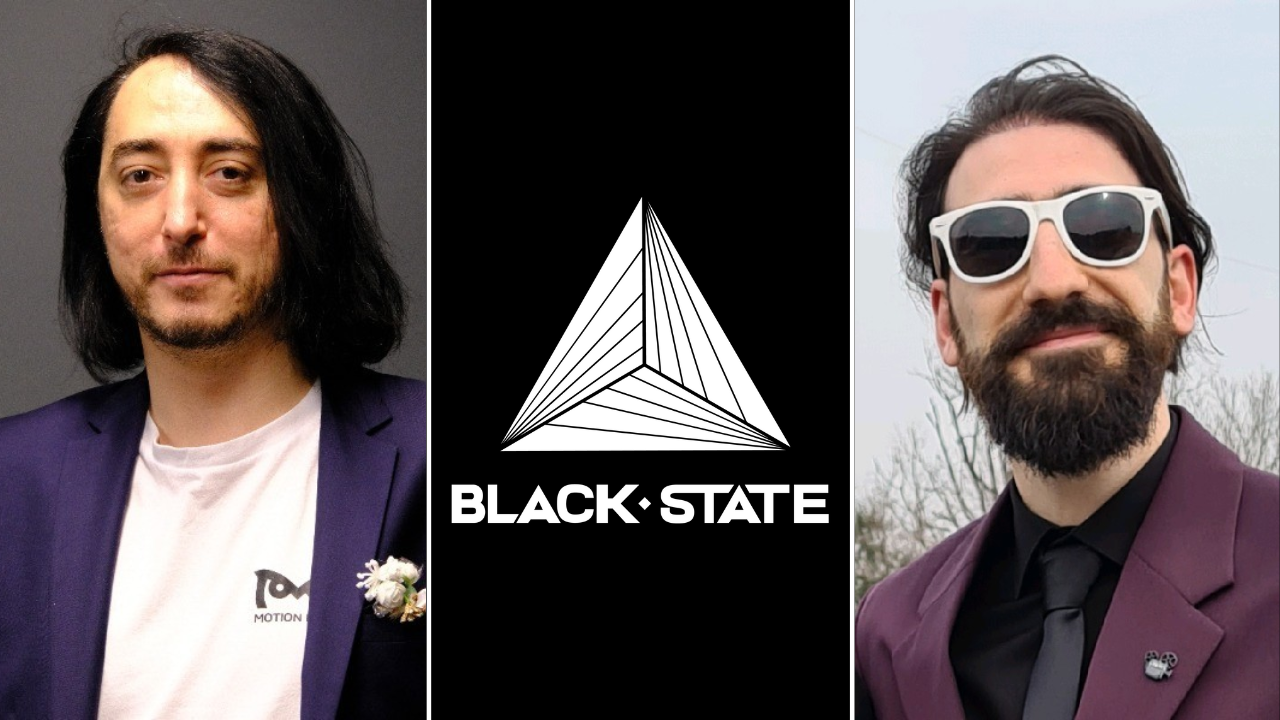
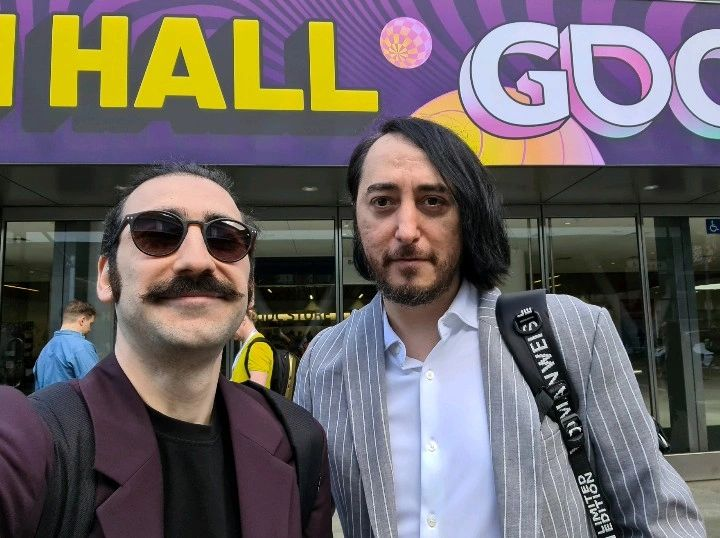
We spoke with Motion Blur Studio’s General Manager, Kadir Demirden, and Studio Director Ömer Faruk Güngör to address players’ feedback, unpack the team’s mindset and devotion, and share new gameplay details.
20 years in the making
Black State marks Motion Blur Studio’s first game in 20 years. You might wonder how a game studio stayed alive for so long without releasing a game at all.
Here is a quick background check:
Kadir Demirden previously worked on Kabus 22, cited as Türkiye’s first game to reach a global release in 2007. Developed with his cousins, Yasin and Yakup Demirden, over 4 years, the title positioned itself as a Resident Evil-style survival-horror set in Türkiye.
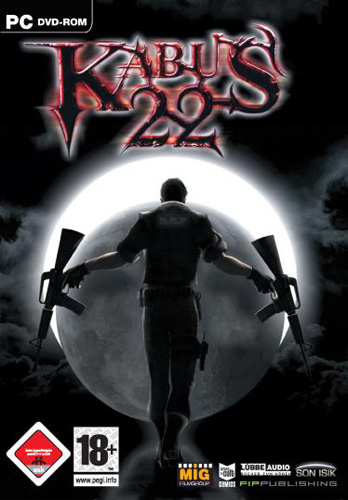
After Kabus 22, Yasin and Yakup Demirden moved into other parts of the industry and now lead SuperGears Games. Kadir Demirden, however, stayed at Motion Blur and spent years working solo, taking on outsourcing work to keep the studio running while sharpening his craft across engines such as CryEngine and later Unreal Engine.
“I was preparing for this project—mentally, and through R&D. I’ve always believed we have to go out and do something bold. If we’re going to do something, we should do it properly. If not, we shouldn’t do it at all.
The timing has to be right: the groundwork, the finances, everything. If I had started five or six years ago, there’s a good chance we wouldn’t even be here. Circumstances matter.
And it’s a team job. If Ömer wasn’t here, if Gürcan wasn’t here, if Ali wasn’t here—if most of this team wasn’t here—I couldn’t do it. I can explain everything I know, but that doesn’t mean you can build it. You need to build the team, and the team needs to grow with the project and be ready for it.”
Kadir Demirden, General Manager at Motion Blur
For the past six years, Ömer Faruk Güngör, Motion Blur Studio’s Studio Director, has been recording behind-the-scenes footage from the development process. The studio plans to release it as a documentary after the game launches, and the archive has already grown to more than 10TB.
“Crazy Tall Guy” and his team
Ömer refers to Kadir Demirden as the “Crazy Tall Guy”, referring to his height, his wisdom, and his incredible devotion to fine-tuning his craft.
After years of long days and late nights, I asked Demirden how he handles the physical and mental strain of that workload.
“We’re not machines, we have ups and downs.
But two things stand out in the end: doing the work as well as we can, and loving what we do. If I spend hours on something and the result satisfies me, then the time was worth it.
“At the end of the day, we all have the same brain. It’s not like other game developers have 500 grams and we have 300.”
Kadir Demirden, General Manager at Motion Blur
Güngör said the team draws motivation from comments like “a game like this can’t be made in Türkiye.” Families sometimes visit the office, and the team occasionally sleeps there, but the studio doesn’t force anyone to work long hours. “If someone works 24 hours on something and the result isn’t usable, we’ll delete it anyway—so there’s no point,” he said.
Güngör also pointed to well-known production stories, such as Cory Barlog filming God of War scenes while holding his child, or Peter Jackson working through holidays on The Lord of the Rings, as reminders that ambitious projects often require sacrifice.

Güngör said the mindset spreads beyond the core team. One talent contacted the studio and offered to participate without pay, simply to learn how mocap works, and the team immediately hired them for the project.
Another young talent, still in university, even received a visit from their teachers, and the studio convinced them that their work matters to the team.
Güngör also noted that roughly 90% of the team has never shipped a game, but they are now listed as contributors to Unreal Engine.
Demirden closed the topic with a simple plan for the day the project ends: he says he wants to do “nothing” for a week.
Crafting a technical masterpiece
After our interview, I had the chance to see and play Black State, and one thing became clear immediately: YouTube doesn’t do Black State justice. The game looks remarkably sharp in motion, and it’s hard to capture that effect in words. This is the kind of experience you really have to see firsthand.
Demirden leads the game’s art direction, and he says he wants to achieve photorealism as a technical standout. Motion Blur handpicked artists with architectural backgrounds so the team can build levels with the intent and structure the studio is aiming for.
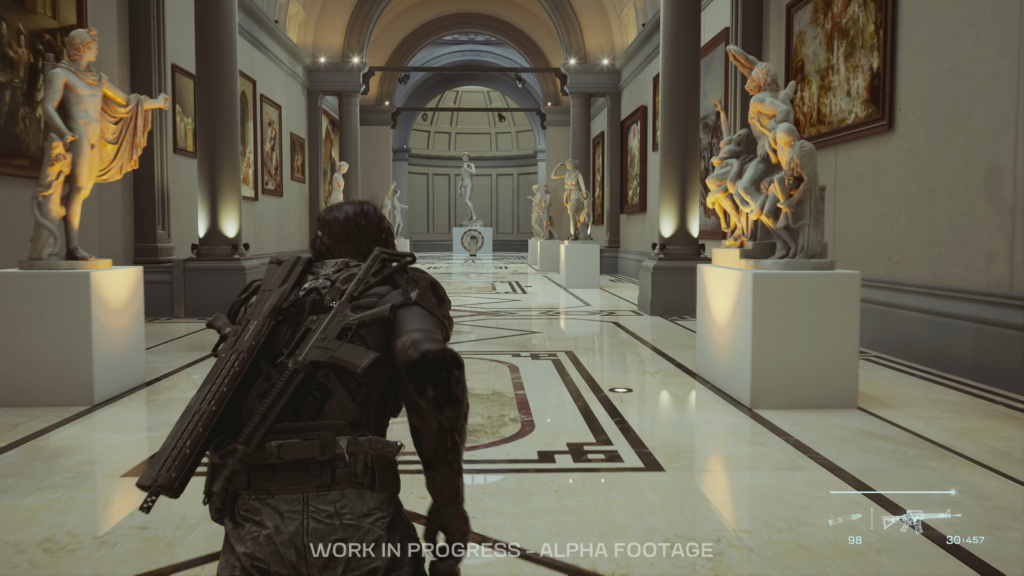
“Artists can’t go beyond what a level needs, but they can add their own touches within those boundaries,” says Demirden. Architects contribute to level design, and the studio aims to make each level and each object feel distinct rather than repeating the same spaces.
“I can say this without exaggeration: Black State isn’t an easy project for any company in the world to take on. It’s so ambitious that you can’t even get many teams to agree to do it.
“We build assets the way you would for multiple games. Take our ship level: we won’t reuse any of the assets made for the ship. In a game built around the same concept—Control, for example—you see the same chair everywhere from beginning to end. And that makes sense, because it’s optimized and it fits the concept.
“But we’ll have an art gallery scene, and then a manor. Even if it’s just a chair, it can’t be the same chair, because one space is baroque architecture, another is religious architecture, and another is modern architecture. It doesn’t fit, so you can’t place it there. That’s the difference. It’s never the same asset.”
Kadir Demirden, General Manager at Motion Blur
Motion Blur’s team makeup leans heavily toward content production: roughly 60% 3D artists and 40% developers, with dedicated specialists across technical art, VFX, vegetation, and more to support the volume of levels, models, and props.
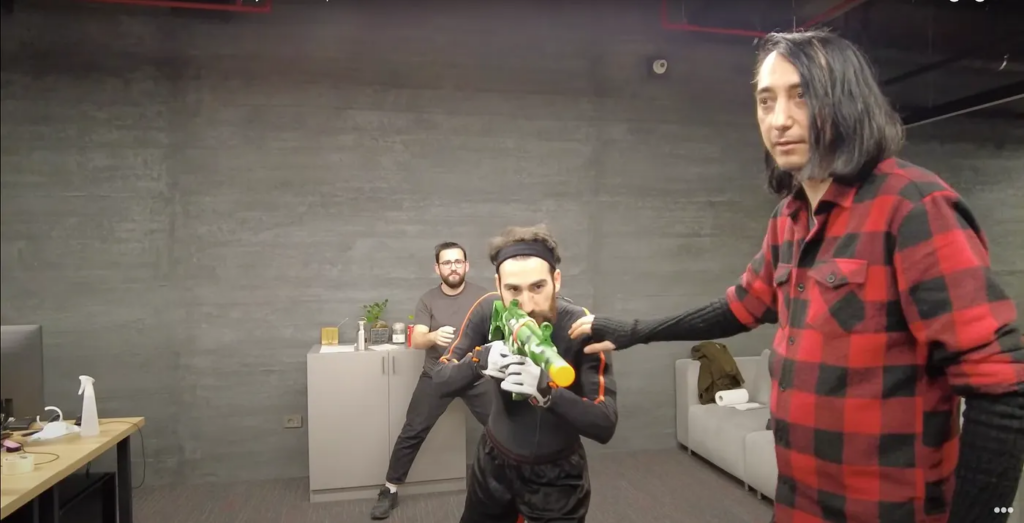
That same mindset also shaped the studio’s motion-capture process. With no experienced mocap actors available locally, the team decided to perform many scenes themselves.
Güngör joked that he might be “the best motion capture actor in the Turkish gaming industry,” as the team captures footage wherever they can—stairwells, parking areas, and around the studio entrance.
As a result, the team tested over more than 500 takedown-style animations and currently uses around 150 in the game.
New gameplay details
One point the team emphasized throughout our conversation is expectations. Motion Blur says it appreciates the Metal Gear Solid comparisons, but it also stresses that Black State is not an MGS-style game—and players who go in expecting that exact experience could leave disappointed.
Black State blends stealth and action, but under its own rules. Here are the key gameplay elements we learned:
- The game won’t force stealth-only or action-only sections. Instead, it gives players room to choose their approach within the game’s restrictions.
- The team says it still has much more to show for enemies, characters, levels, and weapons.
- Players can discover special weapons during gameplay. The Gamescom demo, for example, includes a Desert Eagle that players can find inside one of the tents, and the team says exploration will reward players with similar finds.
- The game will ship with three classic difficulty settings—Easy, Medium, and Hard—and each one will affect not only enemy stats, but also enemy behavior.
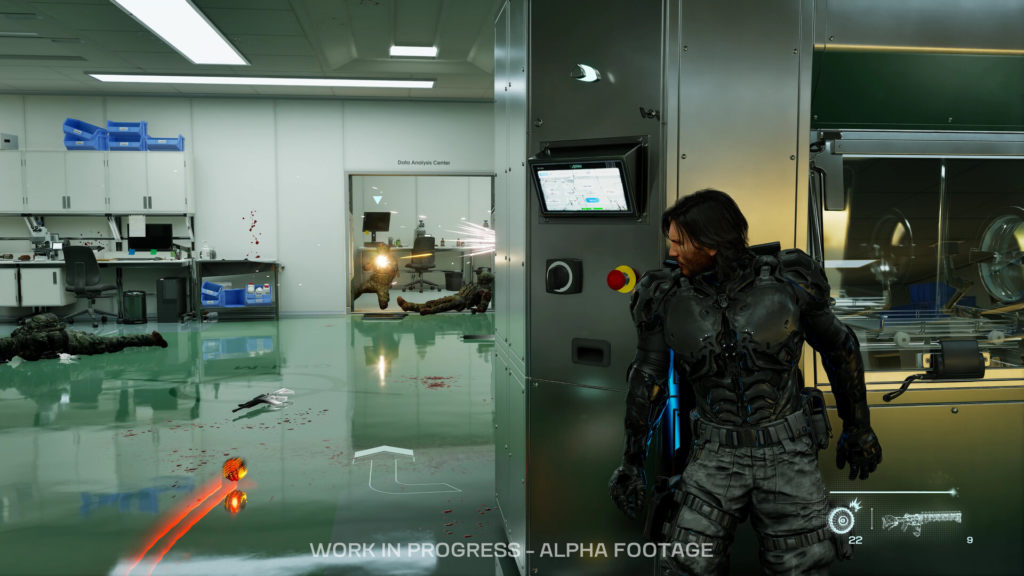
- Motion Blur says it treats enemy AI as a core pillar, and the experience it aims to create is a “fight for survival.” The studio is building AI behaviors around cover usage, protecting each other, calling for backup at different levels, and acting as a group.
- If enemies find a dead body, they will enter an alert state and start searching. During combat, if you manage to break the line of sight and hide, they can lose track of you and shift into search behavior.
- The game includes an X-ray vision feature to help players locate enemies.
- Enemies react based on where they get hit.
- The game will also include plenty of easter eggs to find.
Portal Mechanic Explained
Black State’s portal mechanic has appeared frequently in marketing and showcases as a technical standout, but I wanted to understand how it actually shapes moment-to-moment gameplay.
I asked the team how players figure out where to go, and how taking side paths affects the game’s flow.
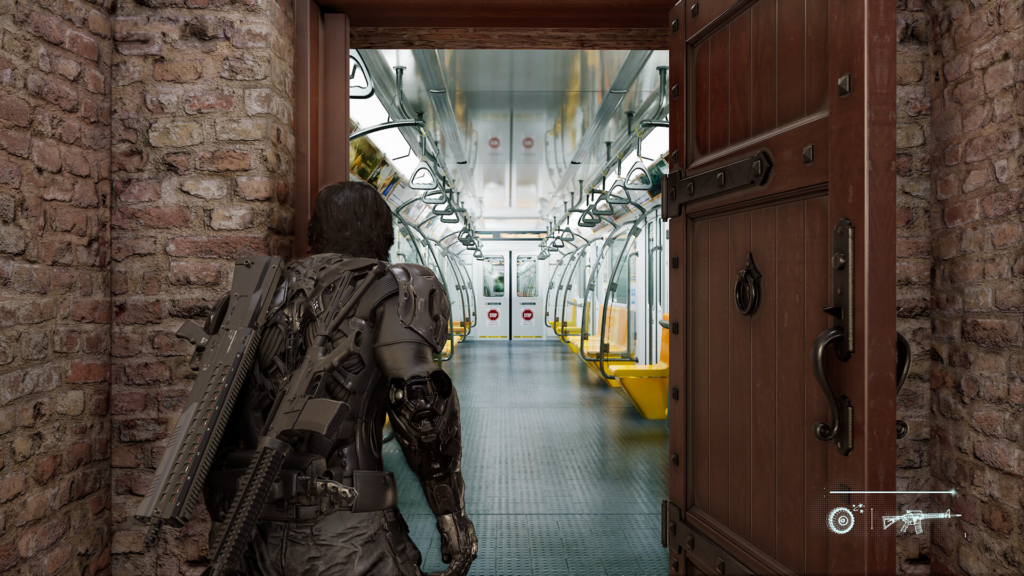
“For us, the portal mechanic breaks linear progression. You may plan to move forward, but you can step into another level, and still have unfinished business behind you. You can return and solve it later, or you can move on without doing it.
That’s why we design around three cases: sometimes you must go there and complete a task, sometimes you must solve what’s here before you go, and sometimes you have to do both.
“Each area players visit carries importance to both the story and the gameplay.”
Kadir Demirden, General Manager at Motion Blur
Demirden added that the mechanic is also tied to what excites him as a player: moving between distinct spaces and feeling a real shift in setting.
“Let’s say you start on a spaceship and the whole game takes place there, and in the last act you finally land on Mars.
For me, that feels like I just opened a new game, a whole new area to explore. I love that feeling, and that’s what I want to do with Black State. That’s why you won’t see the same place twice.”
Kadir Demirden, General Manager at Motion Blur
An emotional, sci-fi story
Motion Blur says Black State tells an emotional sci-fi story, and the team believes the narrative layer will change how people read the project as it reveals more. The studio says it already has marketing beats planned for that, and it intends to show more when the timing feels right.
Demirden first shared the story with Güngör in 2017 as a three-page Word document outlining the core narrative. Güngör says he took that foundation and expanded it with additional story beats, and that the game’s opening scene still closely reflects what Demirden wrote in that early document.
The team also acknowledges that, at a glance, the game can look like “a generic guy shooting enemies.” But Motion Blur says it spent 2.5 years building the world’s structure, its characters, events, and motivations, and it wants the story to hold up under scrutiny.
The goal, the team says, is that when players ask, “Why is this this way?” the game should have an answer essentially every time, because everything needs to make sense within Black State’s world.
In the end, Motion Blur says it measures success by whether it can deliver the intended “feeling” once all elements come together—camera work, story, cinematics, and more. The team also highlights music as a major part of that emotional delivery.
Sound & Music
Black State pairs its sci-fi aesthetics with an original score…from someone who will not disappoint you.
What I can say is this: the music feels both familiar to sci-fi enjoyers and distinct enough to Black State’s world, and Motion Blur expects it to carry more weight than players might assume at first glance, especially as the story reveals a heavier tone than the early footage suggests.
The studio also puts strong emphasis on atmosphere. Each level features its own ambient soundscape designed to support the setting and reinforce the mood as players move between different environments. The music will also respond to the player’s state, shifting its beats and rhythm accordingly.
“Each character has a deep background, and we gave those details to the composer.
We wrote and delivered everything, from how they look in the game, to their motivations, what they are, and even a psychological analysis.”
Kadir Demirden, General Manager at Motion Blur
A devotion story for the future generations
We ended our interview with Ömer’s final thoughts on the work behind Black State, and on how he wants the studio’s planned documentary to frame that journey:
“I want people to read this as a story of devotion, less about how Black State was made, and more about what it means to dedicate your life to something. Kadir worked for 20 years to earn an opportunity like this. I spent eight to ten years alongside him trying to reach this point.
But we also have people here who haven’t graduated from university yet, who’ve had the chance to grow in this studio for four or five years. That makes me truly happy, and it makes me excited about what could be possible 20 years from now.”
Omer Faruk Gungor, Studio Director at Motion Blur