

Mobile gaming continues to dominate the global games industry, but declining app-store revenue, increasing market concentration, and changing regional growth patterns are creating new challenges for developers and publishers, according to a new 108-page gaming industry report prepared by Mariusz Gasiewski, CEE Mobile Gaming and Apps Lead at Google.
Covering market developments through the third quarter of 2026, the report brings together data from Newzoo, Sensor Tower, AppMagic, GWI, Statista, and other industry sources. It examines gaming audiences across platforms, mobile game downloads and revenue, Android and iOS performance, genre-level trends, and differences between major gaming markets.
According to Newzoo estimates cited in the report, the global games market is projected to generate $214 billion in revenue in 2026, with mobile gaming accounting for $121 billion, or 56.6% of the total. PC gaming is expected to contribute $46 billion, while console gaming is projected to generate $47 billion.
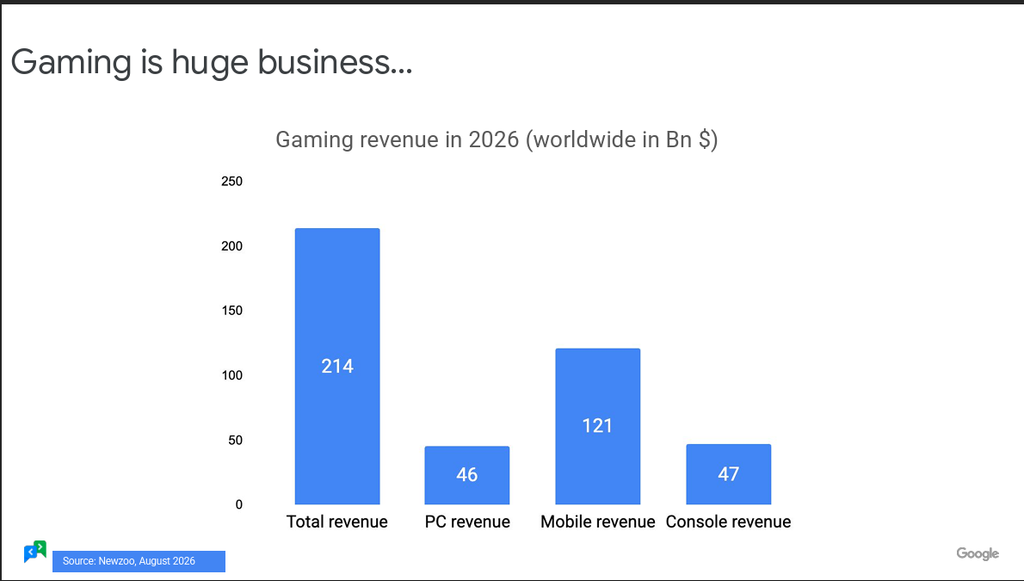
Despite mobile’s leading position, the report identifies growing challenges in maintaining revenue and download growth.
Mobile gaming revenue and downloads decline in Q3 2026
Sensor Tower data presented in the report shows that mobile gaming experienced a difficult third quarter across both major operating systems.
On Android, gaming revenue declined 3.8% year-over-year in Q3 2026, while downloads fell 8.1%. The situation was particularly challenging on iOS, where revenue declined 11.6% and downloads dropped 5.3% over the same period, excluding China.
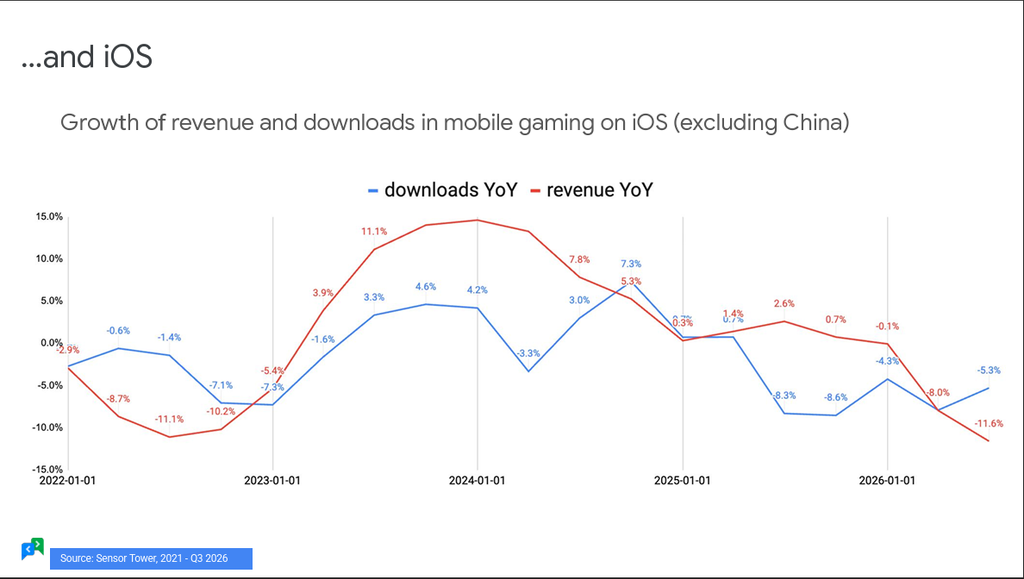
However, Gasiewski highlights an important limitation in the figures. The detailed revenue analysis excludes direct-to-consumer (D2C) revenue, which the report estimates now represents more than 15% of total mobile gaming revenue.
With D2C revenue growing faster than traditional app-store channels, the report cautions that actual revenue growth across several segments could be several percentage points higher than the figures suggest.
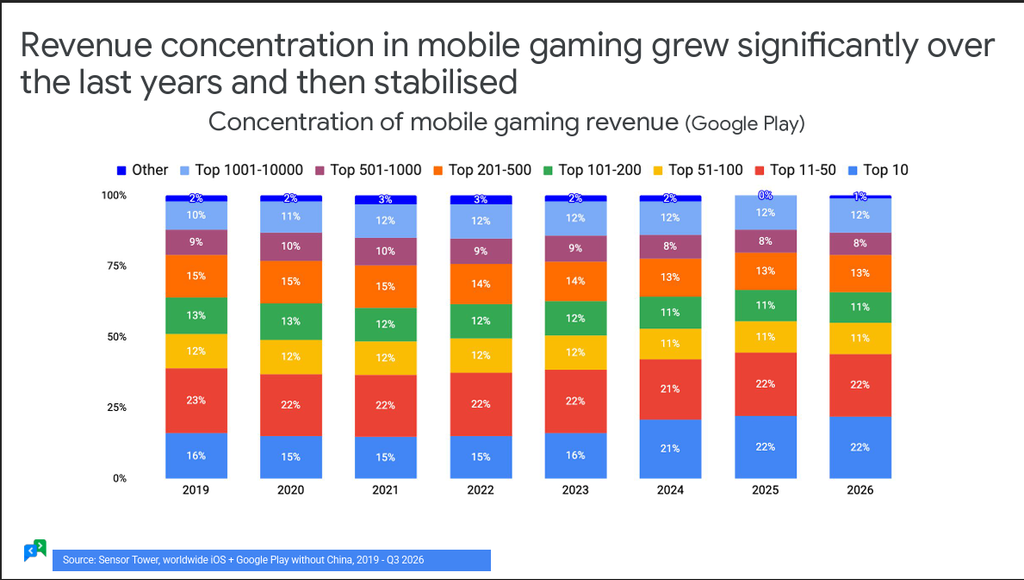
Another challenge is the increasing concentration of revenue among leading games. The report shows that the top 10 games on Google Play accounted for approximately 22% of mobile gaming revenue in 2026, compared with 16% in 2019. On iOS, the top 10 games represented approximately 21%, up from 16% over the same period.
The findings point to a competitive environment in which a relatively small number of successful titles continue to capture a substantial proportion of consumer spending.
Match Merge and Sort games stand out as growth varies across genres
Although overall mobile gaming performance has weakened, the report identifies considerable differences between individual genres and subgenres.
Match Merge and Sort games were among the strongest-performing segments in 2026, while Idle RPG also showed comparatively encouraging performance. Sort games recorded particularly sharp year-over-year revenue growth across Android and iOS during the first nine months of 2026.
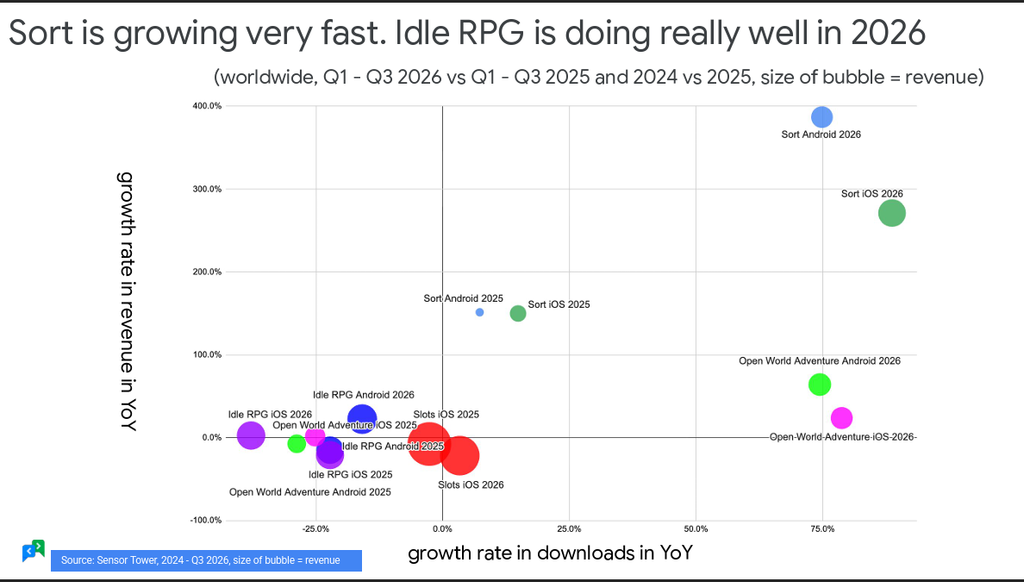
By contrast, 4X Strategy experienced weaker performance compared with 2025, while many core gaming categories recorded negative growth.
These differences are explored through genre-level comparisons of revenue and download growth across Android and iOS, illustrating how individual categories can perform differently even within the same broader market conditions.
The report also examines retention rates across major gaming categories, including Action, Arcade, Puzzle, Strategy, Simulation, Role Playing, and others. Using Sensor Tower data from Q3 2026, it compares Day 1, Day 7, and Day 30 retention among leading games in the United States.
Growth patterns shift beyond established markets
Geographic differences represent another major finding.
Although the United States remains the largest mobile gaming market overall and a leading destination for marketing investment, its performance weakened during the first nine months of 2026 compared with the previous year.
Several other Tier-1 markets experienced similar challenges, while Tier-2 and Tier-3 markets generally demonstrated healthier revenue and download growth.
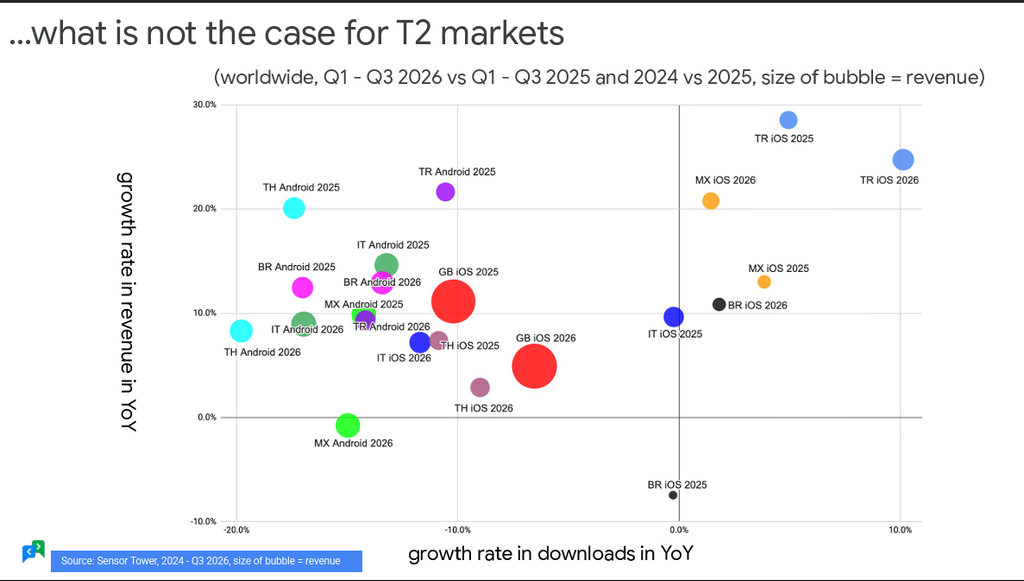
The report also highlights differences between Android and iOS within individual countries. For example, Türkiye recorded positive year-over-year mobile gaming revenue growth on both platforms during the first three quarters of 2026, although Android downloads declined.
Beyond consumer spending, Gasiewski examines country-level marketing investment across gaming categories such as Casino, Strategy, RPG, Hypercasual, Puzzle, Simulation, Board, Card, Sports, Shooter, and Lifestyle. These comparisons show how the relative importance of individual markets changes depending on the game category and operating system.
Revenue concentration, advertising, and retention also examined
Beyond mobile gaming performance, the report provides a broader perspective on the gaming and mobile app industries.
It compares revenue concentration in mobile games with Steam and non-gaming mobile applications, examines gaming audiences across PC, console, and mobile platforms, and explores how device preferences differ between countries.
The analysis also covers the growing importance of smartphones, the increasing number of devices used by consumers, and the slowdown in new internet-user growth across established markets.
Gasiewski identifies these developments as factors increasing the importance of user retention and long-term engagement rather than relying exclusively on reaching new audiences.
In-game advertising receives particular attention, with data examining its role in product discovery across different countries and age groups, alongside forecasts for advertising revenue and mobile advertising expenditure.
Taken together, the findings illustrate a mobile gaming market in which overall scale remains substantial, but opportunities for growth increasingly depend on the combination of genre, geographic market, platform, and player engagement.
Gasiewski said on LinkedIn that the report exceeds 100 pages and was prepared using the most recent available industry data. Those interested in accessing the complete PDF can request a copy in the comments of his LinkedIn announcement.
Source: Mariusz Gasiewski on LinkedIn — Gaming industry report, 2024–Q3 2026.