
In this guest article, Marion Balinoff, Influencer Marketing Consultant, breaks down why creator marketing functions as “efficiency insurance” for mobile growth—supporting paid UA, organic demand, and retention long after campaigns end.
Cutting influencer marketing feels like a rational call. Attribution is murky, results are hard to isolate, and there is always a cleaner channel to point to. So you pause it, redirect the budget, and move on.
The problem is what happens next. Not immediately — that is the part most teams miss. The decay is gradual enough that by the time the numbers look wrong, the cause has been forgotten.
Here is what the data actually shows when you pull influencer marketing out of a growth stack that depended on it.
When you cut influencer marketing, installs decay faster. Even with the same UA budget.
The chart below is from a game that has been live for over 10 years. Mature games naturally decline, acquisition gets harder, and that is expected. But the rate of decline matters enormously.
While influencer marketing was active, installs declined at roughly 2.56% per month. A slow, controlled decay. When influencer marketing stopped, with paid UA spend held constant, the decline accelerated to approximately 7% per month.
Nearly three times faster decay, with no change to paid spend. Teams that see this usually blame creative fatigue, competition, or algorithm changes. The real variable is the one they just removed.
I have observed this pattern across multiple mature titles. It is not a one-off.
When influencer marketing disappears, your paid UA gets more expensive.
This is the connection most UA teams miss, and the one that tends to make them most uncomfortable when they see it.
Influencer marketing keeps paid UA efficient by maintaining familiarity and trust at the top of the funnel. When that disappears, users who encounter your paid ads have less context. They are colder. Conversion is harder. CPI goes up.
The chart below shows a game that cut its influencer marketing budget in half in 2025. CPI did not spike overnight. The gap took close to a year to become obvious. By the time the dashboard showed the problem, the cause had been forgotten.
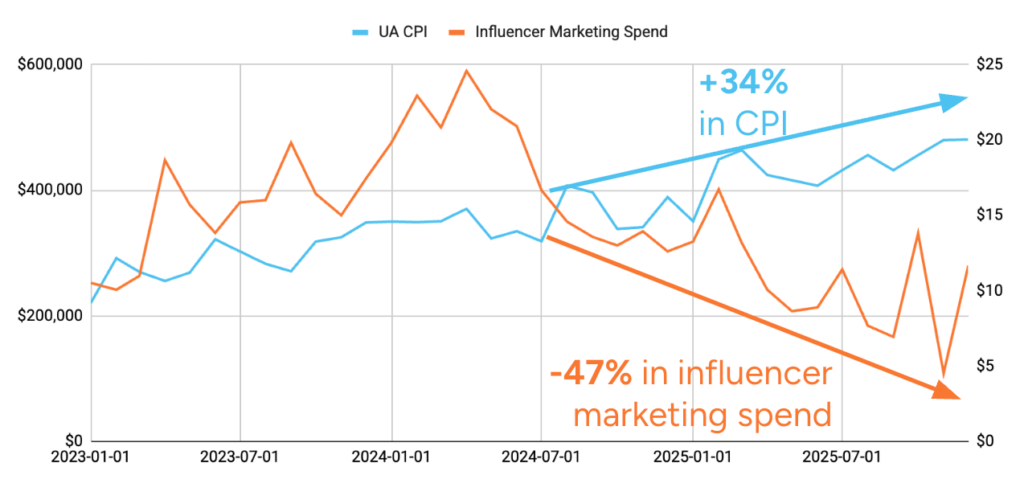
Teams blame creatives. They blame competitors. They blame the algorithm. What actually changed is the ambient familiarity that influencer marketing was quietly maintaining.
Influencer marketing does not just drive installs. It stabilizes active users.
Most conversations about organic impact stop at installs. But consistent creator exposure does something more durable: it reminds people the game exists, brings lapsed players back, and gives active players a reason to stay engaged.
The chart below shows MAU over three years. The vertical line marks when influencer marketing started. What follows is not just growth. The baseline stops dropping back to its previous seasonal lows. Monthly active users stabilize at a higher level, even as seasonal patterns repeat.
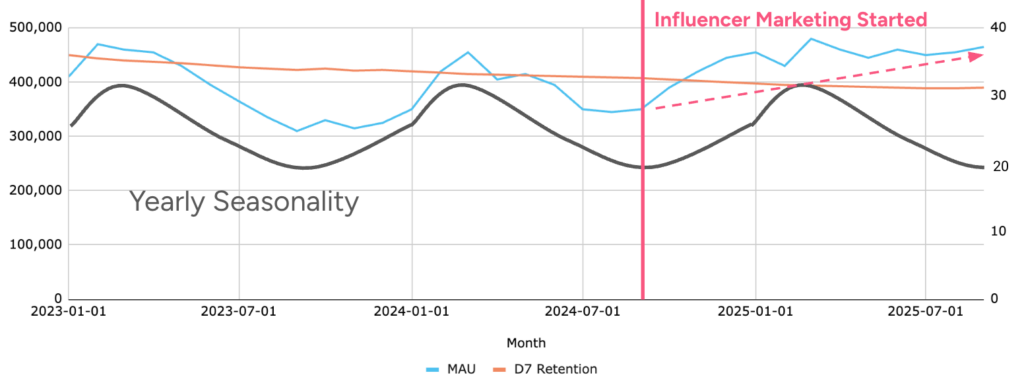
This is how influencer marketing impacts DAUs. Not through spikes. Through presence.
Creators move what paid UA cannot buy: store visibility.
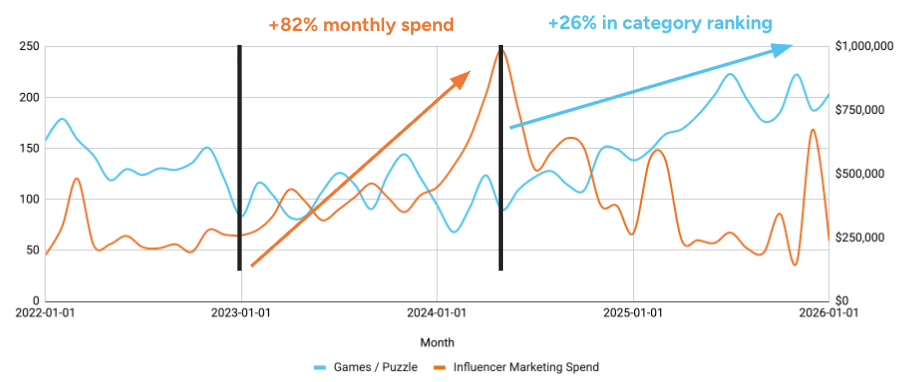
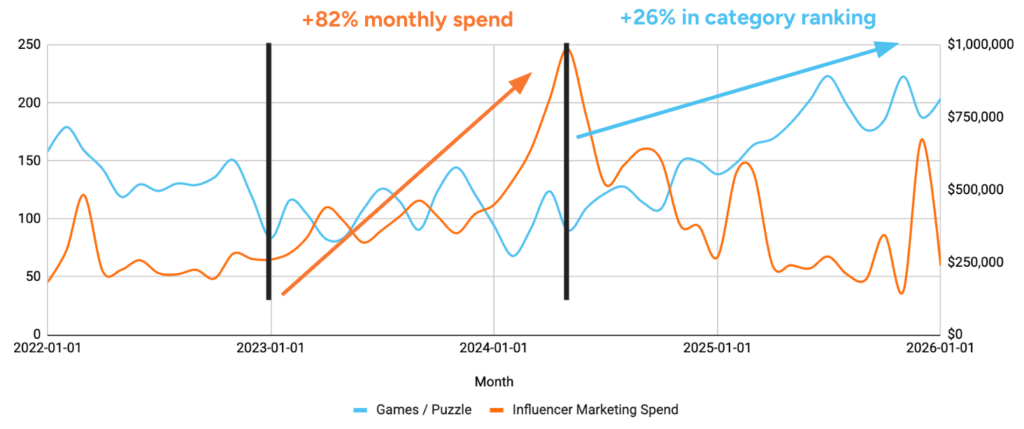
App Store ranking is one of the clearest signals of organic momentum, and one of the hardest to move with paid spend alone. Creator campaigns create a pattern of sustained organic search and install behaviour that the algorithm recognises and rewards.
In one campaign I ran, we increased influencer investment by approximately 82% compared to the prior year. App Store category rankings improved by 26%. Not immediately, the uplift appeared after two to three months. That delay is exactly why short evaluation windows miss this signal entirely.
Content keeps performing long after the campaign ends.
This is the fundamental structural difference between influencer marketing and paid UA. When paid stops, traffic stops. When a creator campaign ends, the content keeps working.
By day 30 of a campaign, you have typically reached only about half of the total exposure you will get over the content’s lifetime. More than 75% of views happen after the campaign window closes. That exposure still drives discovery, installs, and brand perception.
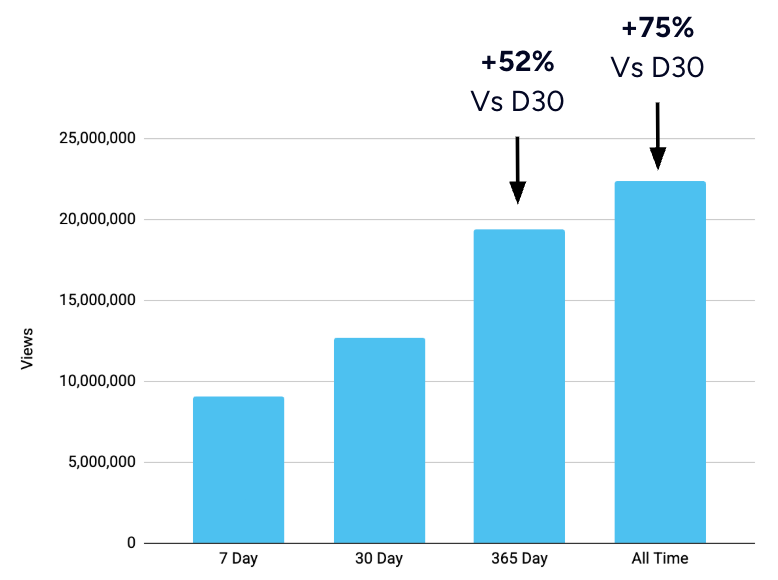
Evaluating influencer marketing on a 30-day window is like judging a billboard campaign by how many people drove past on launch day.
Why most teams think it does not work
They test it like paid UA. One-off campaigns. No iteration. No consistency. Immediate attribution expected.
When it does not show up on the dashboard within the first month, they move on. And they take that conclusion with them to every future budget conversation.
The teams that get real results from influencer marketing are not doing anything magic. They are doing two things consistently: structured testing across audiences, formats, and creator types, and sustained presence over time rather than burst spending.
Creator content also happens to be the highest-signal creative input available. A single creator video tells you what moments hook, what language converts, and what emotions resonate. Industry data from AppsFlyer, Sensor Tower, Adjust, IronSource, and Liftoff consistently shows UGC and creator-style content outperforming traditional ads: up to 25% lower install costs, 30% higher CTR, 15–20% better CVR to install, and ~18% lower overall CAC.
The winning teams are not choosing between paid and creators. They use creators as creative R&D, then operationalise those winning narratives across paid UA.
The real reframe: efficiency insurance, not brand awareness
If you are reading this as the person who controls the marketing budget, this is the section that matters most.
Influencer marketing keeps getting pitched to you as brand awareness. That framing is doing it a disservice, because brand awareness is exactly the kind of thing you have learned to be sceptical of. It is hard to measure, easy to cut, and rarely tied to anything you actually care about.
What influencer marketing actually does is make the rest of your growth stack work better. It keeps your CPIs from drifting upward over time. It sustains organic demand between paid bursts. It tells you which creative narratives convert before you spend a dollar scaling them. And in mature titles, it is one of the only levers that meaningfully slows the rate of decline.
The data in this article is not theoretical. It comes from campaigns I have run across studios of very different sizes, genres, and budgets, and the patterns repeat consistently enough that I no longer think of them as campaign results. I think of them as infrastructure behaviour.
You are not missing out on a marketing channel. You are missing out on the thing that connects all your other channels together. And the longer the gap, the harder the recovery.

Performance Driven Influencer Marketing Consultant