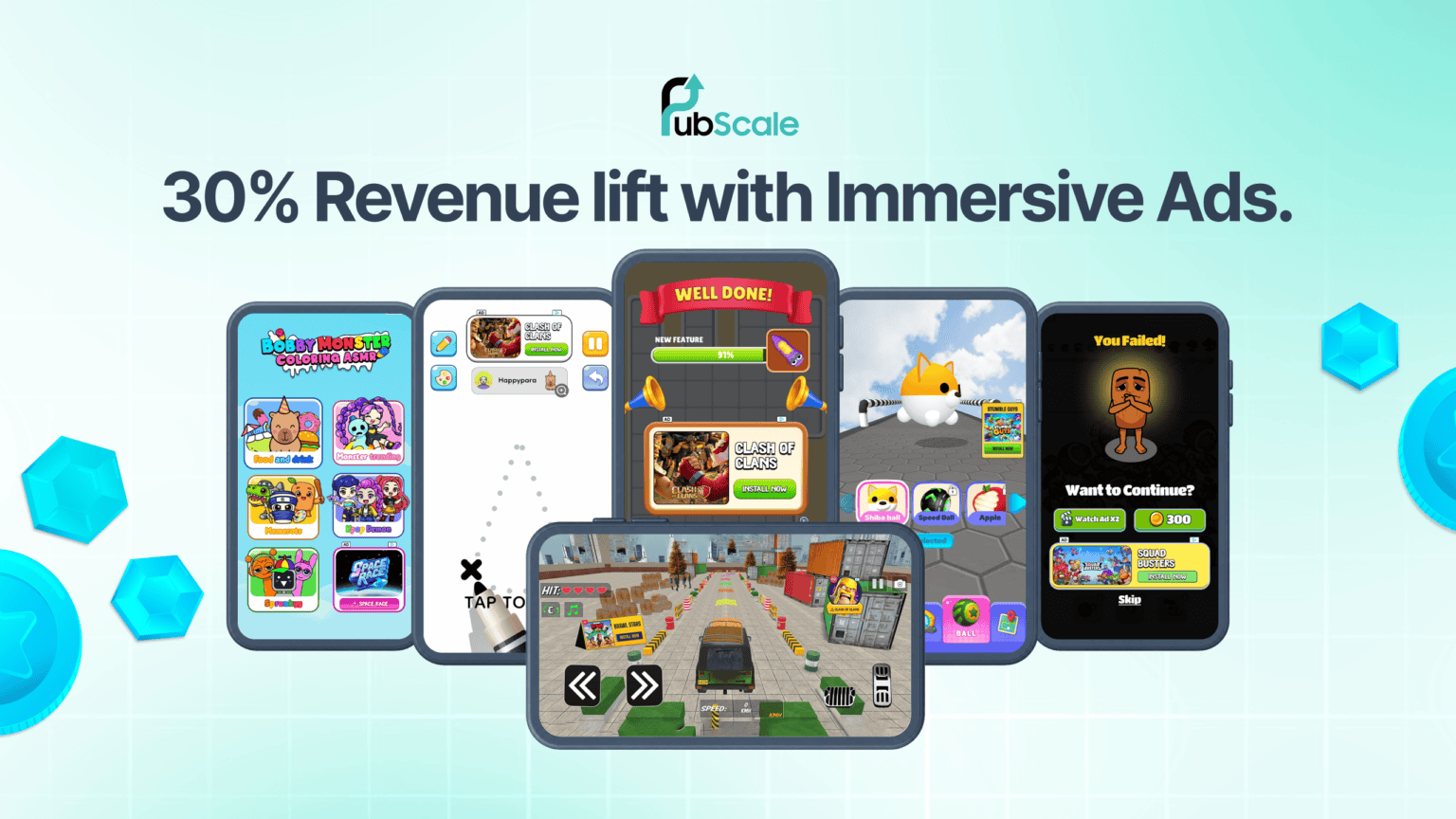

There is a hidden interruption tax, all the publishers are paying without even realising and it is compounding rapidly!
Every publisher in the market is already earning from interstitials, banners, and the standard ad formats. The catch is how do they maximize the existing revenue flow without interrupting the player experience furthermore.
This is exactly where Immersive ads come in, it further contributes to this revenue stream, layering incremental earnings onto inventory that was making nothing, without levying the same tax.
Ads that behave like the Game world.
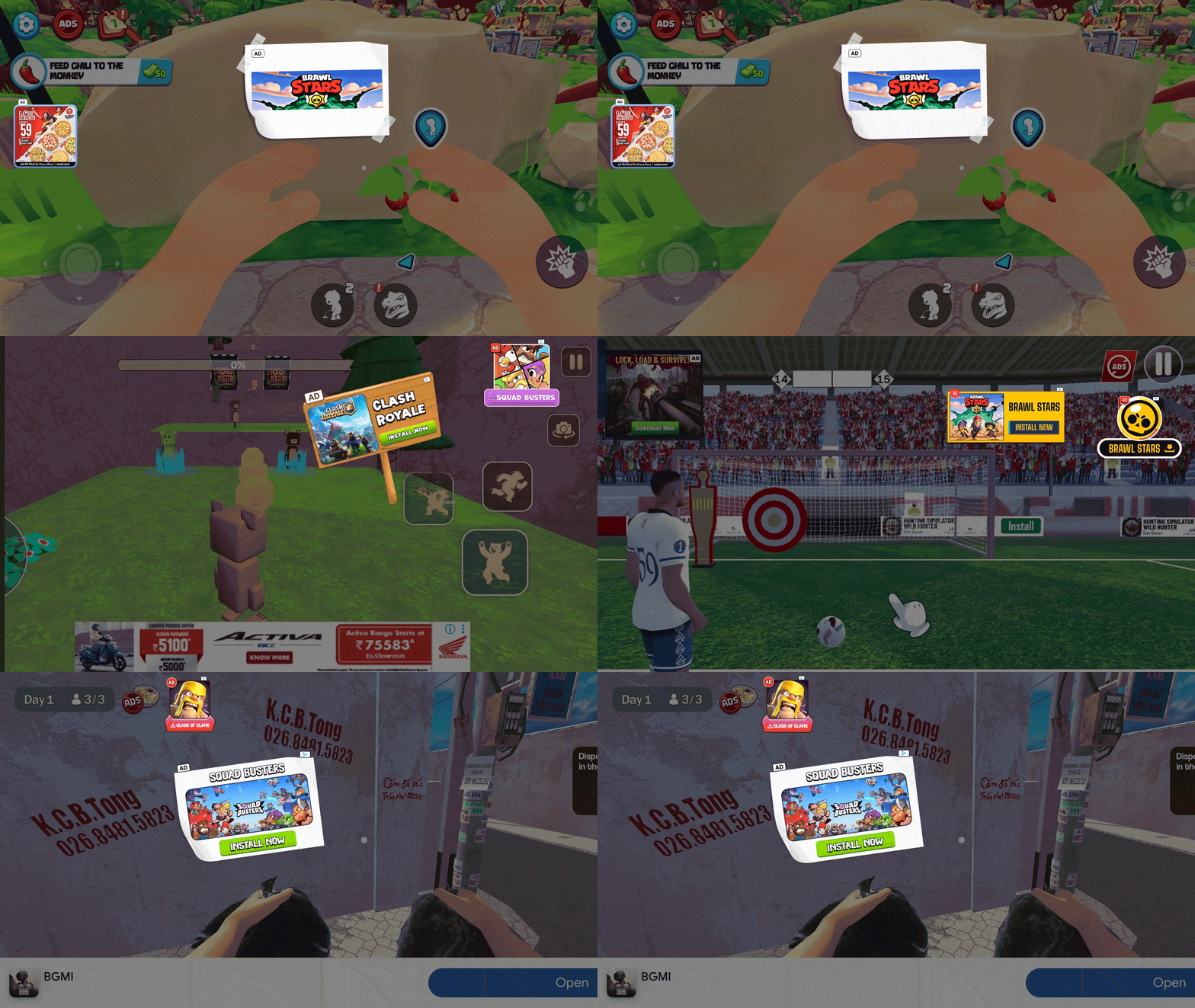
Immersive ads or in-game native ads are placements rendered inside the game world or its natural UI. A real brand on the racetrack billboard, a banner woven into the loading screen, a panel in the lobby that belongs to the environment, the gameplay never stops, because the ad is not an event. It is scenery.
Google’s mobile genre research found that 75% of players report a positive or neutral attitude toward in-game ads. Attention studies found that, in-game placements outperformed 76% of all digital ad formats on attention metrics and delivered ad recall roughly 13 percentage points above the digital media average.
The mechanism is simple, a player in mid-game is fully focused on the screen. No scrolling past, no second device, no skip button to hunt for.
The revenue is incremental, and that is the whole point!
This matters more than any single CPM number, immersive ads create new inventory. It does not compete with your rewarded video, your interstitials, or your IAP. A studio running all three simply adds a fourth stream on surfaces that previously earned zero. PubScale’s Immersive Ads SDK is built to sit alongside existing mediation for exactly this reason, so nothing in the current stack needs to move.
On the demand side, placements fill from Google’s premium demand plus direct brand and agency campaigns, which is what keeps fill rates above market standards in most setups. Across publishers on the network, fill runs 80 to 97% depending on geography, with CPMs typically between $0.40 and $4. Those CPMs are competitive next to banners, but they apply to impression volumes where the banner ad format can never be integrated, on inventory that costs you no gameplay at all.
One publisher on the network pushes more than 600 million ad requests through immersive placements with 85%+ fill across the US, Japan, UK, Canada, Australia, and UAE.
What it looks like when PubScale takes over.
Rocket Studio’s Monster Shooter tells the optimization side of the story. The game had strong engagement and stable ad requests but had hit a revenue plateau. They inculcated our Immersive Ads SDK which applies smarter delivery logic, this lifted their ARPDAU by 30% . Crucially, ad frequency did not increase. The gain came entirely from adding this neglected revenue source with better demand access and yield on placements that already existed.
Gamivision, one of our top publishers, adds the durability argument. The studio’s players average nearly 2.5 hours in-game every day, the kind of attention most developers spend years chasing, yet very little of it was turning into revenue. Immersive placements changed the shape of the business: the format now contributes more than 8% of Gamivision’s total revenue and has been compounding at 35% quarter-over-quarter growth. That is not a one-time bump from a new ad unit. It is a fourth revenue line that keeps widening as the placements mature.
Placement principles that protect the game.
The format only works if the placements respect the world they live in. The following few rules cover most of it. Place ads on surfaces players naturally look at, this ensures better ad performance. The gameplay UI should never be obstructed by any ads. And let the refresh rates be managed by the system rather than it getting maxed out, because an environment that is stagnant stops feeling like an environment.
Modern tooling has made this far less manual than it sounds. Drag-and-drop SDK setup and watch an empty wall turn into an ad.
PubScale’s team reviews placements against Google policy and UX standards before anything goes live.
Start Monetizing.
The monetization debate in gaming is usually framed as a dial: more ads and more revenue on one end, better retention on the other. Immersive ads break the dial. Same player experience with added revenue, because the inventory was always there. It was just never for sale.
If you want to know what your game’s unsold surfaces are worth, sign up at dashboard.pubscale.com and share your app link.
PubScale’s team will map the placements, suggest positions that pass Google policy, protect the UX, and get you to a live A/B test in less than 24 hours.
The fastest way to find out is to measure it in your own game.