
Ad bonuses and cashback can push what a studio really pays per install below the cost per install (CPI) in its ad dashboard. Here is where the gap comes from, how to measure it and where it doesn’t apply.
Picture two mobile games running the same campaigns: same channels, same creatives, same budget. Both dashboards read a $2.00 CPI. One studio paid $2.00 for every install. The other, in its first quarter on three new channels, paid $1.61.
The gap doesn’t come from better bidding or a better creative. It comes from the terms on which each studio buys media, and those terms usually don’t show up in the CPI column.
They matter more as attention gets scarcer. AppMagic estimates that only around 10% of the more than 1.4 million apps and games released in 2025 drew meaningful user attention (AppMagic). When every install is harder to win, what you pay for it matters as much as how you bid for it.
The commercial layer behind the auction
I spent almost nine years at Google, in YouTube Ads sales and product. One of the least visible parts of the ad business is its commercial layer: the terms on which advertisers buy.
Platforms want new advertisers and growing spend, but none can staff a sales team for every studio. So most major platforms work through certified partners, who onboard advertisers, verify them, handle billing and help them grow. Platforms pay partners for that work, and some partners pass part of it on: as ad bonuses (often called ad credits, i.e. free media on the same platform) or as cashback.
Platforms also run promotions for advertisers who buy direct, but in our experience they are smaller and less predictable.
Big studios get partner-level terms and an account manager on every major platform. Most studios get a sign-up form. That is the irony of mobile user acquisition (UA): every winning cohort starts as a small test, yet the teams that rely most on cheap, fast tests get the fewest incentives.
Three kinds of incentives
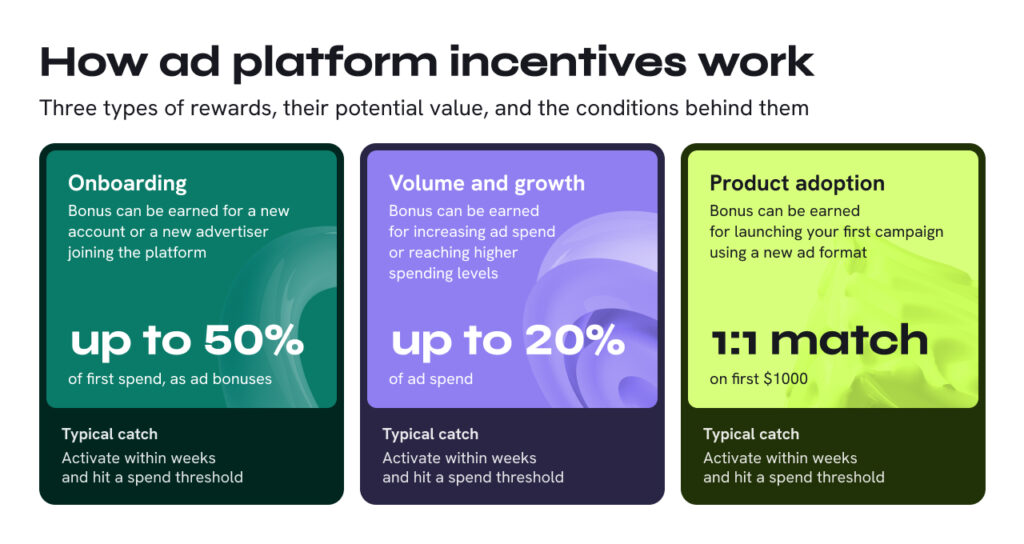
None of these is automatic. Because volume tiers apply to total spend, stopping just below a threshold can cost more in bonuses than reaching it would. Push to a tier only if the extra spend still meets your return on ad spend (ROAS) target.
What the gap is worth
Two illustrative cases show the scale. Both use Emarka’s October 2026 terms and rest on three assumptions:
- Fees. Every channel in both examples carries no partner fee, so cash paid equals media bought. Where a partner charges a fee, add it to what you paid.
- Direct promotions. The comparison is with buying direct without a platform promotion. If you already get one, the gap narrows by that amount.
- Terms. These are not a public offer. Real terms vary by country and need platform approval.
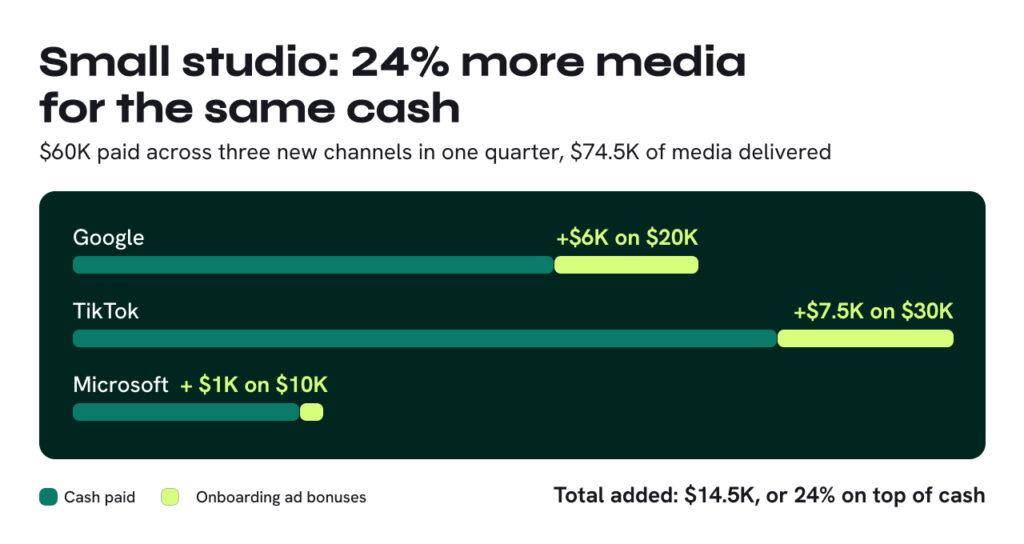
A small studio tests three new channels for one quarter with $60,000. Onboarding bonuses on the new accounts add up to $14,500 of media. At a $2.00 CPI, that is up to 7,250 extra installs, fewer if CPI rises as spend grows: for a small team, often a whole extra geo test.
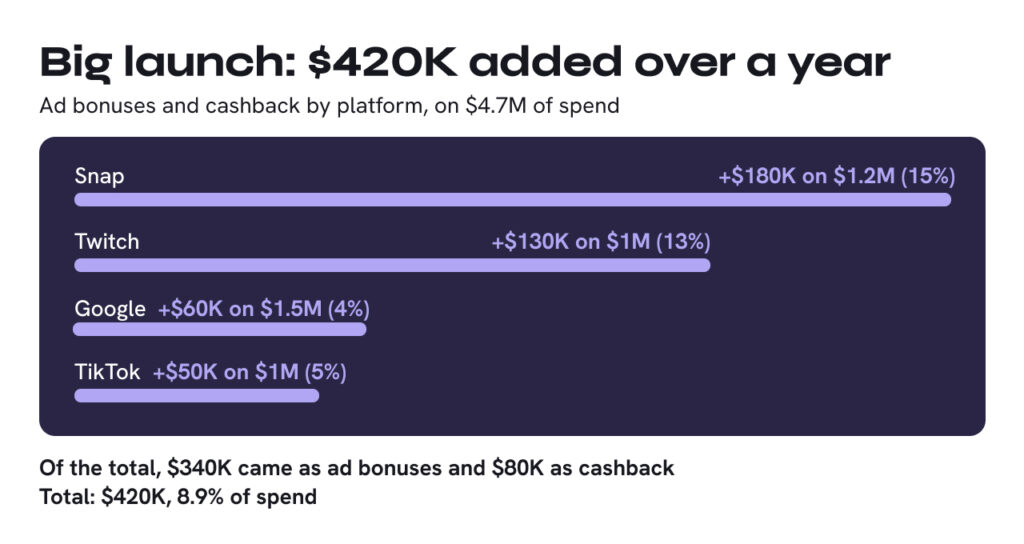
A larger launch spends $4.7 million over a year across four platforms. Onboarding bonuses, volume tiers and cashback add about $420,000. Here the share is smaller, but the dollars fund far more testing.
The number to track: cash CPI
Most ad dashboards report CPI on all the media delivered, including the part paid with bonuses. That helps compare auctions, but rarely tells you what an install cost in cash. Call that number cash CPI:
Cash CPI = (cash paid + partner fees − cashback earned) ÷ installs
- Installs from one source. Count them in your mobile measurement partner (MMP) for every channel, because platforms count them differently.
- Cashback matched to the spend that earned it. Book it against the month or quarter of that spend, not the month it lands, which is often weeks after the quarter closes. Carry it as an expected amount until it is confirmed, then true it up.
If you judge channels on ROAS, apply the same fix: cash ROAS = cohort revenue ÷ (cash paid + fees − cashback earned).
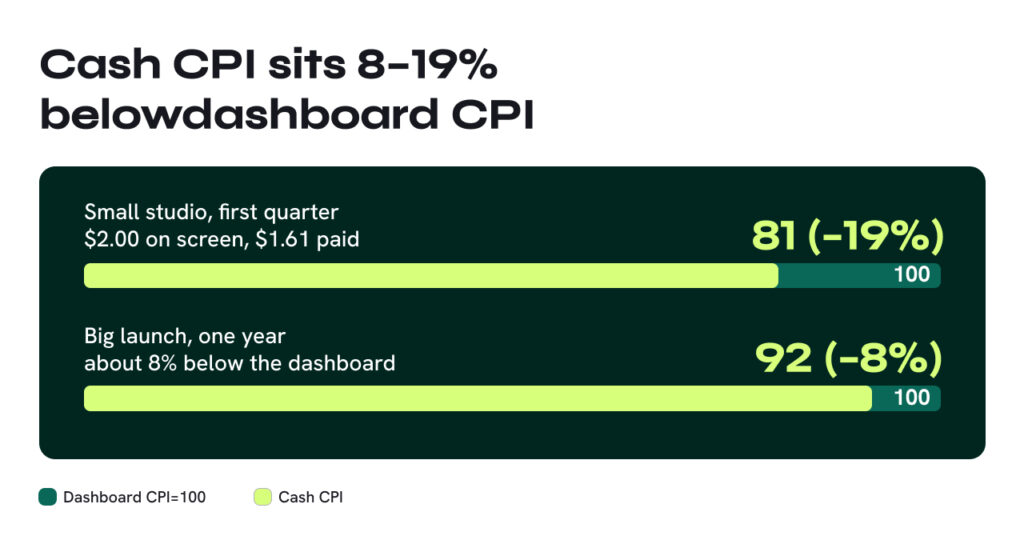
Both figures above assume bonus media converts at the same CPI as paid media, so treat them as upper bounds. Tracking takes one sheet: a row per channel per month. After a quarter, you can see which channels are really cheap, and which only look cheap.
Where this doesn’t help
Partner terms don’t cover every channel, and many games budgets run largely on channels without them. Across a whole budget, the gain is smaller than the examples suggest. Onboarding bonuses come once and expire. A new account can mean restarting campaign learning. And extra media buys installs at your marginal CPI, not your average.
Where Emarka fits
This gap is why we built Emarka: partner-level terms for teams of any size, subject to eligibility and platform approval. Advertisers open accounts on 14 ad platforms online, pay by bank transfer or card, and keep ownership of their ad accounts. Google, TikTok, Snap, Amazon and Microsoft carry no Emarka fee; on Meta and the ad networks, fees start at 3%. Most of our revenue comes from the platforms, so we earn more when you spend more: judge us on your ROAS, not on our bonuses.
Whether or not you work with us, start tracking cash CPI. Most dashboards won’t calculate it for you.
Alexander Bobkov is General Manager MENA at Emarka, built by OHM Agency, a Google Premier Partner. He spent almost nine years at Google in YouTube Ads sales and product, and has worked in digital marketing for more than 15 years. This article is based on his Mobidictum 2026 talk, “Beyond the Bid: The Hidden Economics of Scaling UA”.
Platform names are trademarks of their owners, who have not reviewed or endorsed this article.
Source