
For over a decade, mobile game publishers followed an unwritten contract with the app stores. In exchange for global distribution, built-in payment processing, and friction-free discovery, studios handed over 30% of their gross revenue alongside something far more valuable: direct ownership of the player relationship.
Today, that exchange has fundamentally broken down.
Surging user acquisition (UA) costs, degraded mobile attribution, and flattening organic store visibility have compressed operating margins across the mobile games industry. In response, what began as an experimental workaround has evolved into core infrastructure. According to the State of D2C Game Monetisation Report conducted by FastSpring in partnership with Omdia, D2C monetization is now the status quo. The research reveals that 59% of surveyed mobile gaming executives already run active D2C web shops, while another 37% are actively planning their rollout—bringing total industry alignment to an overwhelming 96%.
Moving Beyond the “Margin-Only” Mindset
When studios first began testing owned web stores, the conversation centered almost exclusively on escaping platform fees. While reclaiming a 20% to 24% margin delta remains economically transformative, the data indicates that financial margin is no longer the primary catalyst driving adoption.
In FastSpring and Omdia’s survey of 110 senior industry executives, margin improvement actually ranked fourth among adoption motivators (52%). The real drivers reflect a strategic recalibration around player lifetime value (LTV):
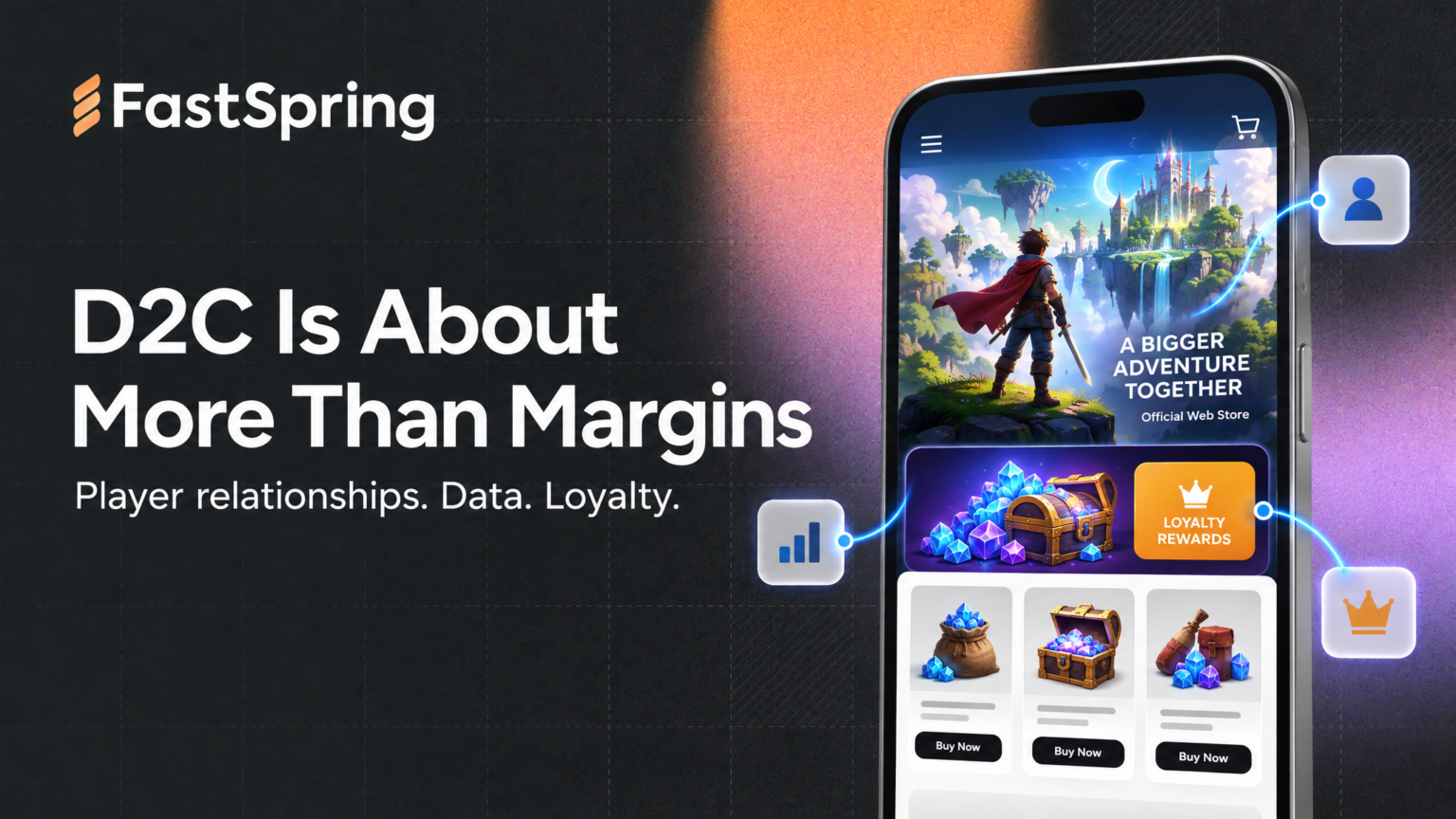
- Brand Visibility and Direct Loyalty (66%): Operating a dedicated web presence enables studios and publishers to present their titles outside the sterile, uniform confines of app store product pages.
- First-Party Data and Unbroken Attribution (58%): Direct digital storefronts allow publishers to collect granular behavioral data, understand purchasing intent, and track cross-platform progression without marketplace data blackouts.
- Pricing and Packaging Agility (54%): Studios gain the freedom to deploy bespoke bundles, dynamic discounts, and personalized SKUs without waiting for platform gatekeeper approvals.
As customer acquisition costs remain historically elevated, acquiring a player once and monetizing them through a single walled-garden channel is commercially unsustainable. This is why publishers must build lasting player equity.
The Economics of Core Player Engagement
In free-to-play (F2P) mobile gaming, audience distribution has always been asymmetrical. Across mid-core, 4X strategy, RPG, and even casual portfolios, an estimated 2% of the active player base routinely accounts for 50% to 70% of total in-app purchase (IAP) revenue.
These high-intent players do not need the App Store or Google Play to discover content; they are already immersed in the game’s meta-systems, guilds, and social loops. Forcing this VIP cohort to transact exclusively through mobile marketplaces imposes unnecessary transaction friction and deprives studios of first-party touchpoints.
When publishers deploy well-integrated web stores, these players migrate readily. Public industry benchmarks mirror this shift: gaming giants like Playtika have reported over 25% of their total revenues flowing through D2C channels, while studios utilizing specialized monetization platforms, like FastSpring, report direct channels consistently capturing 10% to 29% of gross transaction value (GTV).
Crucially, this margin recovery creates an immediate competitive advantage in paid marketing. When 25% or more of an acquisition cohort’s revenue bypasses the 30% store fee, the effective blended ROAS increases, allowing studios to bid more aggressively in UA auctions where competitors are capped by platform overheads.
Incentivizing the Migration: Steering with Purpose
Building a standalone web store is only half the battle; the real operational discipline lies in guiding players to it without causing churn. Successful developers treat the web store not merely as a catalog, but as an official VIP club.
Leading publishers are driving sustained adoption through three proven levers:
- Portfolio-Wide Cross-Benefits (57%): Rewarding players across multiple titles within a publisher’s broader portfolio.
- Value-Add Bonus Currency (54%): Instead of discounting dollar prices, granting 10% to 20% more hard currency or exclusive gear for the same expenditure.
- Integrated Loyalty Progression (49%): Tying web purchases directly to in-game VIP tiers, seasonal milestones, and exclusive battle pass accelerators.
For teams looking to explore how structural changes in consumer payments are unfolding across the wider regional ecosystem, examining initiatives like Türkiye’s mobile gaming out-of-app commerce evolution demonstrates how rapidly alternative billing channels are becoming standard practice across emerging and tier-1 markets alike.
The Bottom Line
The mobile gaming ecosystem has permanently transitioned into a multi-surface monetization play.. Studios and publishers that continue to rent their audience from app store duopolies are voluntarily capping their margins and forfeiting their data. By building an agile, D2C monetization layer through specialized gaming platforms like FastSpring, forward-thinking publishers are taking back control of their margins, their player relationships, and their commercial destiny.