
For studio heads, monetization directors, and mobile game leaders, today’s commercial reality is defined by compounding margin pressure. User acquisition costs remain elevated, live-ops teams are stretched, In-App Purchase (IAP) spending has become harder to scale across broader player cohorts, and programmatic ads have long hit an industry-wide plateau.
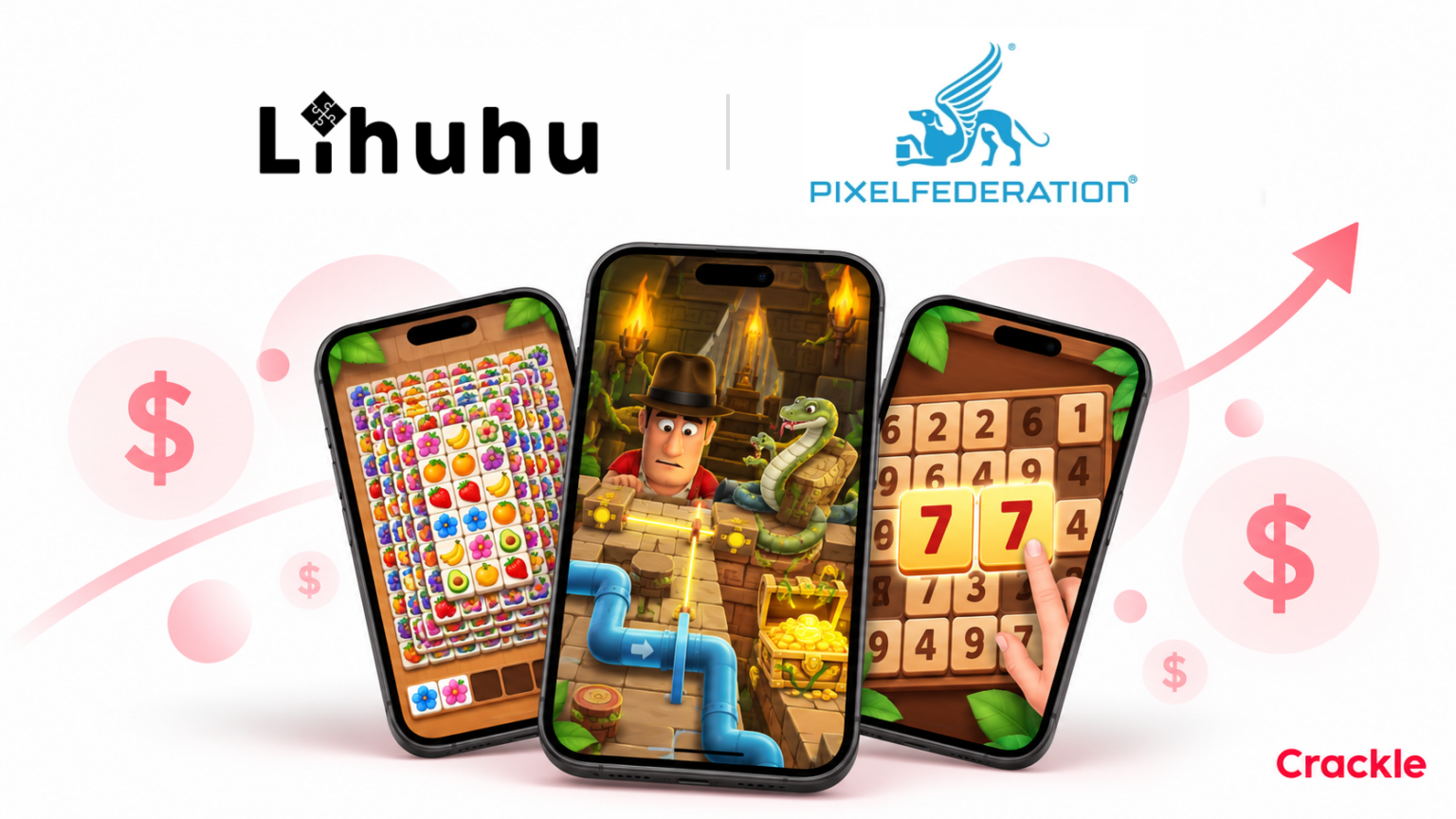
Seeking to extract incremental value from existing traffic, two leading game developers, Pixel Federation and Lihuhu Games, recently introduced a custom network into their mediation setups. The deployment generated immediate, measurable performance gains across both publishers’ ad stacks:
Up to 5% ARPDAU Gains: Measurable growth in average revenue per daily active user realized without increasing ad density or degrading session length.
Up to 10% Share of Wallet: Established a consistent, high-performing presence within publishers’ existing mediation stacks via AppLovin MAX.
Zero UX Degradation: Full compliance with strict creative quality benchmarks, near-zero latency in video delivery, and no intrusive, multi-click ad experiences.
Two Distinct Profiles, One Shared Monetization Dilemma
In Vietnam, Lihuhu Games, the mobile casual division of NCSoft, operates at massive global scale. With hit puzzle titles like Woodber and Match Triple 3D powering more than 350 million downloads, ad monetization forms the operational core of the studio’s daily cash flow. In fast-paced casual game loops, every single basis point of yield counts. However, latency spikes or unvetted, low-quality creatives directly degrade session duration and daily player retention.
Meanwhile, Slovakia-based Pixel Federation has engineered a resilient publishing model around deep simulation and tycoon franchises such as TrainStation 2 and TrainStation 3, entertaining over 140 million players worldwide. Their revenue engine is heavily anchored in long-term IAP and multi-year player loyalty. For their live-ops leadership, scaling ad monetization stood as a strategic priority, but only under an uncompromising “zero-bad-ads” policy where an intrusive creative or a frame drop could disrupt a high-value player’s experience.
Despite these contrasting operating environments, both studios achieved meaningful incremental upside by integrating Crackle into their mediation pipelines.
For Lihuhu, integrating Crackle directly as a custom mediation partner generated between 2% and 4% ARPDAU uplift depending on the title, capturing a 7% to 10% share of wallet in the ad stack.
“Integrating Crackle significantly impacted our monetization strategy,” says Phuc Tran, Chief Revenue Officer at Lihuhu. “I was initially skeptical about adding a custom mediation network to our ad stack, but Crackle helped us capture incremental revenue through their user-level pricing tech without compromising on ad quality. They seamlessly layered in incremental demand in our ads stack, and now have become an essential partner for Lihuhu.”

Pixel Federation recorded similar operational gains inside their AppLovin MAX stack. Crackle introduced competitive, premium demand for Rewarded Video inventory, driving a 5% ARPDAU lift and a 10% share of wallet without inflating ad frequency or compromising technical stability.
The Technology Engine Driving User-Level Yield
Behind these lifts is Crackle, an adtech company founded by former Google leaders that secured venture backing three years ago and is expanding across hubs in Singapore and Delhi.
Rather than operating as a conventional intermediary reselling commoditized inventory, Crackle was engineered specifically to solve a central dilemma for mobile gaming executives: how to capture incremental ad revenue without diluting player engagement.
The platform’s performance advantage is built on three technical pillars:
User-Level Machine Learning: Rather than relying on rigid cohort-based pricing floors, Crackle’s engine evaluates ad requests in real time. By deploying machine learning to dynamically price impressions at the individual user level, the system captures premium bids on high-value players while expanding overall fill rates across broader cohorts.
Diversified Liquidity & Bid Density: Crackle aggregates demand across Tier-1 programmatic buyers alongside specialized regional DSPs, unlocking incremental advertising budgets that traditional mediation networks rarely reach.
Latency-Optimized Video Pipelines: In-game rewarded videos and interstitials stream through low-latency delivery infrastructure designed to prevent frame drops and eliminate ANR (Application Not Responding) risks, even in dense mediation configurations.
Overcoming the Custom Network Stigma
For many mobile gaming executives, custom mediation networks historically came with technical friction, such as auction volatility, dropped bids, or SDK bloat. Addressing that engineering hurdle directly has been central to Crackle’s market adoption.
“Integrating custom networks has historically presented real technical friction for mobile developers, from auction volatility to stability risks in complex mediation environments,” explains Jaivir Nagi, Co-founder of Crackle. “It has been challenging to bring absolute stability, low latency, and consistent yield into custom network integrations, but we are extremely proud of the work our team has done. We’ve proven that machine-learning-driven yield optimization can operate reliably at global scale without compromising gameplay or app performance.”

For mobile game leaders operating in a tightening margin environment, the outcomes demonstrated by Pixel Federation and Lihuhu offer a practical blueprint: unlocking incremental ad revenue does not require heavier ad loads when the underlying stack is optimized with user-level intelligence.