
Hello everyone 👋
Have you ever wondered how much the game industry contributes to the economies of the countries where major game companies operate?
In this research, I looked at one specific part of that contribution: taxes paid by major game companies to governments. I reviewed publicly available financial reports and official company disclosures to see what the numbers can tell us about the economic importance of the global game industry.
The results are quite interesting, especially when we look at which countries and companies appear at the top of the list.
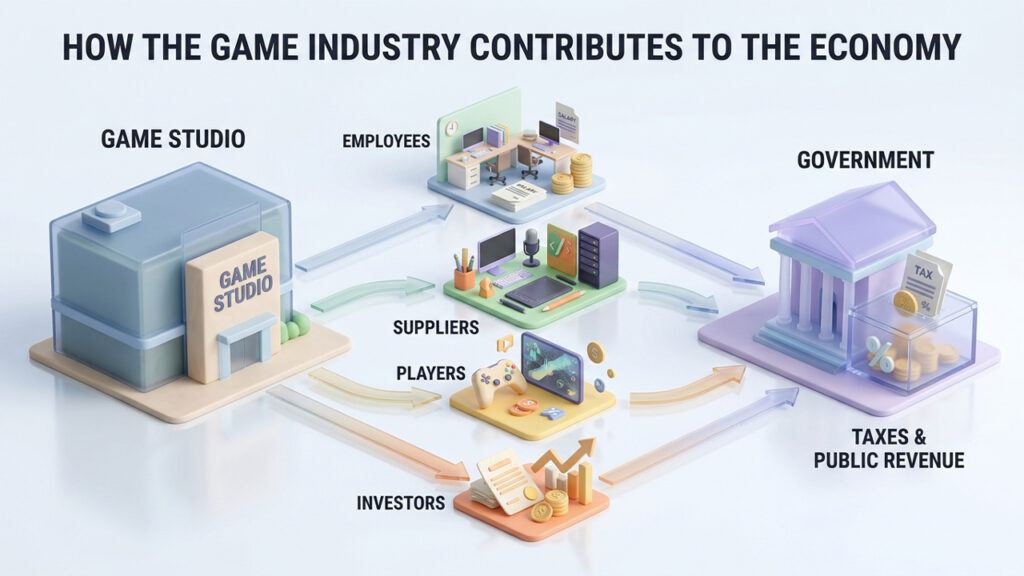
The game industry contributes to economies in far more ways than game sales alone. Game companies create jobs, generate export revenue, develop intellectual property, attract investment, and contribute to public revenues through corporate taxes, employee taxes, social contributions, and other economic activity. As the industry continues to mature, these contributions are becoming increasingly important for governments looking to strengthen their technology and creative economies. One way to get a sense of this economic impact is to look at how much tax major game companies contribute.
Before looking at the numbers, however, there is an important limitation to keep in mind. I reviewed the original financial documents of major game companies, including Japanese financial statements, Korean DART filings, SEC filings, and Chinese and English annual reports. Some figures come directly from official company disclosures, while others are estimates based on available financial data and gaming segment profitability.
Companies such as Microsoft and Tencent were deliberately excluded because they do not disclose a gaming-specific tax figure. Using their total corporate tax would therefore give a misleading picture of the contribution generated specifically by gaming.
Because this type of data is not always publicly available, there may be other companies paying significantly more tax that cannot be reliably identified or compared. The figures below should therefore be viewed as an informed snapshot rather than a definitive global ranking.
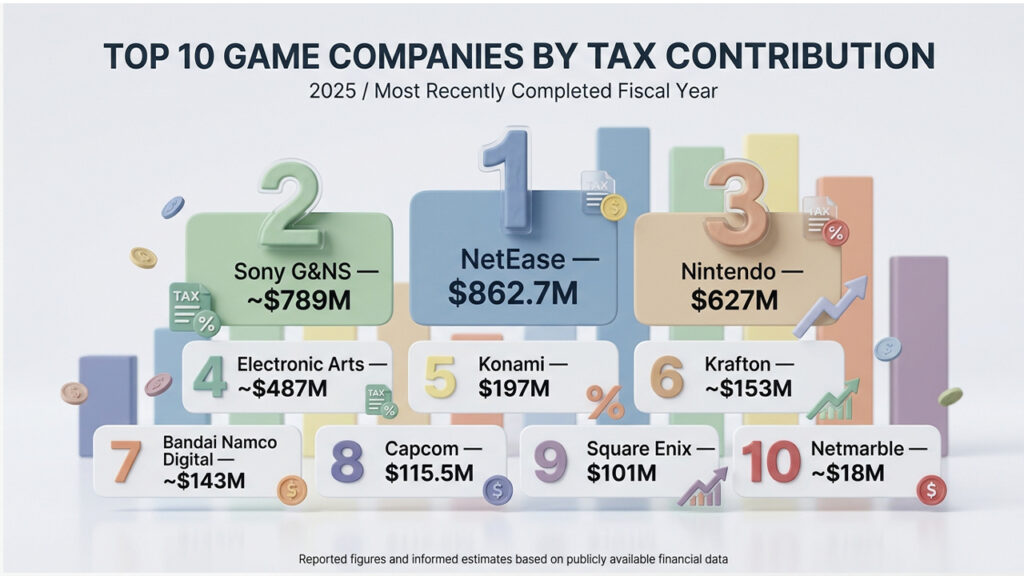
Even with these limitations, the numbers are quite striking. NetEase ranks first with approximately $862.7 million in taxes for 2025, followed by Sony’s Game & Network Services segment at an estimated $789 million and Nintendo at approximately $627 million. US-based @Electronic Arts follows at around $487 million.
Japan is particularly prominent in the ranking, with Konami at approximately $197 million, followed by South Korea’s Krafton at approximately $153 million, Bandai Namco’s Digital segment at an estimated $143 million, Capcom at $115.5 million, Square Enix at $101 million, and South Korea’s Netmarble at around $18 million. Together, these companies cover a wide range of gaming businesses, from console platforms and global publishers to PC, mobile and live-service games.
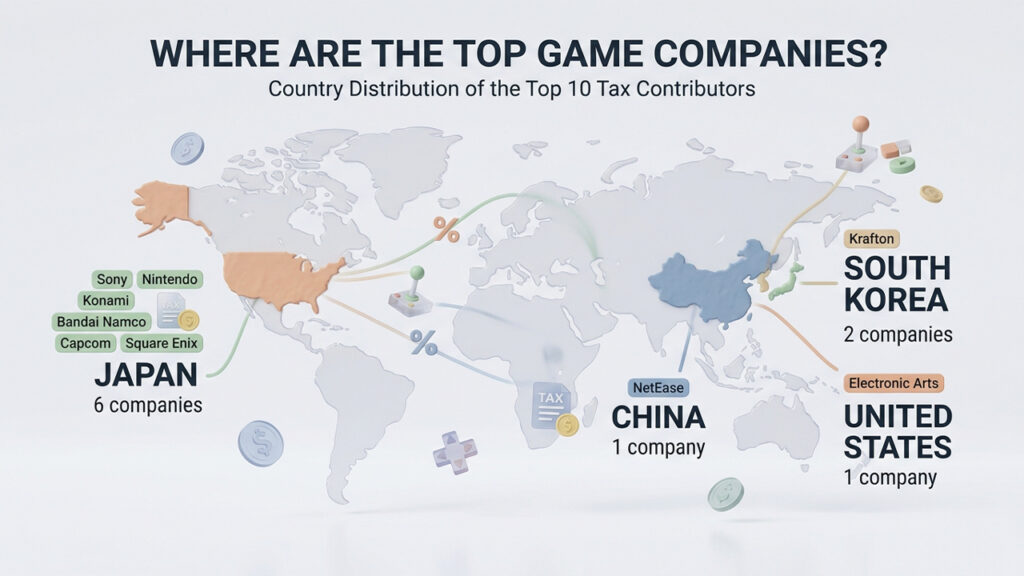
The geographical distribution is also worth highlighting. Six of the ten companies are Japanese, two are South Korean, one is Chinese, and one is American. This strong representation from East Asia reflects the region’s long-established position in the global gaming industry.
From Nintendo’s console ecosystem and Sony’s PlayStation business to Krafton’s PUBG and Capcom’s Resident Evil and Monster Hunter, these companies operate some of the world’s most recognizable gaming businesses. At the same time, NetEase, Netmarble and Electronic Arts demonstrate the scale of China, South Korea and the United States within the global market.
What makes this particularly interesting is the broader economic cycle behind these numbers. Governments can support game development through tax incentives, investment programs, R&D support, and other policies designed to attract studios and encourage local production. The United Kingdom, for example, provides a 34% Video Games Expenditure Credit on qualifying expenditure under its current system. ***
The logic is relatively straightforward: governments provide incentives to encourage investment, employment, intellectual property creation, and international growth, while successful companies contribute back through taxes and wider economic activity.
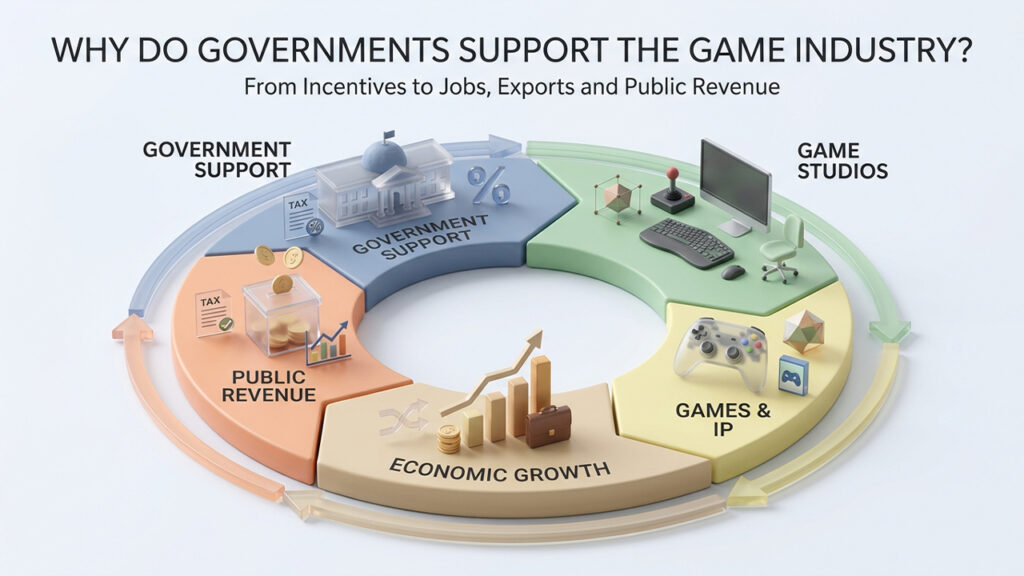
The impact also goes well beyond the tax bill itself. A successful game industry can create highly skilled jobs, support local suppliers and service companies, generate export revenue, attract international investment, and produce intellectual property that can generate value for years. This means that the tax figures in this list represent only one visible part of the industry’s overall economic contribution. In many cases, the wider economic impact can be considerably larger than the corporate tax figure alone.
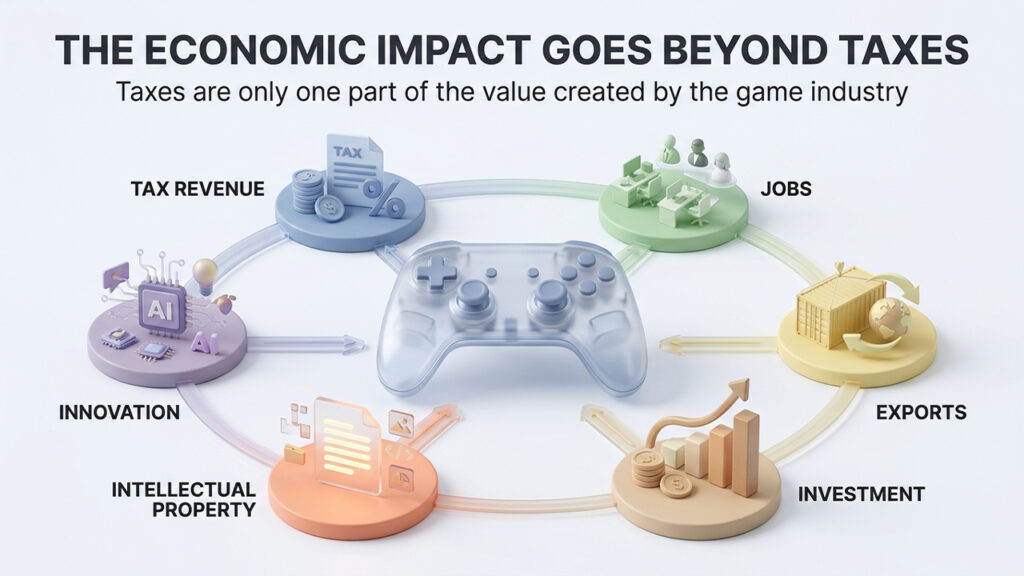
Ultimately, this is why the game industry is becoming increasingly important in national economic strategies. It sits at the intersection of technology, entertainment and creative industries, while creating measurable economic value for both companies and governments.
We may never have a perfectly complete global ranking of gaming-related tax contributions because companies report their financial data in different ways. But even the publicly available figures show that successful game companies can make a substantial contribution to public revenues.
To understand how taxation and economic systems have evolved, perhaps we should go much further back in history, even to the Bronze Age. Lugal: Bronze Age Survival Game offers a small glimpse into that world, where resources, production, trade, and power were already closely connected. If you enjoy survival, crafting, and base-building games, Lugal is definitely worth checking out. It is a fitting reminder that while economies have changed dramatically over thousands of years, the relationship between production, resources, and those who govern them is still very much with us today.
For more game industry research, data, and insights like these, don’t forget to follow us. 📊