
Valeria Svistunova, Head of Monetization at Playgama, breaks down how to approach web game monetization in 2026, covering ad logic, in-game purchases, the differences between web and mobile monetization, and how various game genres should implement it.
The global HTML5 game market is rapidly growing with the emergence of a new generation of platforms such as YouTube Playables, Discord Activities, WeChat Mini Games, and Telegram mini-games. In addition, the shift toward AI makes it easier to develop new titles.
Naturally, more developers are turning their attention to the web games industry, drawn by a relatively easy entry point and the opportunity to reach huge and largely untapped audiences. Lots of teams are creating original games or breathing new life into existing mobile and PC projects, porting them to HTML5.
To help developers navigate this opportunity, we’ve put together a comprehensive guide on monetizing web games, covering everything from setting up ads and in-game purchases to choosing the right platform and maximizing income without compromising user experience.
Table of contents
- Where it all begins: launching a web game
- Distribution to web game portals and platforms: a primary choice
- Standalone domain: setting up ads and in-game purchases yourself
- Frequency, timing, format: getting ad logic right
- In-game purchases: virtual goods to sell and pricing principles
- Monetization for different web game genres
- Web game monetization vs. Mobile game monetization
- Final thoughts
Where it all begins: launching a web game
Every developer faces a choice: launch a game on a standalone website, release it directly on platforms, or through a third-party distribution partner. A standalone domain works well for already-established games, big titles, projects with strong organic growth, or with good potential for it. For most developers, though, the best and most accessible option would be to distribute through established platforms or distributors.
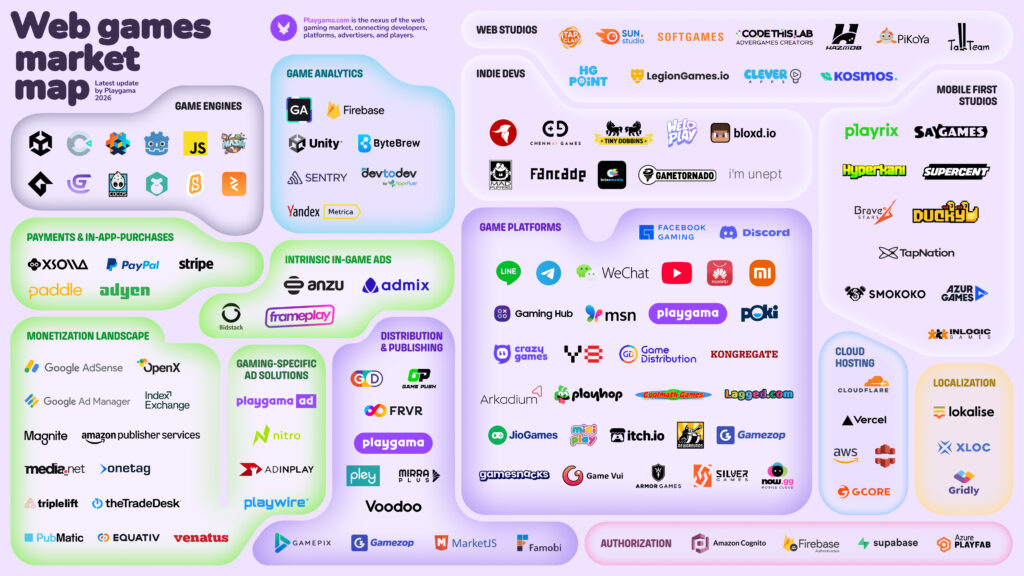
Platforms are portals where players discover and play games: MSN Games, YouTube Playables, Xiaomi Game Center, and others. However, as there are hundreds of them, it’s difficult to deliver to all of these places on your own. So distributors and publishers help navigate this environment as they launch web games across dozens of portals at once. Some operate much like traditional game publishers, curating titles and driving promotion. Others, like Playgama, focus on game distribution, providing the essential tools and infrastructure for developers and launching games across a variety of platforms.
Distribution to web game portals and platforms: a primary choice
One feature that distinguishes the web gaming market from mobile is the absence of monopolists like the App Store or Google Play. It is a patchwork of different platforms where you can launch your games, but each platform comes with its own SDK for handling ads, purchases, save data, and other platform-specific features.
Integrating 10+ separate SDKs is a significant engineering burden, which distributors like Playgama help solve. For example, Playgama Bridge wraps all of them into a single SDK — once you integrate Bridge, your game is technically ready to run on every platform Playgama distributes to, without additional hassle.
When a game is published on a platform — whether directly or via a distributor — the “place” usually has its own advertising infrastructure. Platform controls which demand partners are active, how often ads are served, and what ad content appears. And the developer only designs the triggers inside the game that make ad calls — the ad logic. Keep in mind, though, if you make ads too frequent and exceed a platform limit, it might override your calls to protect user experience (for example, if you try to put interstitial ads between every match so that they appear every 30 seconds, while the platform’s limit is once in 90 seconds).
The same principle applies to in-game purchases (IGP/IAP): the platform provides the payment infrastructure. Keep in mind that only some platforms support IAP, like Playgama, Playhop, MSN, and Facebook.
Standalone domain: setting up ads and in-game purchases yourself
Nowadays, Google AdSense is the starting point for most web developers. The sign-up process is straightforward — basic identity verification is all you need — but the capabilities may seem short for ambitious projects. AdSense provides access to Google’s standard demand pool with minimal customization. You cannot connect additional ad networks on top of it, and the revenue potential reflects that.
A significantly more powerful option is Google Ad Manager, though it’s extremely difficult to access: it’s invite-only, and in practice, you’ll usually need substantial traffic and/or direct connections with Google Sales representatives to get in. Ad Manager allows you to connect multiple demand partners and manage your ad inventory in detail. The more networks compete for your inventory through real-time auctions, the higher your CPMs (Cost Per Mille — the cost an advertiser pays for every 1,000 impressions).
With Ad Manager, you can set price floors, control ad categories, and decide which demand partners have access to your inventory, giving you greater control over how ad demand is sourced and managed. Connecting additional demand sources through Open Bidding or Prebid, however, requires establishing a separate business relationship and agreement with each partner.
If you want the revenue potential of a full demand setup without building an in-house AdOps team, MCM partners are worth knowing about. These are companies that Google has authorized to give smaller publishers access to Ad Manager infrastructure, acting as an intermediary between a developer and the premium ad ecosystem. But keep in mind, monetization partners are selective too: they look for games with a growing player base, a clean traffic profile, and scaling potential.
If a developer plans IAPs for their game on a standalone domain, they select their own payment provider. Common options are Xsolla, PayPal, Stripe, Paddle, and Adyen. These providers approach taxes differently, with some acting like merchants of record, and may not support all local payment methods. Developers should therefore consider both the country where their business is registered and where their core audience is located.
Frequency, timing, format: getting ad logic right
Web games give developers more flexibility with ad frequency than mobile games. This is due to web ads being simpler, shorter, and closing with a single click, so players tend to accept more ad calls per session with less churning. Logic of ad placement, however, might differ in the case of apps and web games. That said, player experience matters everywhere.
Banners
Banners are persistent on-screen placements that rotate periodically. They’re the lowest-CPM format — typically 4–5 times cheaper per impression than interstitials — but they can generate comparable revenue in certain genres due to constant visibility without interrupting gameplay.
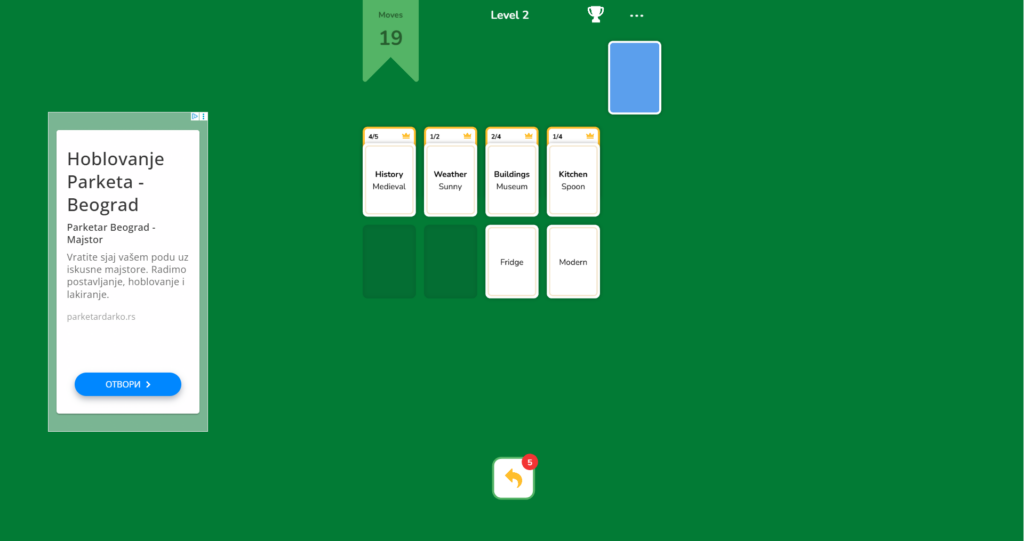
Placement recommendations: Keep banners away from controls, menus, and any interactive UI elements. Place no more than two banners per screen (some platforms may allow only one). The ad refresh rate should not exceed once every 90 seconds to keep a healthy balance between fill rate and eCPM.
Interstitials
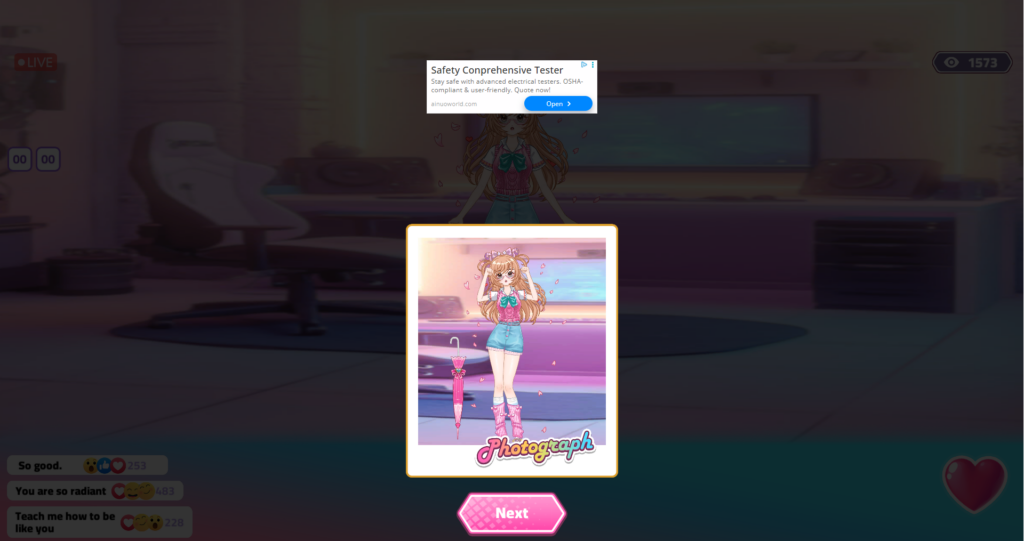
Interstitials are full-screen ads shown at natural breaks in gameplay. Along with rewarded ads, they are the highest-earning format. The standard interval between interstitials is 120–240 seconds, varying by genre.
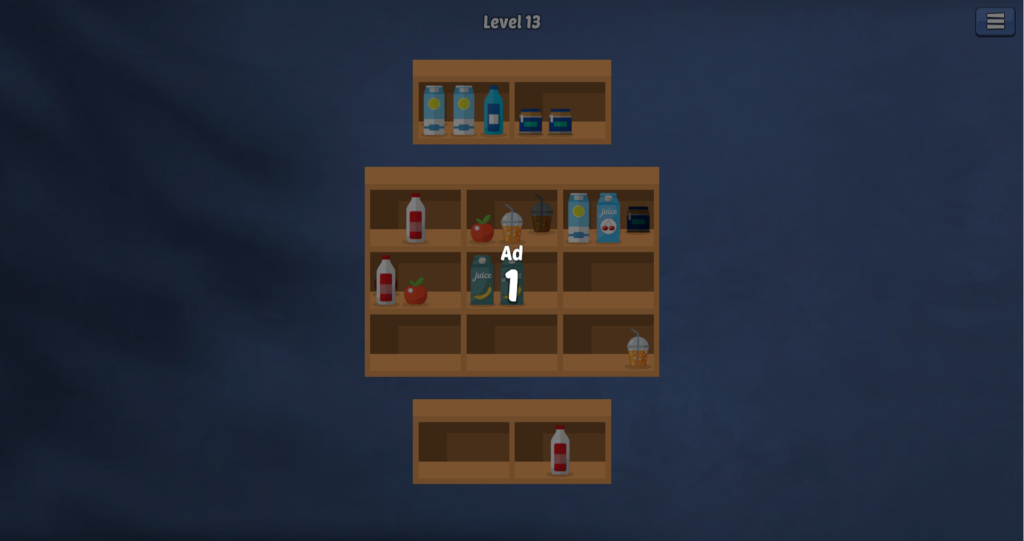
Placement recommendations: Avoid showing an interstitial at game launch or during the first few levels. First-time user experience should be engaging and smooth to avoid Day 0 churn. Wait until after the tutorial, the third or fourth level, or at least 40–60 seconds of gameplay.
Don’t put them after every game or match. And if you don’t have logical pauses like win or lose screens, add a countdown (“Ad in 3…2…1”) to notify a player beforehand. Always pause gameplay and mute game sounds while the ad is running — this is a standard requirement across platforms.
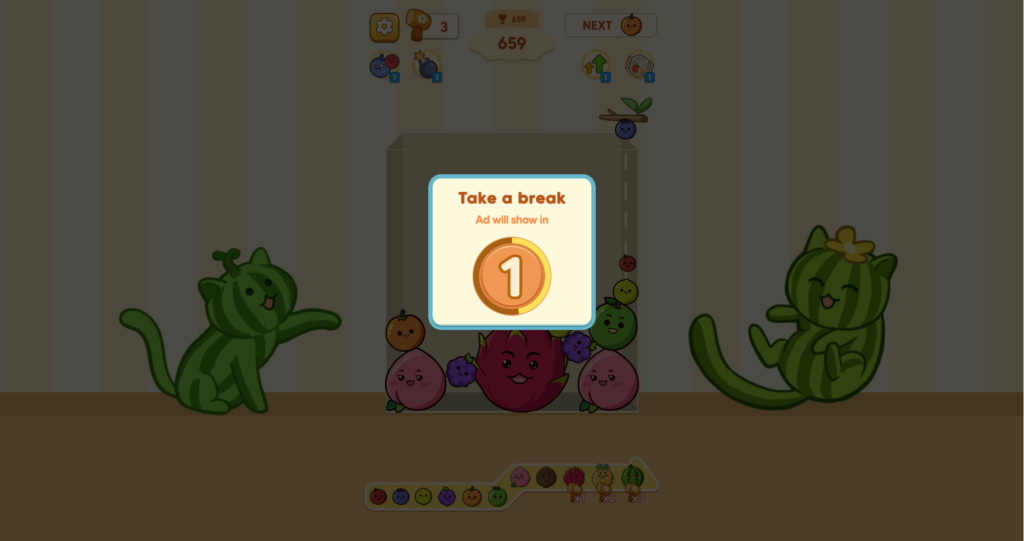
Rewarded ads
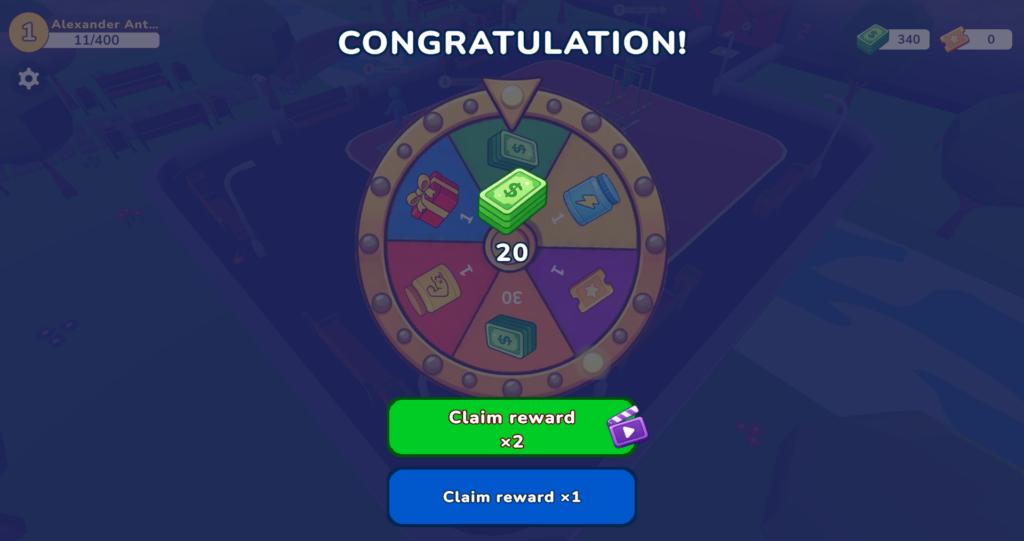
Rewarded ads are initiated by a player in exchange for an immediate benefit. They include second tries or revivals, double rewards, hints or boosters, daily bonuses, time skips, and other benefits depending on the gameplay loop.
As rewarded ads feel the most organic and not forced, they can be seen in almost every game and might be called essential.
Placement recommendations: Always reveal the reward before the ad plays (“Watch & Get +1 Life” rather than “Watch Ad”). It’s worth noting that you shouldn’t create gameplay situations where players can’t proceed without watching an ad. The reward should feel like a welcome bonus, not a mandatory step.
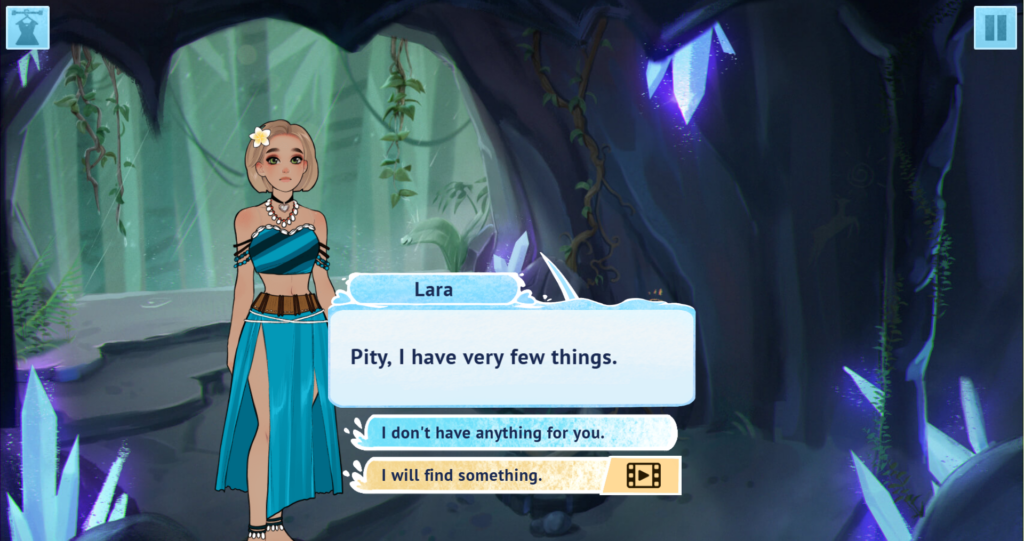
A well-performing game has around 3 rewarded views per average session, and 30–40% of all players click the rewarded button at least once per session.
If your game also has in-game purchases, keep rewarded ads to 1–2 per session at most, not to devalue IGPs.
Intrinsic ads
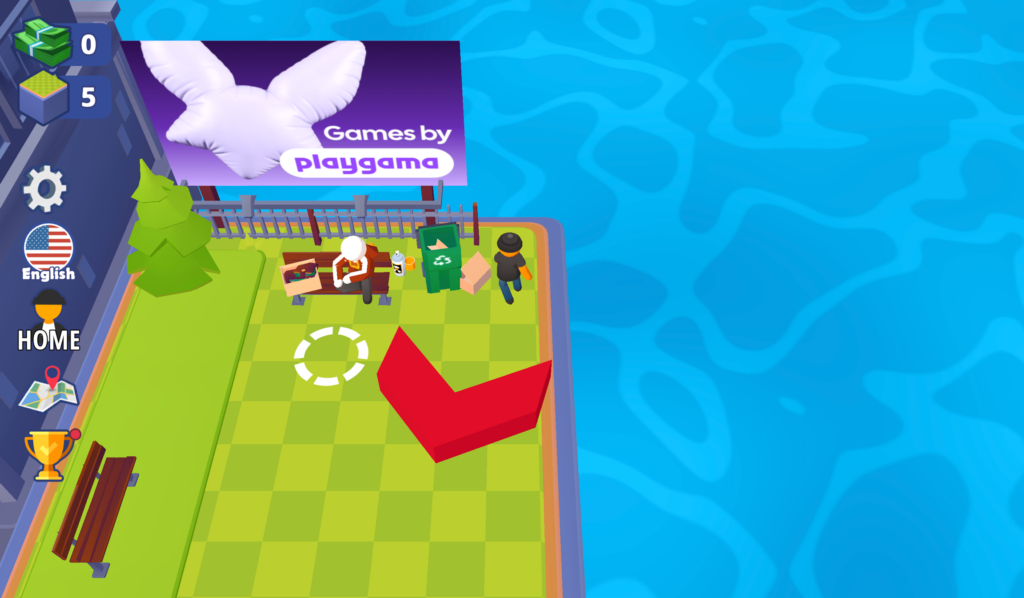
Intrinsic ads are placements built into the game environment itself — a billboard on a racetrack, a poster on a city-building wall, a screen inside a virtual arena. Unlike standard overlays, they’re programmatically filled with real brand campaigns without interrupting gameplay. That’s a rare and yet developing format for web games, more often seen in mobile games.
In-game purchases: virtual goods to sell and pricing principles
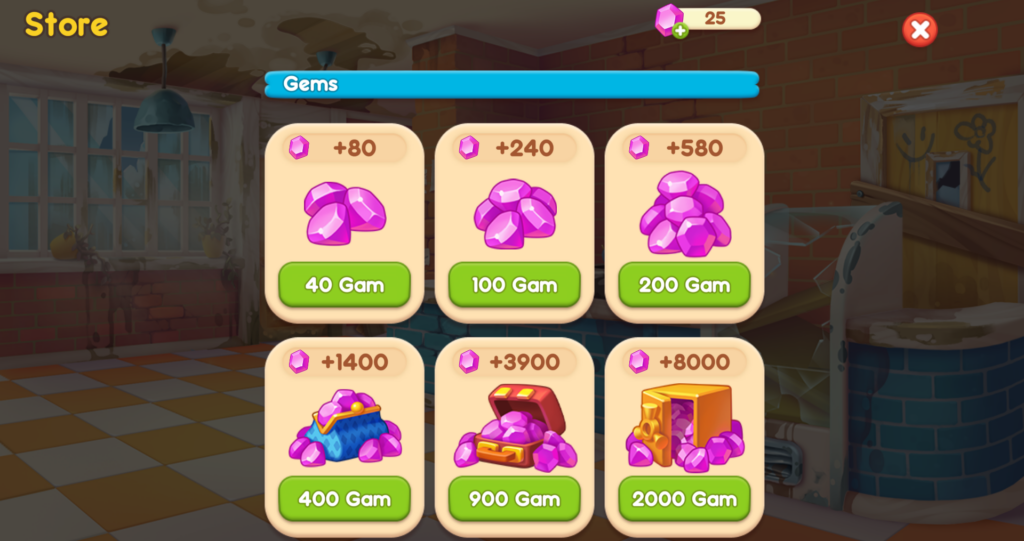
If ads are the core of web game revenue, IGPs are targeted towards a small (often <2%) but highly engaged cohort of players. Virtual goods are usually divided into consumables (premium currency, resources, energy, boosters, game lives, and bundles) and permanent items (character skins, new level packs, gameplay unlocks). Some games also have battle or season passes as part of time-limited events.
LiveOps is designed similarly to how it’s done in mobile games, and there are titles making temporary events, e.g., Halloween or Christmas, to release and sell new thematic items.
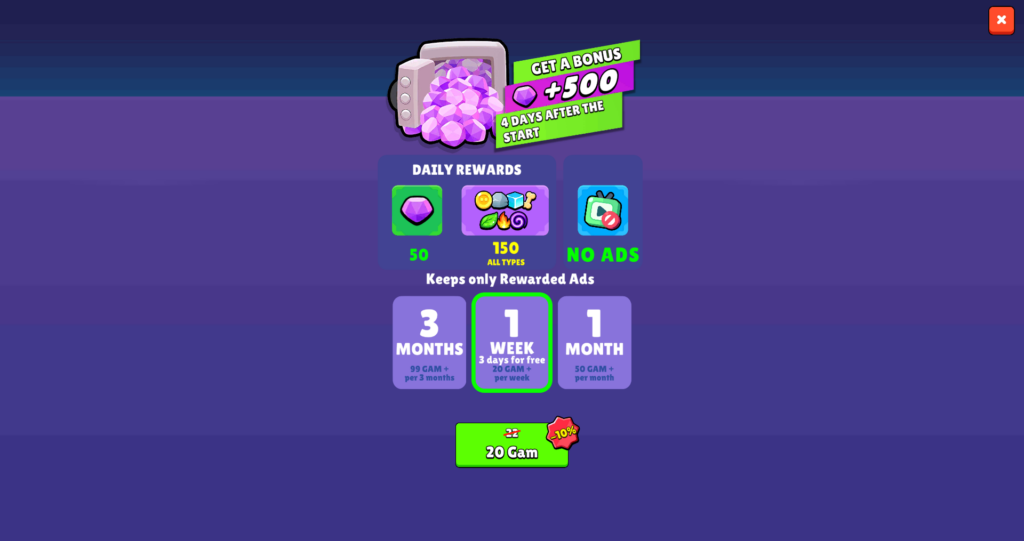
Monthly or weekly subscriptions exist in some web games, but are uncommon. Also, be careful with loot boxes: they are legally restricted in some countries.
Prices for web games should generally be lower than in mobile — between $0.99 and $4.99 per item as a baseline, but with the audience shaping the pricing. On average, prices can go higher for games and genres with clear high-value permanent items, such as competitive shooters, as their players tend to pay less frequently but more mindfully.
Genres like match-3 and merge tend to monetize successfully through in-app purchases both in mobile and web, with resources and boosters playing a key role in player progression. The price of bundles in the merge genre, even on web platforms, can run as high as hundreds of USD.
Successful games usually combine ads and IGPs — this is called hybrid monetization. The right balance depends on your audience and may vary from one web game portal to another. If your player base is small but paying, lean into in-game purchases. If it’s large and casual, ads will drive the bulk of your revenue. Beyond that, genre shapes the equation significantly.
Monetization for different web game genres
Monetization logic differs significantly by genre. There’s no universal template — but here are a few patterns worth understanding before you start configuring.
Match-based games (FPS, racing, sports): Sessions have few natural pauses, which limits interstitial slots — but since rounds run long, you can justify an interstitial between them. Rewarded ads and in-game purchases are the primary revenue drivers, since they fit the session rhythm without forcing interruptions. Banners work well as a passive secondary layer on lobby and menu screens, outside of active gameplay.
Static or board games (chess, solitaire, card games): In games like these, there’s rarely a natural break for an interstitial, so banners around the game board can become the dominant monetization layer — sometimes contributing nearly as much revenue as interstitials do in other genres.
Short-level casual games (some puzzles, match-3, bubble shooter): Frequent level transitions create natural interstitial slots. In match-3 games with in-game purchases, watch the rewarded ad balance carefully.
One principle holds across all genres: don’t copy another game’s monetization setup and expect the same results. Use others as reference points, not blueprints. Your game’s session length, difficulty curve, and player incentives are unique, and your monetization has to reflect that.
Web game monetization vs. Mobile game monetization
Web ads are shorter and easier to dismiss than mobile ads. A rewarded ad on mobile can run for a full minute with multiple confirmation taps to close, and may even be a “playable”; on the web, ads are more basic, and players move through them swiftly. This means web players generally tolerate more frequent exposure, and you have room to experiment.
The bigger shift is the screen. Mobile games are optimized for small screen sizes and either landscape or portrait orientation — on desktop, standard 2D assets may either scale badly or leave empty margins around the gameplay zone. That extra space isn’t wasted, though: if your game has persistent UI elements around the play area, those margins become natural slots for banner placements that simply don’t exist on mobile. Revisit your banner layout entirely when adapting a mobile game for the web.
Rewarded ad logic transfers fairly directly and doesn’t need major adjustment. The triggers and reward structures that work on mobile generally translate to the web without rethinking.
And, as we already addressed that, you might need to revise a pricing policy for IAPs.
Final thoughts: there are no templates but common sense, individual approach, and countless iterations and experiments
There’s a temptation to treat monetization as something you configure once before launch and then leave alone. In practice, it’s an ongoing process — and the developers who earn the most from their web games are the ones who keep iterating.
Start conservatively. It’s far easier to add more monetization later than to recover players who churned because you were too aggressive at launch. That said, don’t launch with no monetization at all — platforms use revenue signals in their ranking algorithms, and a game that earns nothing may get deprioritized in recommendations regardless of its quality. Find a baseline that’s present but not intrusive, and build from there.
Use your data. Track session length, Day 1, Day 7, and Day 30 retention, and revenue per session. A long average session with low revenue suggests undermonetization. A very short session might mean players are leaving due to ad friction. The answers are in the numbers, so check your metrics. Thankfully, platforms and distributors usually have tools for that — like on Playgama’s Developer portal, you can see all the logs needed for adjusting.
Fix technical issues before anything else. A rewarded ad that doesn’t deliver its reward, or an interstitial that doesn’t pause the game, damages player trust and turns them away to never return again. These are the kinds of issues that show up in reviews and in churn data.
Optimize your build for all target platforms and devices. Web games run on Windows desktops, Android browsers, and iOS, and must do it smoothly. After all, there are many titles on each game portal, and players can switch if a loading screen stays for too long or if a game simply breaks.
Listen to the moderation team or your monetization partner. They see patterns across hundreds of games and will often flag practical improvements, whether that’s adding more rewarded placements, adjusting interstitial timing, or moving banners to the side. That expertise is one of the less obvious benefits of working with an established distribution partner.
And remember: the web games market is getting highly competitive. With the rise of AI and vibecoding, distributors are getting more and more strict towards low-quality projects. So to succeed and turn your game into a hit with lavish revenue, you need to pursue quality and raise players’ engagement, tracking playtime, retention, and monetization metrics like eCPM. Which means iterating, testing, and adjusting your gameplay and monetization. The games that do it consistently are the ones that grow.

Head of Monetization at Playgama