
A new study has revealed how a new generation of web games is experiencing significant growth, engaging players of every kind, driving spend across the gaming ecosystem, and even outcompeting social media when it comes to consumer attention.
Commissioned by Poki and conducted by independent MRS-certified research firm Atomik Research, The 2026 State of Web Gaming report is based on a survey of 2,000 web gaming consumers and 400 game developers across the US and UK. Its findings reframe browser gaming from a nostalgic gaming destination of the past to a future-facing form of entertainment that thrives in meeting consumers’ needs in the increasingly fragmented attention economy.
To-date, robust data on the realities of modern web gaming has been extremely limited. The 2026 State of Web Gaming moves to address that issue, also uncovering a spectrum of developer attitudes towards web gaming; from those already using browser to engage new audiences and drive exposure of their PC and mobile IP, to cautious teams who still perceive the format as it was seen during the casual boom of the 2000s.
The report also includes qualitative insights from experienced studios already publishing to the web, and those holding back for now. Contributors include Outfit7, HappyLander, Radical Play, Burny Games, StoreRider, Gopandagames, and Emolingo.
KEY FINDINGS INCLUDE:
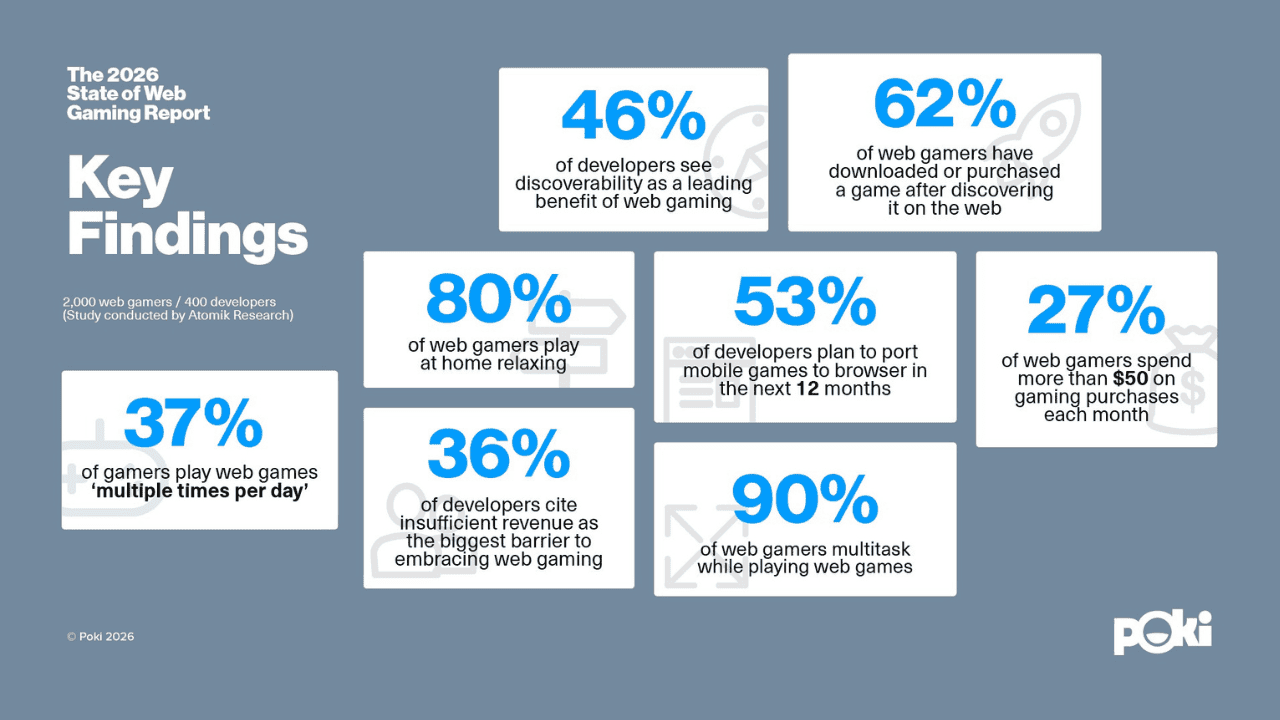
- Today’s web gamers are deeply engaged, high-value players: 37% of surveyed consumers play web games multiple times a day, highly rating the format for its quality. 92% describe HTML5 games as high quality. Those players are also high-value themselves. 27% of web gamers spend more than $50 on purchases across the gaming ecosystem each month, rising to 35% among the most frequent players. They are highly engaged with all types of gaming. 71% of web gamers own premium gaming hardware too: 42% of web gamers own a PlayStation 4 or 5, 27% own an Xbox model, and 27% own a Switch or Switch 2. The web gaming audience is no longer made up of casual players alone, but a broad spread of demographic groups looking for quality gaming experiences that fit into their lives.
- Web gaming is countering the discoverability issue: Web gaming platforms are where consumers decide what to play – and where to spend – next. Web has become the discovery layer of modern gaming, providing an immediate, low-friction gateway to unearth 1,000s of fresh games and IPs. 46% of developers already see discovery as a core benefit of publishing to web and 53% see web gaming as a way to reach new users. Players, meanwhile, are actively using web games as a discovery channel. 62% have downloaded or bought a game after first playing it on the web, rising to 72% among the most frequent players.
- Web gaming complements modern consumption habits: As the media landscape expands and diversifies, and the battleground of the attention economy becomes ever fiercer, consumers have identified web gaming as a way to fit quality gaming into their modern lives. 90% of respondents listen to music, chat with friends, watch streams, use social media, or engage in other consumption while also playing web games. 56% of web gamers favour the format because web games are easy to access, while 58% choose web games because they are free. Web gaming is growing because the format provides a dynamic entertainment layer that fits around other consumption habits.
- Web gaming is also growing relative to social media: Seven in ten respondents (71%) say the amount of time they spend playing web games relative to social media is either stable (43%) or increasing (28%).
Stein Janssen, COO of Poki, said:
“At Poki we became keenly aware that there is almost no available data on the reality of web gaming as it is today. With that in mind, we commissioned Atomik Research to speak to hundreds of developers and thousands of players. A fascinating picture is emerging. Web gaming is usually discussed through the lens of what it used to be, rather than what it has become. And what it has become explains why it is currently enjoying significant growth.
Web gaming today drives discoverability, thrives in engaging users distracted by a fragmented attention economy, exposes games and IPs to high-value players willing to spend on the worlds they discover, and is even reducing consumers’ time on social media. Developers yet to move on web haven’t got it wrong. But they increasingly risk being late to a new movement in games, where revenues are growing, players are staying, and gaming brands are unleashed to new audiences.”

Will Freeman, veteran games industry journalist and the report’s author, concluded:
“In my 20 years covering this industry, I’ve rarely seen a sector with such a large and engaged audience go quite so under the radar. Writing this report was an eye-opener because it allowed me to tear down my own assumptions about the format. I learned a tremendous amount writing it, and I hope readers do too.”

The 2026 State of Web Gaming whitepaper is available to download here.