
Vietnam has become one of the most active gaming markets in Southeast Asia, with its ecosystem continuing to attract international attention from developers, publishers and service providers alike. As Mobidictum continues expanding its presence in the region through initiatives such as the Mobidictum Mixer Hanoi | Sponsored by Point2Web, conversations around the country’s rapid growth have become increasingly relevant.
One of those discussions comes from industry veteran Maxon Pugovsky, who recently joined Roman Garbar to break down Vietnam’s evolution into one of the world’s leading mobile game development hubs. In the interview, Pugovsky explored why Vietnam has become the second-largest exporter of mobile game downloads, the industry’s next challenges, and why the domestic market remains an overlooked opportunity for international companies.
Check out the interview on Tenjin’s YouTube channel below or continue reading on our website!
From outsourcing destination to mobile game powerhouse
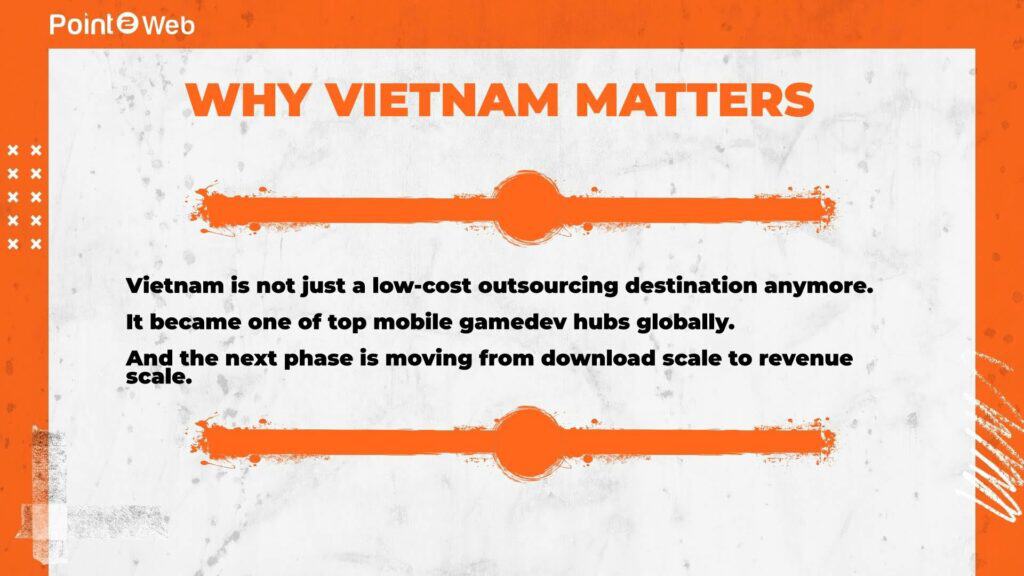
For years, Vietnam was primarily recognized as an outsourcing destination for international game studios. Today, the country has become one of the world’s leading producers of mobile games.
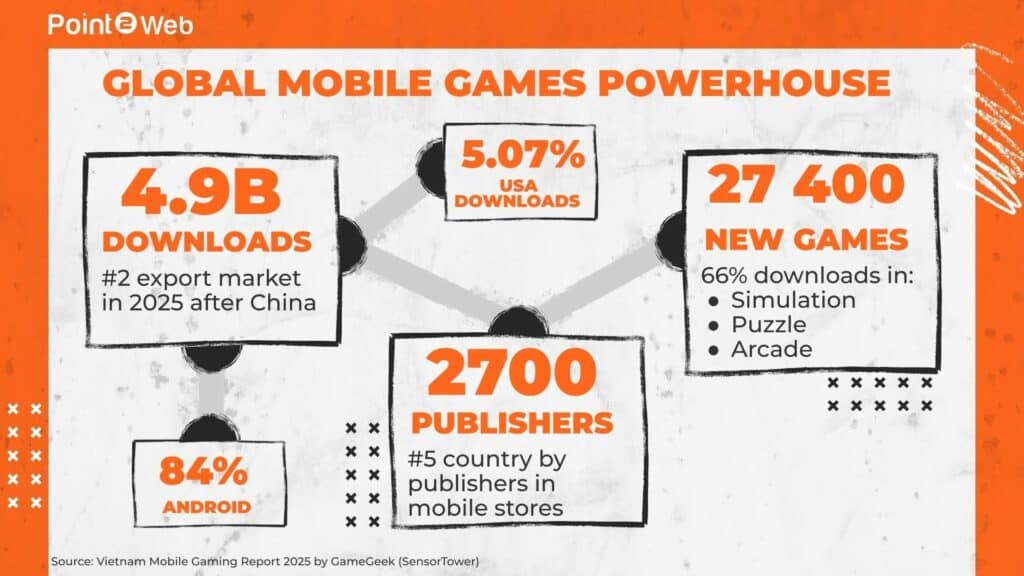
According to industry data shared by Pugovsky, Vietnamese developers generated nearly 5 billion mobile game downloads in 2025, making Vietnam the second-largest exporter of mobile game downloads globally, behind only China. The majority of these downloads came from Android devices, while only a small percentage originated from Tier 1 markets such as the United States.
Rather than focusing on premium markets, many Vietnamese studios have built successful businesses by targeting regions with lower acquisition costs across Latin America, the Middle East and other developing markets. This strategy has enabled studios to scale rapidly through advertising-driven monetization, particularly in genres such as simulation, puzzle and arcade games.
However, Pugovsky believes the industry’s next stage of development requires a different mindset.
“Vietnamese studios understand that they need to transition from download scale into revenue scale,” he explained. “The goal now is to generate more value from every player they acquire.”
How Vietnam built its mobile games ecosystem
Pugovsky attributes Vietnam’s rise to a combination of strong technical education, entrepreneurial culture and relatively low operating costs.
The country graduates around 50,000 technical specialists every year, creating a steady pipeline of engineers and developers. As outsourcing expanded during the early 2000s, many of these professionals gained experience working with international companies and adopted global production standards.
One defining moment came in 2013 with the success of Flappy Bird, developed by Vietnamese creator Dong Nguyen. Beyond becoming a global phenomenon, the game’s success inspired a new generation of developers to launch their own studios.
Unlike many Western startups, most Vietnamese game companies were founded without venture capital. Small teams relied on personal savings or support from friends and family, allowing founders to retain ownership while gradually scaling their businesses.
This entrepreneurial culture remains one of the market’s defining characteristics today.
The industry’s biggest challenge: building games with deeper monetization
While Vietnam has mastered efficient production and user acquisition, Pugovsky argues that the country’s next challenge is creating games capable of generating significantly higher lifetime value.
Many successful Vietnamese publishers currently specialize in hybrid-casual, puzzle and simulation games that rely heavily on advertising revenue. Revenue per download remains relatively low compared to companies producing more sophisticated mid-core or live-service experiences.
“The challenge now is to create games with deeper gameplay, stronger meta systems and more original experiences that encourage players to spend, rather than simply watch ads,” Pugovsky said.
He noted that local developers have become exceptionally good at production, rapid iteration and scaling successful concepts. The next step is developing original intellectual property capable of competing in genres with significantly higher player spending.
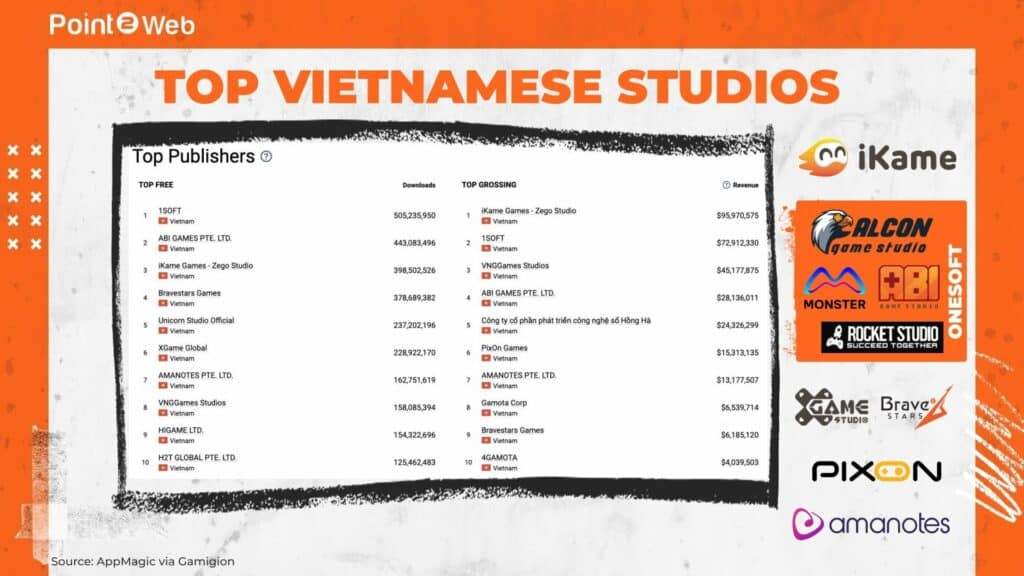
Several major Vietnamese publishers, including OneSoft, Amanotes and ABI Game Studio, are already investing in this transition, while maintaining the independent culture that has defined the industry.
Investment activity signals a maturing ecosystem
Vietnam’s games industry has also started attracting larger strategic investments.
Pugovsky highlighted two recent deals as important milestones.
The first was Pantera Global’s $1.5 million seed investment, one of the country’s first publicly announced venture capital investments into a local game studio.
The second was NCSoft’s acquisition of a 67% stake in Lihuhu Games for approximately $105 million.
Rather than treating the acquisition as an exit, Lihuhu’s founders retained minority ownership and continue to lead the company.
According to Pugovsky, this reflects the mindset shared by many Vietnamese founders.
“Most founders don’t want to leave the business,” he explained. “Their companies are already successful, and they genuinely enjoy building games.”
Instead of seeking purely financial investment, many studios now prefer strategic partners that can provide expertise in product development, monetization and international expansion.

Vietnam’s hidden opportunity: its domestic mobile games market
Beyond game development, Pugovsky believes Vietnam remains one of the industry’s most misunderstood publishing markets.
Industry estimates place Vietnam’s mobile games market at roughly $800 million annually, although he believes actual spending is considerably higher because much of the country’s revenue flows through local payment systems rather than traditional in-app purchases.
Only around 15% of mobile game payments are processed through Apple and Google. Most players instead purchase content through local payment methods and publisher-operated web shops.
As a result, developers evaluating Vietnam solely through App Store or Google Play revenue data may significantly underestimate the market’s potential.
To access this revenue, international developers typically partner with local publishers who manage licensing requirements, regional payment systems and regulatory compliance.
Pugovsky also noted that Vietnamese players show particularly strong engagement with mid-core and hardcore genres, including strategy and MMORPG titles, where spending ceilings are considerably higher than in casual games.
International collaboration will shape the next stage of growth
As Vietnamese studios continue evolving, international collaboration is becoming increasingly important.
Pugovsky believes external consultants, experienced game designers and strategic publishing partners can help local companies accelerate their transition toward higher-value products.
He also pointed to Google’s consulting initiatives in Vietnam as an example of ecosystem support, where international experts work directly with local studios on monetization and product strategy.
At the same time, language barriers and cultural differences still present challenges for foreign companies looking to establish long-term partnerships.
Despite these obstacles, Vietnamese studios have shown growing interest in recruiting international talent, particularly experienced designers capable of bringing expertise from more mature gaming markets.
Looking ahead
Vietnam has already established itself as one of the world’s most productive mobile game development ecosystems. The country’s technical talent, entrepreneurial culture and efficient production capabilities have enabled local studios to dominate download charts worldwide.
Now, according to Pugovsky, the industry’s focus is shifting toward creating games with deeper gameplay, stronger monetization and greater long-term value.
For international developers and publishers, that evolution presents opportunities on two fronts: partnering with increasingly sophisticated Vietnamese studios and exploring a domestic market that remains largely overlooked outside Asia.