
Over the past year, global interest in Short Drama has continued to rise. The conversation is shifting from whether the model can work overseas to a more pressing question: how can companies build sustainable growth and profitability?
To help answer that question, SocialPeta and BidMatrix have jointly released the 2026 H1 Short Drama Advertising Trends & Growth Insights report, drawing on SocialPeta’s monitoring coverage of 70+ countries and regions, 80+ global advertising channels, and more than 1.7 billion ad creatives.
This article highlights the report’s most important data points and market shifts, offering a quick view of what changed in the first half of 2026. The full report includes complete rankings, advertiser case studies, creative breakdowns, and practical growth frameworks.
Part 1: Market Growth — More Advertisers, Fiercer Creative Competition
The global Short Drama advertising market is becoming increasingly crowded. The number of advertisers rose from about 940 in 2024 to more than 2,900 in 2025, and reached 3,928 in H1 2026 — already exceeding the combined full-year totals of 2024 and 2025. At the current pace, the market could surpass 4,500 advertisers by the end of 2026.
As more advertisers enter the market, creative competition is intensifying. In H1 2026, the average number of creatives per advertiser reached 12.5K, roughly equivalent to the full-year 2024 level. The annual average could exceed 15K creatives per advertiser in 2026. Leading players are scaling creative production with AI-powered generation tools, while smaller advertisers face higher creative thresholds and rising user acquisition costs.
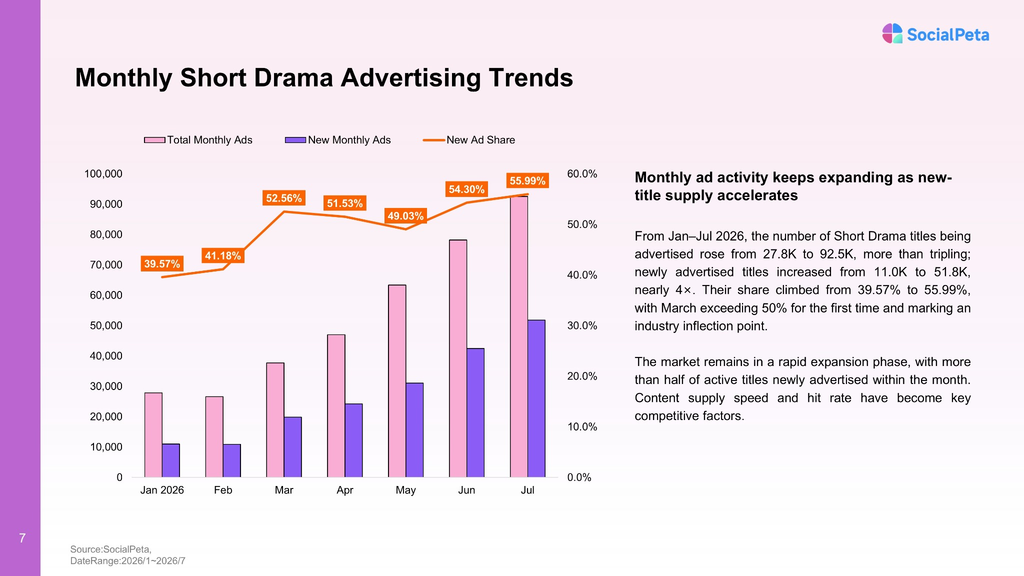
Monthly activity shows the same acceleration. From January to July 2026, the number of Short Drama titles being advertised increased from 27.8K to 92.5K, more than tripling. Newly advertised titles expanded even faster: their share exceeded 50% for the first time in March and reached 55.99% in July. More than half of active titles were newly advertised within the month, making content supply speed and hit rate two of the most important competitive factors.
Part 2: AI-Generated Live-Action Short Drama — From Emerging Format to Core Growth Engine
Monthly advertising for AI-generated live-action Short Drama titles surged from 1,479 in January to 11,962 in July, an increase of more than 7×. Newly advertised titles rose from 378 to 8,447, up more than 21×. June and July marked a clear breakout period: in July, newly advertised AI Short Drama titles accounted for 70.62%, far above the 56% level for Short Drama overall.
Why is AI Short Drama scaling so quickly? The production cycle is shorter, content can be iterated faster, and studios can respond more rapidly to the advertising market’s demand for fresh titles. In a market where supply speed matters, AI-generated content is moving from experimentation to a meaningful source of incremental growth.
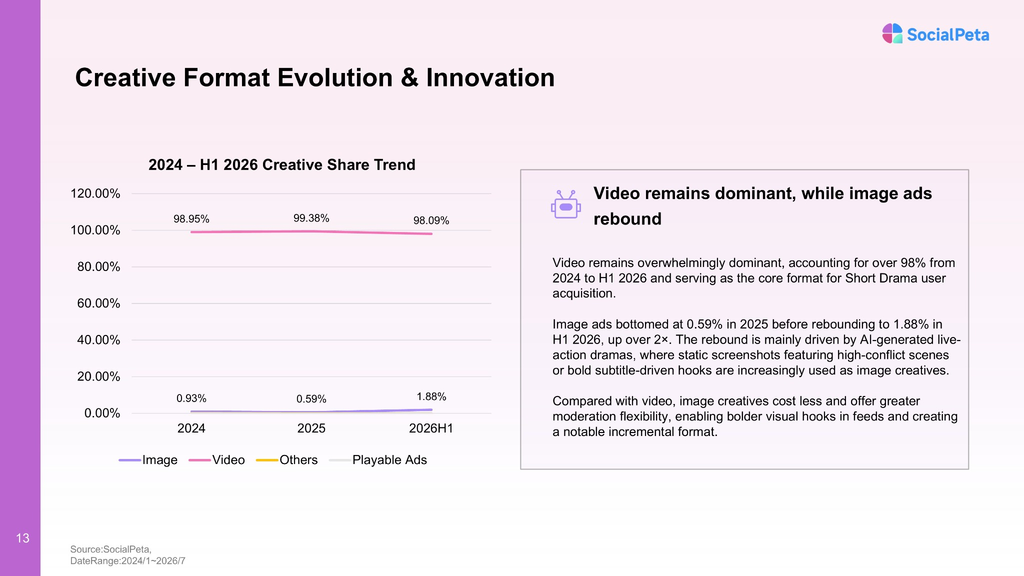
The rise of AI content is also changing creative formats. Image creatives fell to just 0.59% of the mix in 2025, then rebounded to 1.88% in H1 2026 — more than doubling. Many of these new image ads use high-conflict screenshots from AI-generated dramas. Their lower production cost and greater moderation flexibility make them an increasingly important complement to video creatives.
Part 3: Global Expansion — Europe Leads, Latin America Emerges as a Second Growth Engine
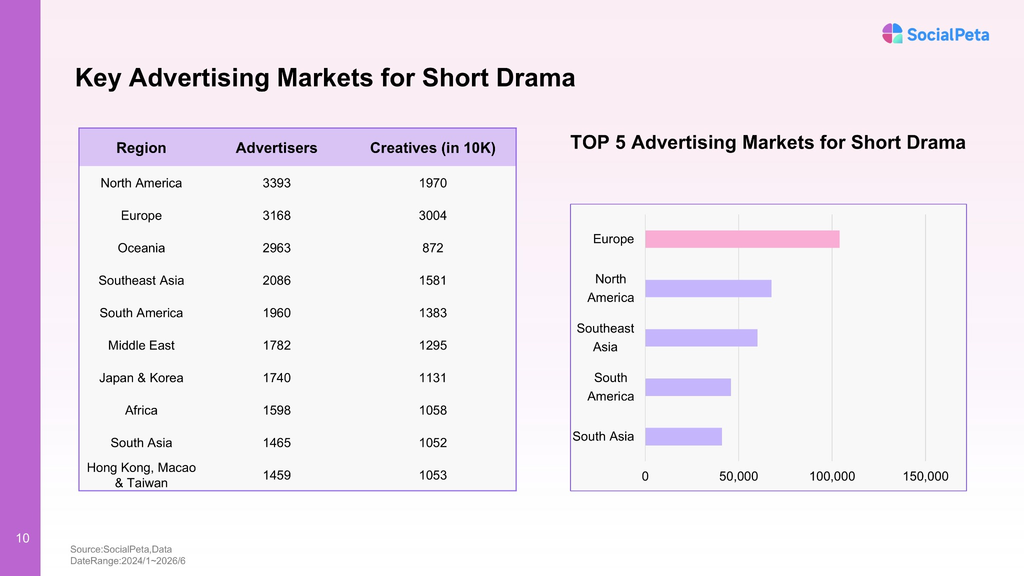
Europe and North America remain the two most important advertising regions for Short Drama:
- Europe: around 30.04 million creatives, making it the most active region by creative volume.
- North America: the largest advertiser base, with 3,393 advertisers and around 19.70 million creatives.
- Southeast Asia, South America, and the Middle East form the second tier. South America reached 13.83 million creatives, already surpassing the Middle East.
Channel concentration remains extremely high. Meta accounts for 95.55% of advertising activity, followed by TikTok at 2.30% and Google at 1.12%. Meta’s feed ecosystem remains the foundation of Short Drama user acquisition, while TikTok provides an important complement for reaching younger audiences and generating rapid bursts of traffic through short-form video.
Language data points to another important shift. English-language creatives reached 1.3 million — more than ranks 2–10 combined — making English-speaking markets the most competitive arena for creative iteration. Meanwhile, Spanish and Portuguese together account for 14.44% of creatives, with very similar volumes (162K vs. 155K). This suggests that Brazil and Spanish-speaking Latin America are attracting comparable advertising investment, and that Latin America is emerging as a well-established regional market and the second major growth engine for global Short Drama expansion.
Part 4: Competitive Landscape — Three Models, Three Paths to Scale
The report highlights three advertisers that illustrate very different approaches to growth:
HotDrama (Kunlun Tech) — a multi-market IAAP growth model. The US leads with a 23.09% share, while five European markets account for more than 71% combined. Mature Asian markets such as Japan and South Korea are also covered, reducing dependence on any single geography. Its content mix is built around comeback, romance, and revenge, with a strong female audience focus and a dual track of urban and fantasy themes.
Story TV — an efficiency-led single-market strategy. India accounts for 97.36% of its advertising footprint. By using predominantly English-language creatives in a market with strong English adoption among urban users, Story TV reduces localization costs while scaling through 421K creatives. Its genre mix is highly concentrated around urban stories (76.27%), comeback narratives (72.95%), and revenge (61.55%), reinforcing the same efficiency-first strategy.
MigoReels — differentiated growth through a cash-reward model. Vietnam leads with a 51.66% share, while the Philippines, Kenya, Brazil, and other emerging markets form the second tier. Developed Western markets account for less than 6%, creating clear differentiation from IAP-focused platforms. Its creatives rely heavily on real-person UGC to show tangible cash-out results, turning the abstract promise of “watch and earn” into a visible, credible experience.
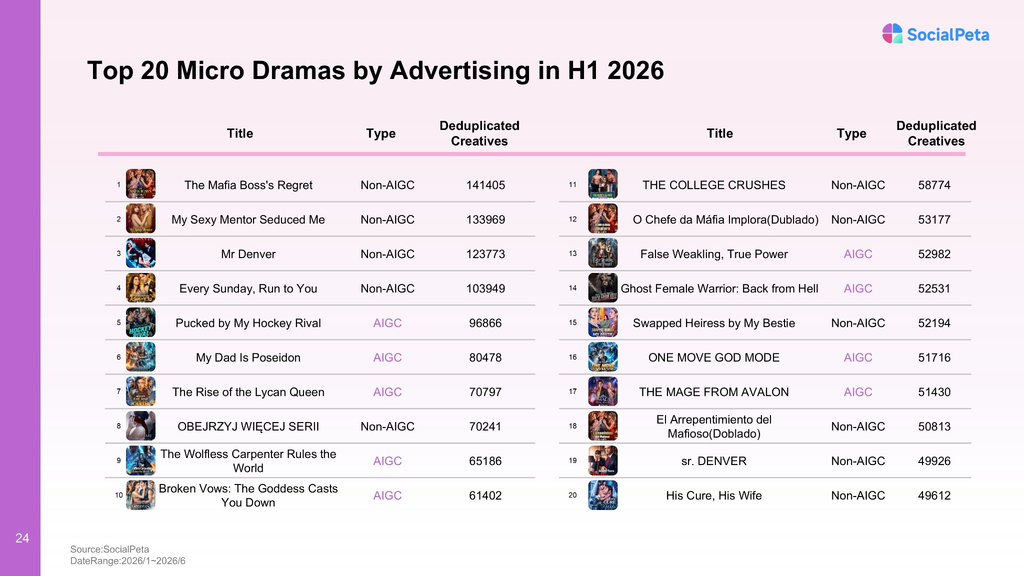
In the H1 2026 ranking, The Mafia Boss’s Regret ranked No. 1 with 141K creatives and an estimated 3.4 billion impressions. AIGC titles accounted for nearly half of the Top 20. The full report also includes frame-by-frame creative breakdowns of three major hit formulas: the chase-the-wife/replacement trope, strong-female warrior narratives, and underdog-to-power fantasy reversals.
Part 5: BidMatrix Insights — Why Low CPI Can Be Misleading
The final section draws on BidMatrix’s frontline campaign experience and addresses a common optimization trap for Short Drama advertisers:
A low CPI does not necessarily mean high user value. Short Drama campaigns can generate inexpensive installs, but many of those users may churn after the first episode. More meaningful indicators include first-episode completion, paywall reach, subscription behavior, and retention.
Several findings illustrate the gap between cheap installs and valuable users:
- Users who complete the first episode are 2.1× more likely to reach the paywall than other users, and their probability of returning on Day 7 is 38% higher.
- Across 37% of the analyzed country-source cohorts, the source with the lowest CPI did not deliver the lowest cost per Day 7 retained user.
- In a six-week Indonesia campaign, the optimization goal shifted from install volume to first-episode completion and Day 1 retention. CPI increased by 28%, but the cost of acquiring retained viewers fell by 21%.
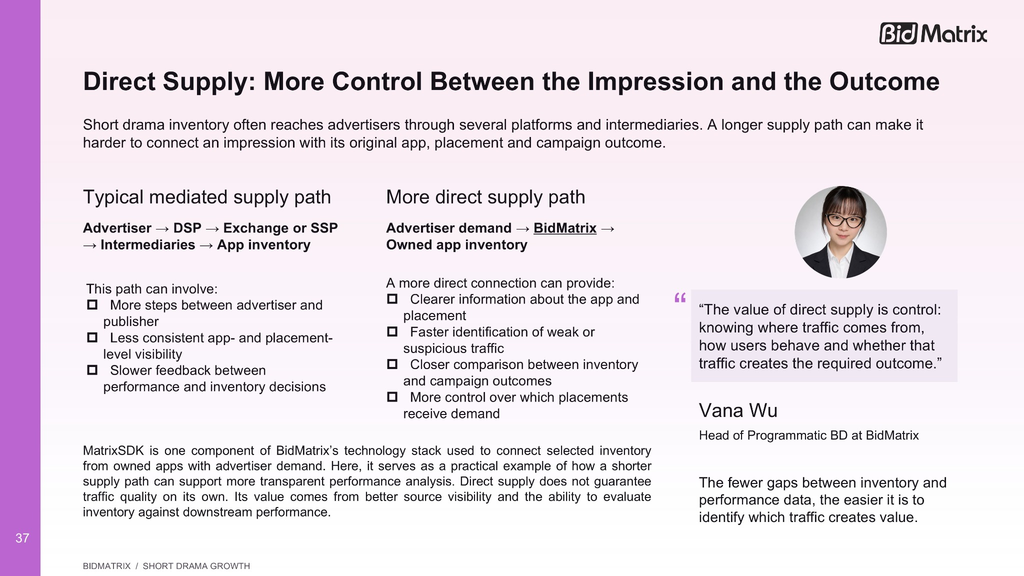
The takeaway is straightforward: Short Drama performance should be evaluated by the cost of acquiring engaged, retained users — not by install cost alone. The full report also introduces a five-step “quality-first” framework and explains how more direct supply paths can improve visibility between inventory and downstream outcomes.
Conclusion
Four themes stand out in the global Short Drama market in H1 2026: more advertisers are entering the category, AI-generated content is scaling rapidly, Latin America is emerging as a major regional market, and competition is intensifying across both creative production and user acquisition.
These findings represent only part of the full 2026 H1 Short Drama Advertising Trends & Growth Insights report. The complete report takes a deeper look at creative-volume trends from 2025 through H1 2026, the full Top 20 Short Drama ranking, detailed breakdowns of high-performing creatives, advertiser case studies across different market strategies, and BidMatrix’s practical framework for improving retention and traffic quality.
For teams working across Short Drama production, user acquisition, creative strategy, or monetization, the report offers a more complete view of how the market is evolving—and where the next growth opportunities may emerge.
Download the full report to explore the complete data, rankings, case studies, and growth insights.