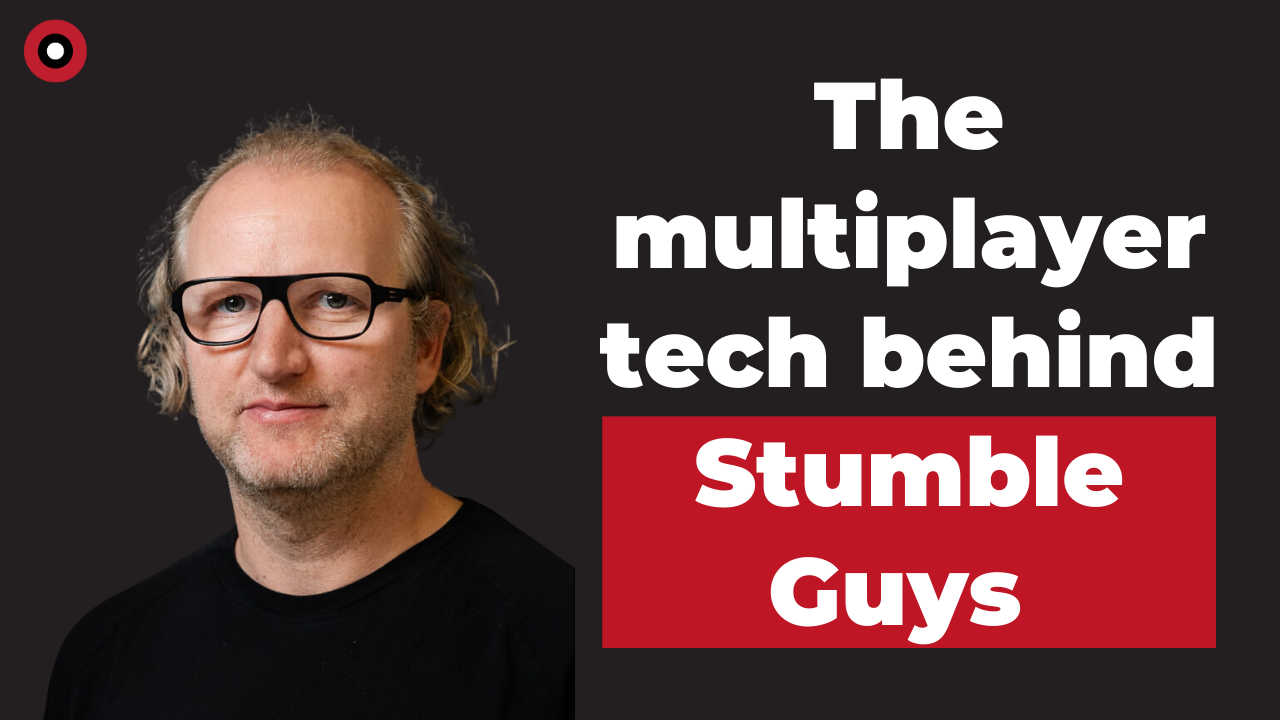

This article is a condensed written version of our full YouTube interview with Christof Wegman, Founder & CTO of Photon Engine.
Watch the full interview here:
In this conversation, we explore the evolution of multiplayer technology, the story behind Stumble Guys, and what the future holds for developers building connected games.
What Is Photon Engine?
For developers unfamiliar with multiplayer infrastructure, what exactly is Photon Engine?
“At Photon, we focus on technology and SDKs that enable multiplayer for game developers. Studios choose their engine — Unity, Unreal, or others — and we provide the networking layer that connects players worldwide.”
Photon’s core mission:
“We make multiplayer simple.”
For over two decades, the company has focused on reducing networking complexity so developers can build great gameplay experiences without reinventing infrastructure.

From Nokia Phones to Global Multiplayer
Photon’s story began in the early 2000s, when mobile phones had just 64KB of RAM.
“We saw the potential early. Phones were becoming connected devices. It felt natural that people would want to play together.”
Their first multiplayer prototype? Two cockroaches spitting at each other across Nokia phones.
From that experimental beginning, Photon evolved into infrastructure powering hundreds of multiplayer titles worldwide.
The Shift to Real-Time Multiplayer
In its early years, Photon built backend systems such as:
- Login systems
- High scores
- Turn-based multiplayer
- Payment integrations
The product worked, but the market wasn’t ready.
About 13 years ago, Photon pivoted to real-time multiplayer. This included:
- UDP-based low-latency communication
- Globally distributed data centers
- Seamless scaling through Photon Cloud
Fusion vs. Quantum — Choosing the Right Architecture
Photon doesn’t sell “features.” It starts with a question: “What kind of game are you building?”
Different multiplayer genres require different architectures.
Fusion is best suited for:
- Competitive shooters
- Fast-paced action games
- Dedicated server setups
Designed for experiences similar to modern competitive FPS titles.
Quantum is best suited for:
- Physics-heavy games
- Fighting games
- Party games like Stumble Guys
- Competitive mobile games
Quantum uses deterministic simulation, allowing developers to build multiplayer logic as if it were a local game, without manually handling complex netcode.
The Stumble Guys Story
One of Photon’s most notable success stories is Stumble Guys.
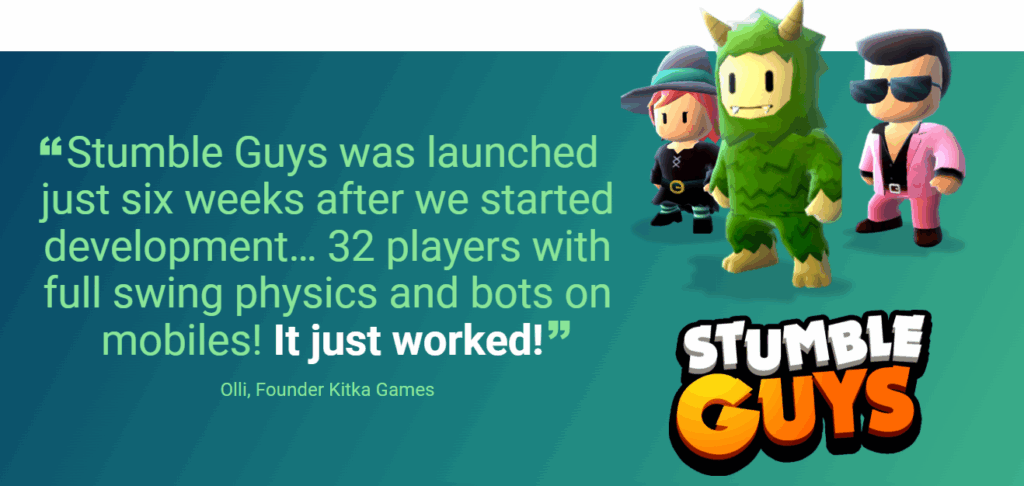
Inspired by the explosive popularity of Fall Guys, Photon created a technical demo showing that similar gameplay could run smoothly on mobile using Quantum.
A small Finnish studio partnered with them. Within weeks, they had a playable prototype.
The results were extraordinary:
- 55% Day 1 retention
- 2 million downloads per day at peak
- 1 million concurrent users
- Around 25 million daily active users
Eventually, the game was acquired by Scopely.
“In one year, Stumble Guys reached what Photon took ten years to build.”
What Makes Multiplayer Feel Good?
According to Christof:
“It has to feel seamless.”
Key factors include:
- Low latency
- High update frequency
- Smart synchronization
- Global data center coverage
Photon operates 21 data centers worldwide to minimize latency and provide stable performance across regions.
Photon Cloud & Scalability
Photon Cloud removes infrastructure complexity for developers.
Studios don’t have to:
- Manage servers
- Handle scaling
- Mitigate DDoS attacks
Photon manages everything behind the scenes.
Thoughts on Cloud Gaming & Web Games
Christof remains cautious about pure cloud-streamed gaming.
“I believe having games installed locally is still a big advantage.”
However, web gaming presents strong opportunities, especially as mobile markets become increasingly competitive and saturated.
The Future of Photon
Photon today:
- ~60 engineers
- Profitable and product-focused
- Expanding to Unreal, Godot, and web engines
- Continuously evolving Quantum and Fusion
With AI-assisted coding accelerating development speed, multiplayer may become even more accessible.
Final Thoughts
The games industry is entering a new phase:
- More founders
- Faster development via AI
- Increased competition
- Distribution becoming critical
Multiplayer is already dominant, and tools like Photon are making it more accessible than ever.

Founder & CTO at Photon Engine