

A few highlights from Appcharge’s latest report:
- $700M+ in transactions reveal how DTC monetization is reshaping mobile games – as the top 200 publishers are wasting $41m per day on app store fees
- App-to-web payments are bringing players off-platform, and web stores drive the greatest long-term value
- 56% of app-to-web Payment Link buyers are completely new to DTC, making it the strongest top-of-funnel entry point seen so far
- One in four of those players later convert into web-store buyers, with no cannibalisation of existing revenue
- 97% of web-store revenue now comes from repeat buyers, with AOVs 3× higher than app-to-web payments
It is estimated that the world’s top 200 mobile game publishers are collectively wasting approximately $41 million per day by continuing to route the majority of player spend through app store billing at 30% fees, rather than through DTC payment infrastructure charging closer to 5%¹.
Based on millions of checkout sessions across the US, Europe, and Asia – representing more than $700 million in annual transaction volume – the report shows how regulatory change, app-to-web payments, and maturing web-store design are fundamentally reshaping how players spend and how publishers capture value.
One of the clearest shifts is the emergence of app-to-web Payment Links as the strongest entry point into DTC. Appcharge data shows that 56% of players using Payment Links are completely new to DTC, with one in four later converting into web-store customers.
Crucially, the introduction of Payment Links does not cannibalize existing web-store revenue, instead driving incremental growth.
While Payment Links introduce players to DTC, the report shows that web stores are where publishers achieve the greatest long-term value. Across Appcharge-powered stores, 97% of revenue comes from repeat buyers, with average order values three times higher than app-to-web payments.
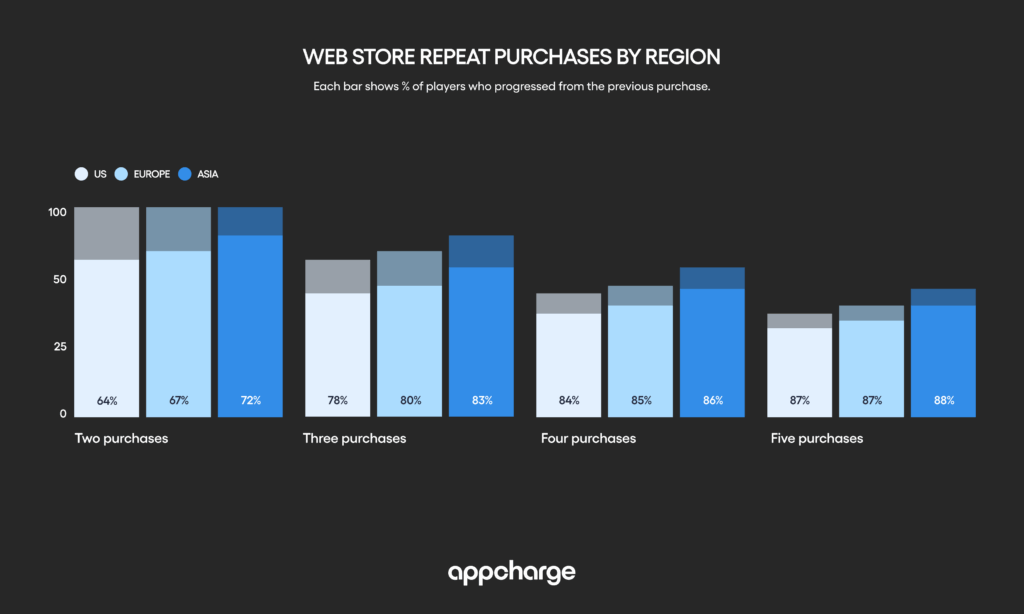
Once players make three web-store purchases, repeat rates exceed 84% globally, signalling a shift from occasional buying to habitual spending.
The data also shows that DTC behaviour in mobile games now mirrors LiveOps, not traditional e-commerce. High-performing web stores are designed and operated as live products, using mechanics such as progress bars, rolling offers, and daily bonuses to influence repeat behavior and materially lift ARPPU.

Additionally, the report highlights stark regional differences in payment behavior.
Seasonal campaigns in particular have become powerful revenue moments, with events such as Black Friday and Cyber Monday driving 50–60%+ spikes in web-store revenue in a single day.
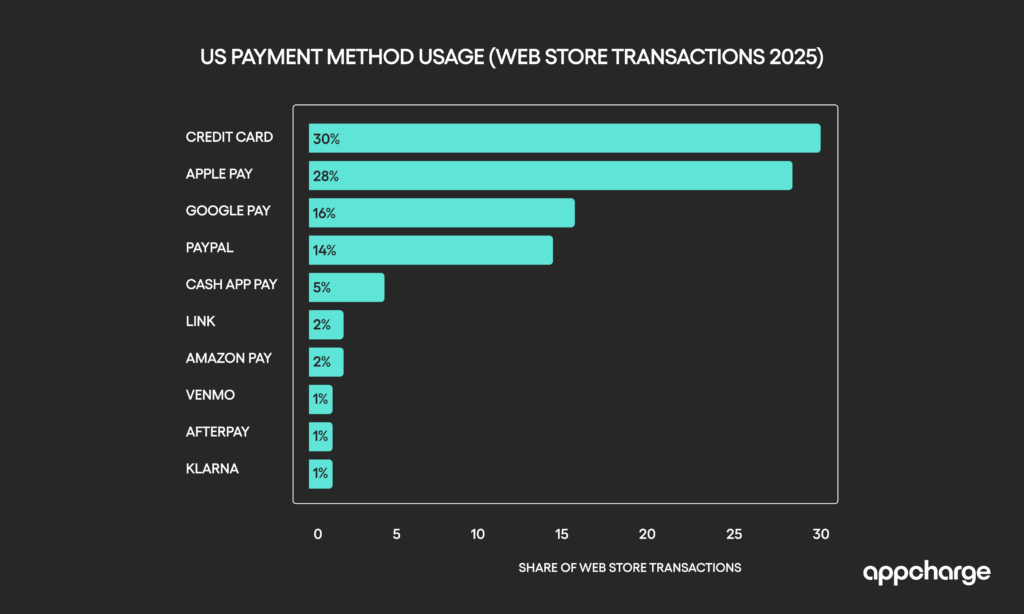
In the US, three payment methods account for roughly three-quarters of web-store revenue, allowing teams to optimize around a small core.
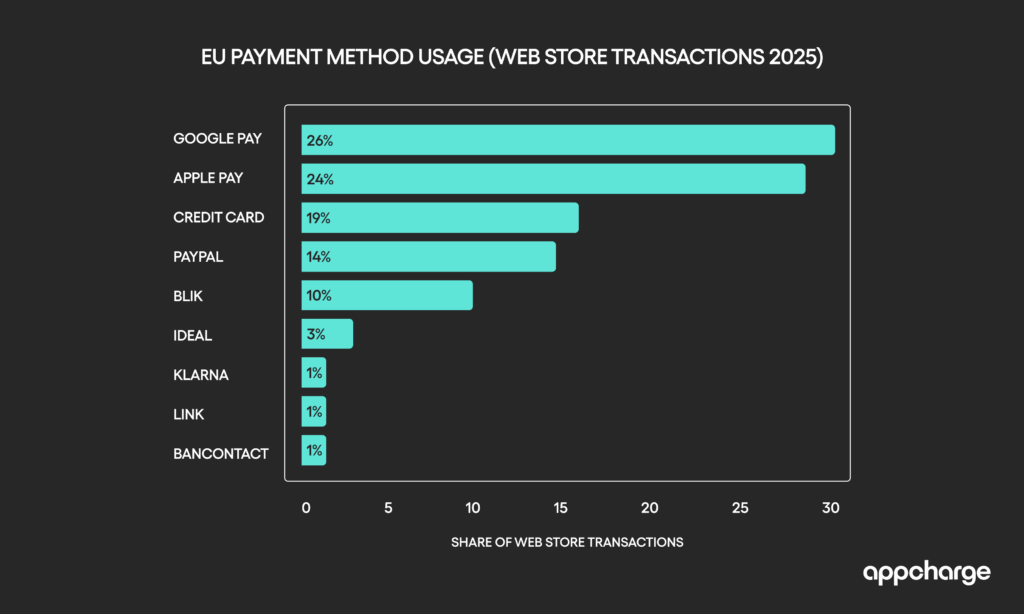
In Europe, by contrast, no single method exceeds 30% share, with local payment options acting as critical conversion gates in specific markets.
“Our data shows that 2025 was the inflection point where app-to-web payments, web stores, and alternative distribution moved from edge cases to scalable, repeatable revenue engines.”
“While Payment Links open the door, web stores build the house. The publishers winning in DTC are treating web stores like LiveOps products – continuously optimized, personalized, and deeply connected to player behavior.”
Maor Sason, CEO of Appcharge

Looking ahead to 2026, the report concludes that while app-to-web payments will continue to play a supporting role, the next phase of DTC growth will be driven by web stores run as long-term products, supported by owned distribution channels such as email, community platforms, and VIP programmes.
The full Appcharge report: “The DTC Inflection Point”, is available here.
Appcharge’s previous data report (July 2025) can be found here.
Read Next: Appcharge announces strategic expansion into Turkiye with new office and local team