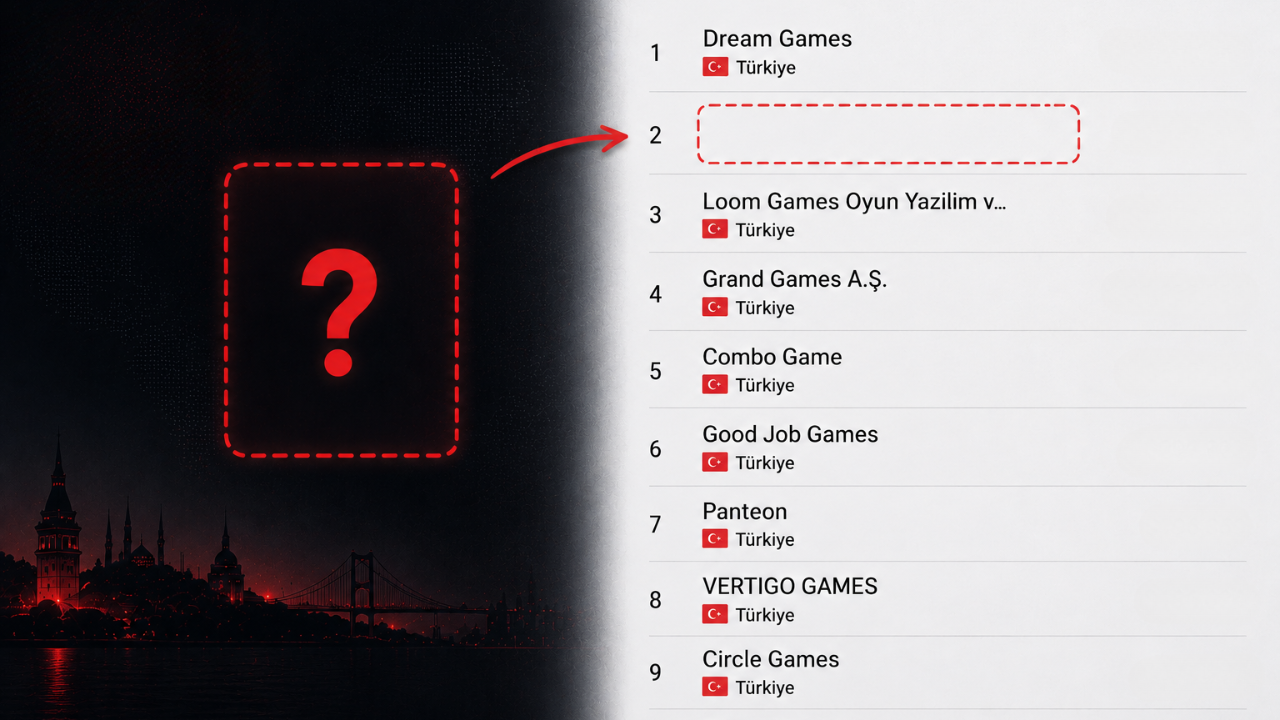

If you recently checked the Top Grossing Mobile Publisher charts in Türkiye, you may have noticed something unusual.
The rankings look very different than they did just a year ago.
At first glance, it might seem like new studios are suddenly dominating the market. But the reality appears to be more structural, and possibly tied to how data is now categorized on AppMagic.
Recently, I noticed that some of Türkiye’s biggest mobile gaming success stories, including Peak Games, Rollic Games, and even Zynga, no longer appear independently in AppMagic’s publisher rankings. Instead, they now seem to be grouped under Take-Two Interactive, following the broader consolidation of mobile assets after Take-Two’s acquisition of Zynga.
In AppMagic, the publisher is currently displayed as “Take-Two Interactive (Peak Games)”, headquartered in the United States, bringing together titles from across its portfolio under one roof.
If this categorization continues, it significantly reshapes how Türkiye’s top publisher charts appear.
Of course, in the grand scheme of things, it does not really matter what the charts show or how publishers are grouped. The games are still being built, operated, and scaled. However, because much of the industry still references AppMagic rankings to benchmark success and understand market dynamics, the shift creates an interesting new picture of Türkiye’s ecosystem.
Loom Games Climbs to Second Place
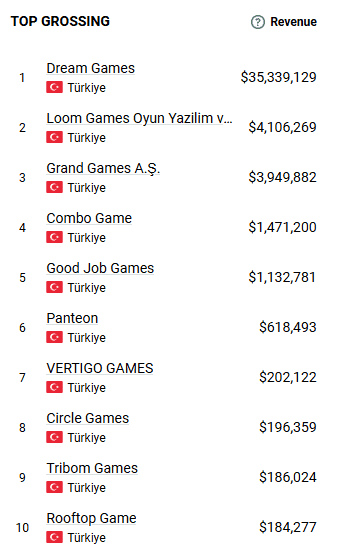
One of the biggest surprises is Loom Games, now sitting in second position with an estimated $89 million in revenue, according to AppMagic data.
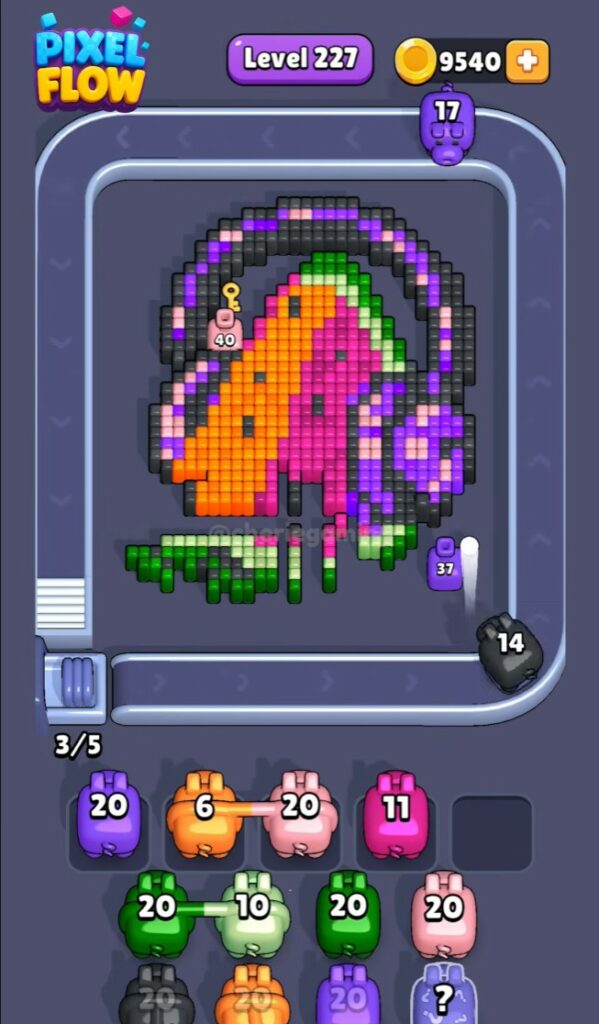
Much of this momentum comes from Pixel Flow, the breakout hit that recently led to the company’s acquisition by Scopely. Following the exit, the game has continued scaling aggressively, proving that the momentum behind the title was far from temporary.
Mobidictum previously covered the acquisition, highlighting how Loom Games transformed years of mobile expertise into one of Türkiye’s most impressive recent success stories.
What makes Loom’s rise particularly interesting is timing. In an industry where many believe mobile growth has slowed and finding a hit game feels increasingly difficult, Pixel Flow proved there is still room for breakout success.
Grand Games Continues to Scale
Sitting in third position is Grand Games, generating an estimated $56.7 million in revenue.
Grand is no longer an emerging story. Following its recent Series B round, the company has already established itself as one of the fastest-scaling gaming companies coming out of Türkiye.
What makes Grand particularly interesting is its portfolio strategy. Rather than relying on a single breakout title, the company has been methodically expanding its portfolio and experimenting with multiple products. The big question now is whether Grand will continue scaling its current catalog or introduce another major hit that strengthens its position even further.
With the pace they are moving, many in the ecosystem are already wondering whether Grand Games could become Türkiye’s fourth unicorn.

A Chart That Looks Emptier Than Before
There is also a broader implication here.
Türkiye’s gaming ecosystem has produced multiple successful exits over the years. Studios have been acquired, integrated into global holding structures, and increasingly managed under parent companies.
If acquired studios begin appearing under global parent entities, Türkiye’s publisher charts may start looking surprisingly empty, even though the country’s influence on mobile gaming remains stronger than ever.
In reality, the talent, IP, and operational expertise are still coming from Türkiye. They may simply no longer appear under local studio names.
Of course, in the bigger picture, it does not necessarily matter how the chart is displayed. The games are still being built, scaled, and monetized. However, since much of the industry still relies on AppMagic rankings to benchmark performance and understand market shifts, the change creates an interesting perception of Türkiye’s ecosystem.
Following our inquiry, the AppMagic team clarified that this change is part of a broader technical improvement:
“As a first step, we consolidated several logically related publishers under a single parent publisher. We’ll soon introduce the ability to view and analyze the individual publishers within each parent publisher directly on the platform.”
This means the ecosystem may soon regain some of its familiar visibility, allowing analysts and founders to look deeper into how individual studios are performing under larger holding companies like Take-Two Interactive.