
Every studio chasing engagement eventually runs into the same nagging doubt: when players interact with rewards inside your game, are those rewards actually keeping them around, or are you just watching the super-fans who were never going to leave anyway?
PlaySuper, an AI-led platform that connects game studios and brands to deliver real-world rewards inside games, set out to answer that on Cympl Studios’ time-management hit Masala Express. The resulting report is refreshingly free of inflated numbers and it shows what actually moved.
The results prove to be the interesting part. Players who engaged with PlaySuper opened the game 10% more often, played on 10% more days, and earned in-game coins 42% faster than a near-identical control group. Most importantly, the study found a Day 7 retention lift of 5.8 percentage points; a 12% relative jump on a 51% baseline.
The setup: a big game, a tiny footprint
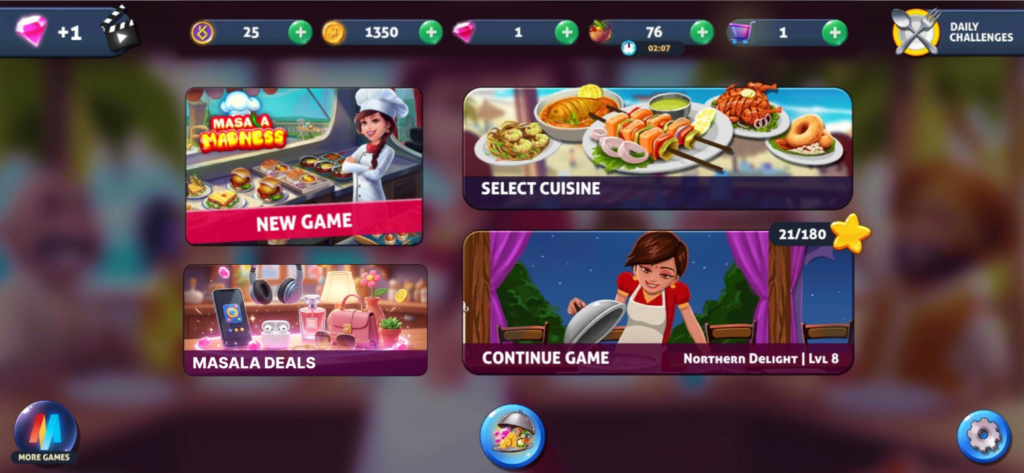
Masala Express is a fast-paced restaurant game with over 10 million downloads, a 4.2-star rating across 132,000 reviews, and 300+ levels of Indian culinary chaos. It runs at a steady 50,000+ daily active users (DAU) across Android and IOS systems around the world..
Cympl Studios switched on the PlaySuper integration in 2026, and tracked the next following days. Crucially, they didn’t provide every player with the integration setup. The rollout reached under 10% of daily actives, roughly 4,000 to 5,000 players, about 1.6% of total DAU. Of those, a small cohort of players actually engaged, and every figure in the study rests on that group, measured against an equal-sized control.
PlaySuper argues the tiny footprint is a feature as opposed to being a bug. It proves a clean retention lift at a certain scale and then expansion becomes a matter of opening the valve.
The “Behavioral Twins” method
Any rewards study is vulnerable to selection bias. Engaged players are the ones most likely to tap into anything new, so comparing them to random users makes the data look spectacular for the wrong reasons.
PlaySuper’s fix was a matched-cohort design built on “behavioral twins.” For each of the engaged players from the cohort, it found a twin in the non-engaged pool matched on discovery week and exact game opens in the first three days. An impressive 94% of pairs were identical on baseline activity.
The report is candid about how much that correction deflated the raw numbers:
| Metric | Raw, Unadjusted | Matched-Twin Reality |
| Game opens | +101% | +10% |
| Days active | +52% | +10% |
| Coins earned | +82% | +42% |
In other words, roughly two-thirds of the apparent “win” was just selection bias. Strip it out, and the remaining 5.8-point Day 7 lift is mathematically full-proof; its 95% confidence interval excludes zero, and it holds across single discovery waves, app versions, and tighter or looser definitions of engagement.
What the data actually shows
The corrected numbers tell a clear story: engaged players didn’t play longer single sessions, they actually came back on more days. They opened the app 4.51 times over the window versus 4.11 for their twins, and were active on 2.09 distinct days versus 1.89. Since every fresh return reopens the game’s monetization surfaces, pulling players back is exactly the kind of lift studios would want.
It wasn’t a novelty bump; the gap widened over time:
- Day 1: +1.6 pts
- Day 3: +3.9 pts
- Day 7: +5.8 pts ← peak impact
- Day 14: +4.9 pts
A short-lived curiosity spike would have collapsed within days, but this one compounded, and that was the mark of a genuine retention hook rather than a one-off.
Why it actually keeps players
So why does engaging with PlaySuper translate into more return visits? The study frames it as a returning-player tool rather than a first-time conversion play. Real-world rewards give players a concrete reason to reopen the app that lives outside the core loop, so there is always something new worth coming back for.
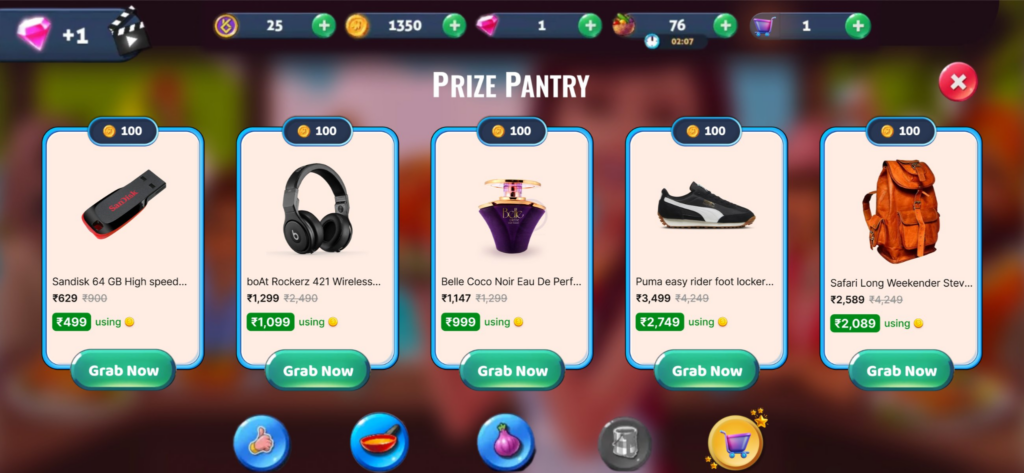
Since that reward layer rides alongside the game’s own progression rather than interrupting it, it reinforces the habit instead of competing with it. The operational key is freshness: surfacing new rewards on a regular cadence is what turns a one-time bump into the compounding, multi-day curve the data shows. Players return for the next reward, push through more levels to earn it, and the loop sustains itself, which is precisely why the gap keeps widening through Day 7 instead of fading after the first session.
The economic ripple
The biggest shifts happened inside the game’s economy. Engaged players earned coins 42% faster (21.9 per week versus 15.4), burned 82% more, and were 66% more likely to make any coin transaction at all rather than hoard. Since coins in Masala Express are earned by clearing levels and completing challenges, faster earning means deeper play.
PlaySuper flags coin velocity as a leading indicator of real-money spend. Players deep in the coin loop are the ones who hit the friction points like currency shortages, time-savers, and energy refills that in-app purchases are built to resolve.
When and where players engage
For studios weighing a similar move, two operational lessons stand out:
First impressions are everything – 55.9% of all eventual visitors engaged on Day 0, the very first day they opened the game; and 92.8% within three days. It can be said with certainty that if you miss a player in their first few sessions, you’ve likely missed them for good.
Not all in-game real estate is equal – Five surfaces drove 99% of all visits: first-time onboarding led with 35% (the primary gateway for 45% of users), the persistent home-screen widget delivered 27%, and the level-win screen drove 15% and is flagged as the biggest untapped opportunity. The level-lose screen managed just 1%; unsurprisingly, players who’ve just failed aren’t in a mood to engage.
The lift also landed where it counts. Sorting users into ten engagement tiers, visit rate climbed from 14% at the bottom to 44% at the top where the core players engaged at three times the rate of casual newcomers. A small group of eight confirmed buyers behaved like outright titans, with 10x the coin burn and 5x the coin earnings of the average player.
The conclusion on ARPDAU
It’s worth calling out that this retention story sits on top of the value PlaySuper already delivers through commerce. Beyond the ARPDAU uplift PlaySuper drives via its rewards commerce, Cympl Studios also saw a clear lift in player retention and engagement. The commerce layer adds revenue directly; the retention gains documented here are an additional return on the same integration.
The commercial thesis is quite simple: this lifts ARPDAU without touching your core game balance. More sessions mean more natural ad impressions at your existing eCPM. Higher coin velocity primes players for IAP triggers and because retention multiplies everything else, a 5.8-point Day 7 lift simply means more eyes on screen down the line.
Put directly in ARPDAU terms, the cleanest signal is the session gain. Since ad revenue scales with session count, the +10% lift in game opens among engaged players maps to roughly 10% more ad-impression revenue per player, before any in-app-purchase upside is counted, on the same DAU base and the same eCPM. PlaySuper’s position is that this is a floor instead of it being a ceiling: the +42% coin-velocity lift feeds IAP propensity on top, and retention compounds both.
The Realist’s Caveat
To its credit, the report doesn’t hide its limits. The sample was small (under 5,000 exposed users), and the buyer pool was just eight players. But the data integrity is tight: 27,234 of 27,242 coin transactions map cleanly to individual players.
In a market where acquisition costs keep climbing, keeping the players you already have is the ultimate growth lever. These numbers are small by design but they prove that the right rewards can keep your most valuable players cooking.
Read the full case study
The complete case study; including the full user-flow mechanics, retention insights and cohort methodology is available here: PlaySuper × CYMPL: Masala Express
For methodology breakdowns and partnership inquiries, reach the team at [email protected].