
For most mobile game studios, monetization typically comes down to two familiar levers: advertising and in-app purchases. But what happens when neither can be pushed further without impacting player experience?
According to a recent case study involving Teslatech’s CallBreak, a third monetization layer built around brand-funded rewards generated measurable revenue uplift without increasing ad load or changing the game’s IAP strategy.
CallBreak publisher Teslatech layered a brand-funded commerce infrastructure onto its application and lifted ARPDAU 52.5% inside the exposed cohort ; validated against a clean control. Here is how the model works, and what the numbers say.
If you run a casual mobile game, you know the monetization drill all too well. You have two classic levers to pull: annoying people with more ads, or squeezing the tiny fraction of users who actually buy in-app purchases (IAP).
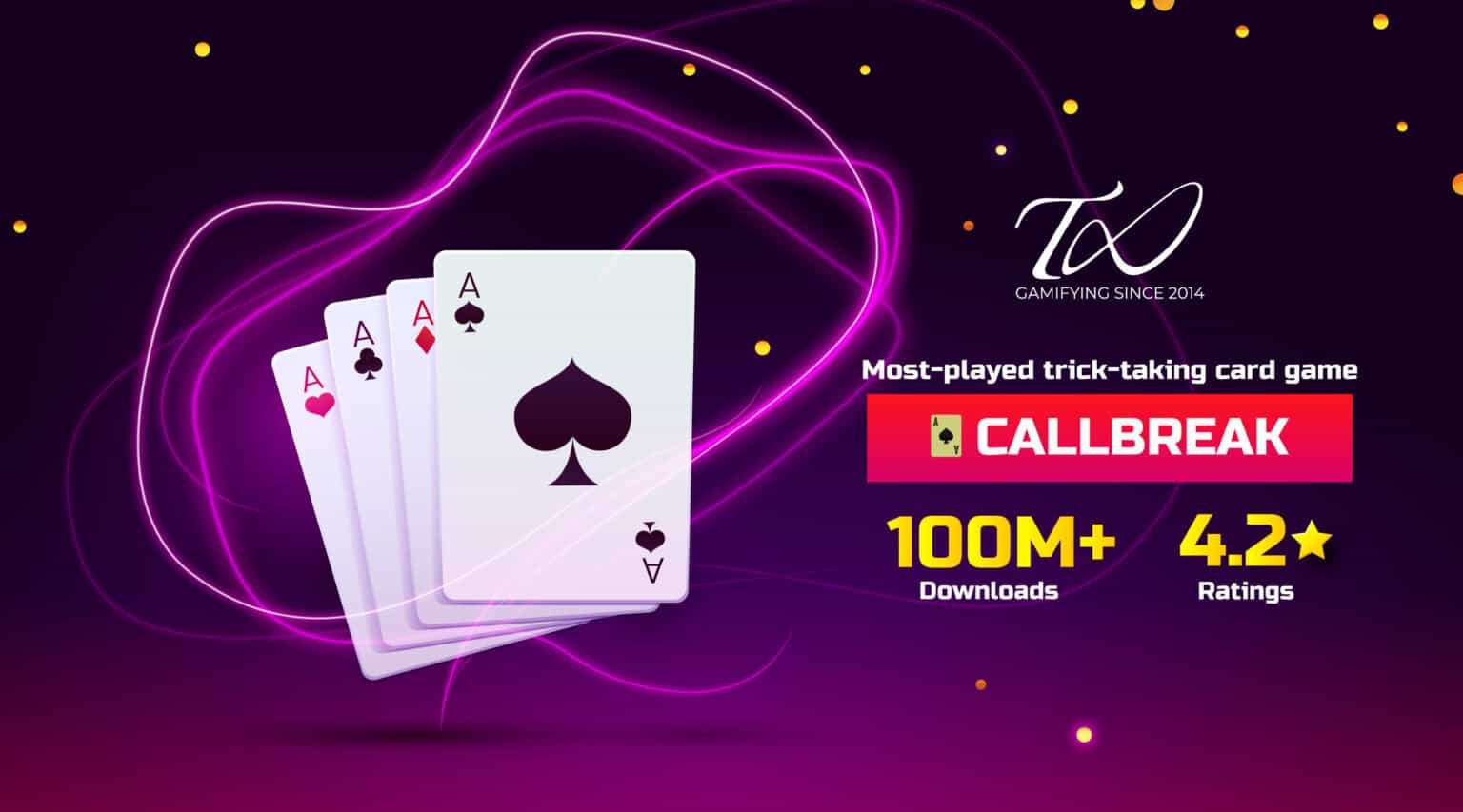
Teslatech’s hit multiplayer game, CallBreak, was no exception to the rule. With over 100 million Google Play downloads, 550,000+ reviews, a 4.3-star rating, and a massive community of 1.5 million daily active players (DAU) across South Asia and its diaspora, the math was predictable: around 5% of players opened their wallets for IAPs, while the remaining 95% simply kept the multiplayer lobbies alive and generated ad impressions.
However, a fresh case study from PlaySuper, which is a brand-funded commerce platform, reveals what happens when you introduce a third lever: real-world brand rewards baked right into the game lobby, paid for by corporate marketing budgets rather than traditional ad networks. By rolling this out to less than 10% of players, Teslatech unlocked a +5.2% ARPDAU uplift across their entire 1.5M+ DAU base, verified against a strict control group.
The results at a glance
| Metric | Result |
| ARPDAU uplift across full 1.5M+ DAU base | +5.2% |
| ARPDAU uplift on the 100K exposed cohort | +52.5% |
| CTR on PlaySuper tiles | 10–15% |
| Monthly brand GMV (current rollout) | $53K |
| Monthly recurring studio share | $5K+ |
| Projected at full rollout (conservative) | ~+13% ARPDAU, ~$17K/mo studio share, ~$180K/mo brand GMV |
No IAP changed. No ad load added. No new screens. The figures above are observed; everything beyond them is a conservative projection.
The challenge: a saturated ad stack and an unreachable majority
CallBreak’s display and rewarded placements were saturating player attention without converting at scale; click-through degrading over time, eCPMs were hovering at the lower end of the casual card game spectrum. Worse yet, 60% of the daily audience went offline before monetization could reach them at all, lost to save-data prompts and ad fatigue before a single impression served. Pushing harder on IAP or ad load risked alienating the free, social player base whose presence was the product itself.
Teslatech needed a revenue channel drawing on a separate pool of capital; one that didn’t compete with its existing surfaces.
The integration: two native tiles, no new attention demanded
PlaySuper delivers real-world coupons, gift cards, and physical goods as in-game reward units. Brands fund the inventory as a customer-acquisition channel; the publisher earns a share of every redemption. For CallBreak, the integration was deliberately narrow: two native tiles inside existing lobbies, sitting alongside the game-mode cards players already see.
- The “Hot Deals” Tile (Play Online Lobby): A dynamic space featuring real-time, contextual offers that shift automatically during major sales campaigns.
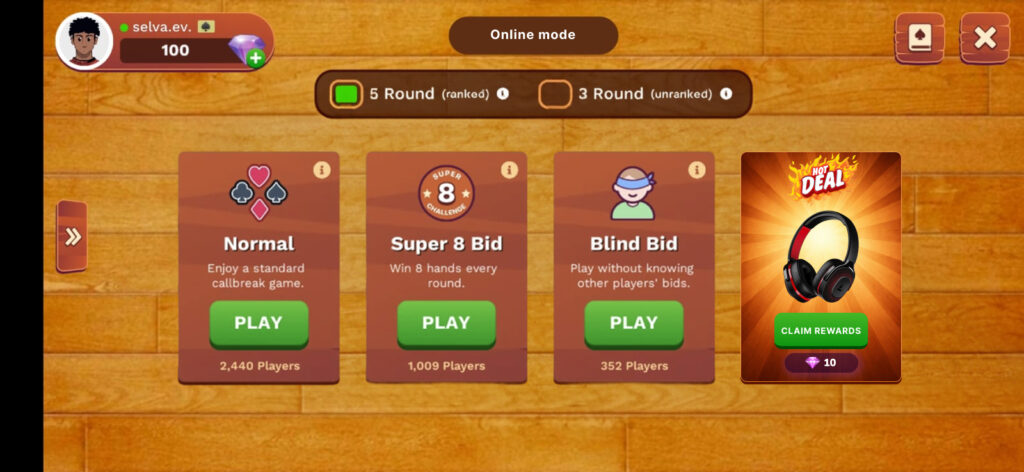
- The Static Tile (Offline Bots Lobby): Designed specifically to convert offline players into online ones. This single incentive successfully pulled 10% of offline players online, naturally boosting traditional ad-impression volume as a side benefit.
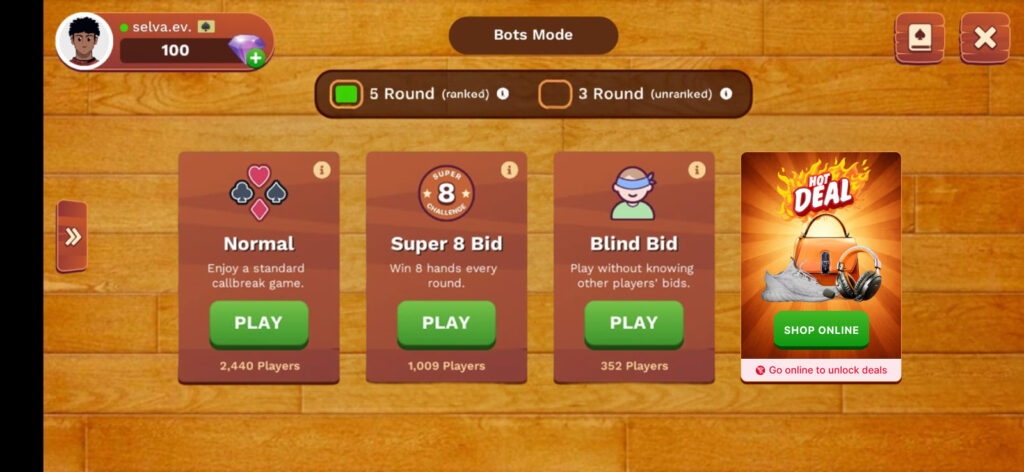
Players spend the in-game currency they already grind for as a discount on real-world rewards, then return to the game with fresh purpose ; a loop that reinforces retention rather than taxing it. PlaySuper acts as merchant of record with a single PCI-compliant payment gateway inside the SDK; the studio keeps full creative, frequency, and placement control.
The rollout was disciplined: a 100,000-player exposed cohort drawn from the 1.5M DAU base, with an equivalent control cohort held out. Teslatech’s engineers wired the SDK ; under 200KB, sub-50ms initialization, 99.95% production uptime ; into the title in a matter of hours, with no rebuild of core systems.
What the numbers show
On the exposed cohort, PlaySuper tiles drew a 10–15% click-through rate on the same lobby surface where display ads managed ~1% and rewarded ads ~4%. That click-through compounded into roughly $53K in monthly brand GMV and a recurring $5,000+ monthly studio share ; a +52.5% incremental ARPDAU uplift inside the cohort, validated against the control.
Spread across CallBreak’s full 1.5M+ DAU base, that contribution registers as the headline +5.2% ARPDAU uplift Teslatech sees on its P&L each month. Notably, the case study refuses to scale the cohort uplift linearly: full-rollout projections are deliberately conservative at ~+13% ARPDAU, ~$17K per month in studio share, and ~$180K per month in brand GMV ; which would still make it the largest single brand-funded contribution to Teslatech’s P&L.
“What surprised us most was seeing $5,000+ a month flow back when we’d only rolled PlaySuper out to under 10% of our daily audience. PlaySuper effectively gave us a new growth budget that wasn’t on our P&L before, with significant headroom remaining as we scale exposure to the rest of our audience.”
– Sujan Shakya, CEO, Teslatech
Why it worked
The case study points to six structural design choices that made the integration successful:
- Purchase Intelligence Over Impressions: Targeting players based on real-world buying intent rather than just blasting them with eyeballs-on-screen ads.
- 100% Native Placement: Seamlessly blending into the UI without demanding new screens or disrupting user flow.
- Untapped Capital: Pulling directly from brand-marketing budgets rather than fighting over programmatic ad-network spend.
- Physical-World Reward Density: Giving players high-value physical rewards that clear at far higher rates than arbitrary virtual currency.
- Linear Scaling: Predictable economics that grow smoothly alongside player exposure.
- The Redemption Loop: Driving higher returning-DAU and steadier session frequencies among the exposed cohort because players have a real-world reason to return
The key takeaway for casual game developers and publishers is: the 95% of players who never buy IAPs are far from a dead asset. Brand-marketing budgets can monetize your non-paying audience beautifully—without cannibalizing your existing ad setup or turning your game into an ad-filled nightmare.
Read the full case study
The complete 12-page case study ; including the full user-flow mechanics, money-flow breakdown, SDK SLA targets, and cohort methodology; is available here: PlaySuper × Teslatech: The CallBreak Case
PlaySuper works across mobile, console, and PC titles, and against any in-game currency a studio runs. Studios can estimate the upside for their own title at www.playsuper.ai or reach the team at [email protected].