
As AI coding assistants become part of everyday game development, separating genuine productivity gains from added complexity has become increasingly important. In this guest article, Olga Taranova, a Tech Lead with more than eight years of experience in the games industry, examines where AI coding tools deliver measurable value and where they can introduce hidden costs.
Drawing on industry research and practical development experience, she explores why indie game development provides one of the clearest environments for evaluating AI’s real impact on software production.
AI coding tools can accelerate parts of the development process, but faster output is not the same as usefulness. In a game project, generated code has to fit changing design goals, existing systems, limited review time, and the specific way a team builds the game. That makes indie development a useful crash test. It exposes not only whether AI can produce code, but whether that code is worth integrating, testing, and maintaining. When an AI assistant saves time, the benefit is immediate. When it shifts effort into review, correction, or maintenance, the cost becomes clear just as quickly.
This leads to a more precise question: which tasks give AI a measurable advantage, and which mainly move effort downstream? The real measure is whether the output is valuable enough to justify the cost of checking, integrating, and maintaining it.
Why Indie Development Exposes the Real Cost of AI
Indie development often makes the hidden context around game code more visible. Features may change through short feedback cycles, and design decisions are often shaped by conversations, playtests, and quick iteration rather than formal documentation. The reason a camera behaves a certain way, or why a combat system keeps an exception for pacing or animation timing, may be clear to the team but invisible to an AI assistant reading the code.
A study based on interviews with developers at 10 indie companies found that time and resource constraints limit the validation and playtesting these teams can conduct. That matters for AI-assisted development because generated code still has to be checked. If a tool saves time during implementation but requires extended review, testing, or correction, the productivity gain can disappear before the change is ready for production.
That is where the hidden cost of AI-generated code becomes visible. The code must fit the game, endure iteration, and remain understandable when revisited months later. If it only works at the moment it is generated, the initial speed gain becomes much less meaningful.
The industry’s current use of generative AI suggests similar caution. The 2026 GDC State of the Game Industry report, based on responses from more than 2,300 game industry professionals, found that 36% use generative AI tools in their work. Among those users, the most common applications were research and brainstorming, daily tasks, code assistance, prototyping, and testing or debugging. Only 5% reported using generative AI for player-facing features. At the same time, 52% of respondents said generative AI is having a negative impact on the game industry.
This does not mean developers are rejecting AI outright. Taken together, these figures suggest that developers are more willing to use AI when its output is easier to verify and more cautious when mistakes could become costly production issues.
The Difference Between a Benchmark and a Production Codebase
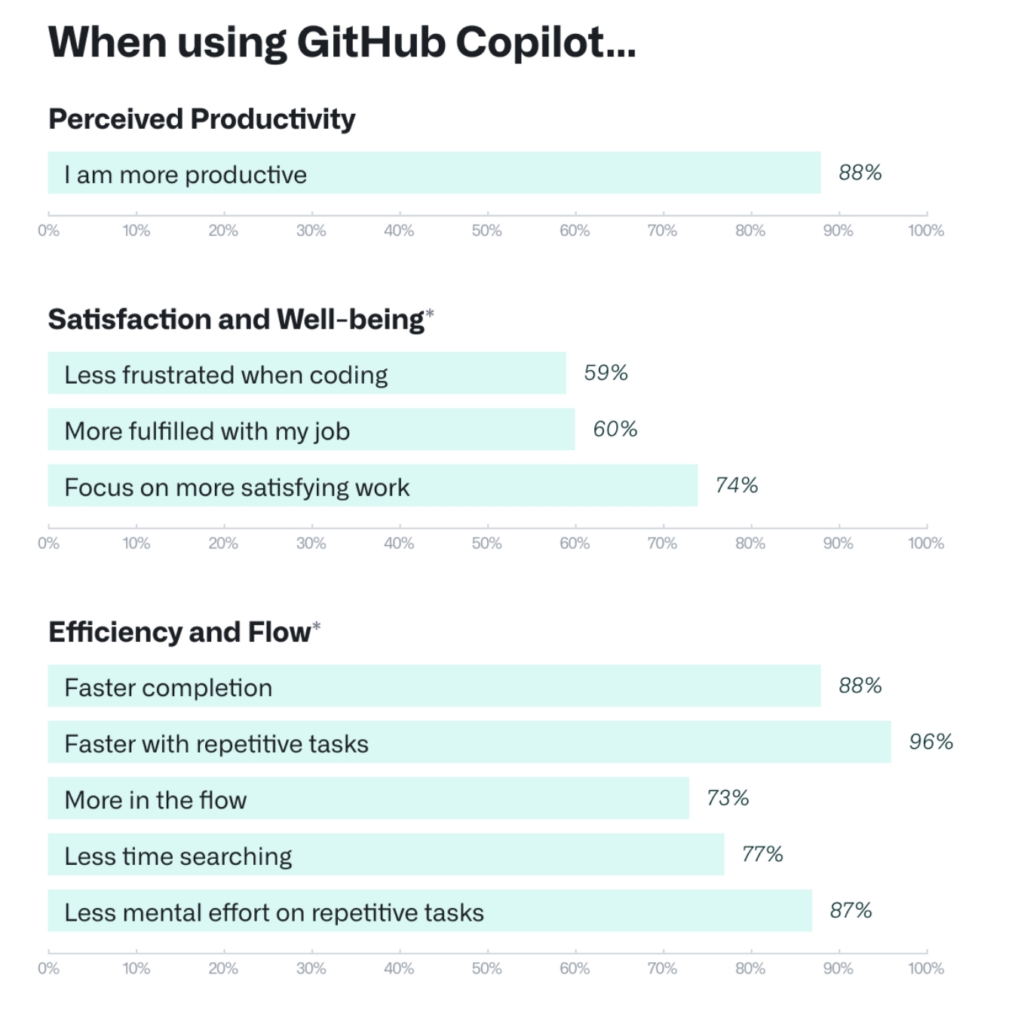
A widely discussed GitHub Copilot study found that developers completed a programming task about 55% faster with AI assistance. The speed gain was real, but so was the experimental setting: participants were asked to implement an HTTP server in JavaScript, with the same instructions and an automated test suite to evaluate correctness and completeness. This is close to an ideal setting for an AI coding assistant: the problem is well-defined, the technologies are documented, and correctness can be verified without knowledge of the broader project.
A later randomised controlled trial by METR tested AI in a very different setting. Sixteen developers worked on 246 issues across repositories, with an average of 5 years of prior experience. Before the experiment, they expected AI to reduce completion time by 24%. Even after finishing, they believed AI had made them approximately 20% faster. In reality, access to early-2025 AI tools increased completion time by 19%.
AI tends to perform better when tasks are isolated, and success criteria are explicit. Its advantage is less predictable when tasks are embedded in mature systems with local conventions, historical compromises, and requirements known only to the people working on them. Gameplay and production code often involve a great deal of the second kind of work.
Gameplay Code Is Also Design Knowledge
Gameplay systems do not exist only in source files. They also depend on assumptions that are not always written down: how a feature should feel, how it should fit existing systems, and which project-specific rules or engine behaviors it must account for. Two implementations may be equally valid to the compiler but produce very different player experiences.
An AI assistant can generate code that looks technically plausible in isolation. What it cannot automatically determine is whether that code aligns with the project-specific reasoning behind a feature. The problem is not only model capability. In many projects, essential context is not recorded in a form accessible to the model.
Current coding tools already try to address this context problem. Anthropic, for example, recommends adding CLAUDE.md files so teams can provide persistent project instructions such as coding standards, architecture decisions, preferred libraries, and review checklists. These files can improve an agent’s usefulness, but cannot fully capture evolving designs. They describe how a project is built, but not why certain behaviours matter or how design priorities have changed over time.
This resembles what recent software engineering research calls comprehension debt: a growing gap between the code a team has and the code it can confidently explain, modify, and maintain. Generated code may work at first, yet still become a liability if the team has not built a clear understanding of how it works. For small teams, the risk is sharper: every extra verification step competes with the same limited time needed for implementation, debugging, tools, and builds.
A study of AI-assisted open-source development points to a similar shift in verification work. After Copilot adoption, less-experienced contributors produced more code, but their contributions required additional revision. Experienced core developers reviewed 6.5% more code while their own original-code productivity fell by 19%.
Where AI Does Earn Its Keep
AI is most useful in game development when the task can be clearly described, and the result can be checked quickly. Prototyping is one example: AI can help produce a rough version of a mechanic, tool, or workflow quickly enough to test whether the idea is worth continuing. The result does not have to be final; its value is in shortening the path to a first working version.
Testing is another case. AI can help draft unit tests, suggest edge cases, or generate test scaffolding around behaviour that has already been defined. It does not decide what the game should do, but it can reduce the time required to express expected behaviour in code.
Tooling often fits the same logic because the work is narrower than core gameplay logic and easier to verify. It has concrete inputs and outputs: files, schemas, assets, logs, build artefacts, or automated validation results.
These cases work for slightly different reasons. A prototype can be useful even if it is later thrown away, because its purpose is to test an idea quickly. A test is useful when the expected behaviour is already known. A tool or script is useful when inputs, outputs, and failure cases are concrete enough to check. The shared advantage is that the team can usually decide quickly whether to keep, revise, or discard the result, before taking on a longer-term maintenance burden.
Three Questions to Ask Before Using AI on a Task
Before assigning a task to an AI assistant, teams can start with three questions.
Is the task clearly described and bounded? → It should be clear what the AI needs to change, what it should leave alone, and what a successful result looks like.
Is the context around the task likely to stay stable? → If the data format, engine integration, or design assumptions are still changing, much of the generated implementation may become obsolete.
Can the result be checked quickly? → There should be a practical way to catch the most meaningful errors, such as a test, compiler check, linter, or another clear way to verify the result.
If all three answers are yes, AI-assisted implementation is more likely to be worthwhile. If any answer is no, the team should assess the likely costs of review, rework, and knowledge transfer before assuming AI will save time.
What This Means in Practice
In practice, AI coding tools are still more reliable as workflow assistants than as autonomous parts of a production pipeline. They are most useful when a person or team can keep ownership of the task: define the goal, judge the output, integrate the result, and decide whether it is worth keeping.
Autonomous use is harder. A tool that changes production code without close supervision needs more than the ability to generate plausible output. It needs access to the right project context, a reliable way to validate its changes, and enough trust from the team to let those changes move further through the pipeline. In game development, especially in small teams, those conditions apply to some tasks but not to others. Some work is easy to isolate and verify; other work depends on design expectations, engine behaviour, team conventions, or assumptions that were never written down.
This does not make AI a failed promise or a temporary novelty. It means the practice is still being shaped. Indie teams are likely to keep experimenting because the potential value is too large to ignore: less repetitive work, faster prototypes, more efficient tooling, and more support for teams with limited time. The useful question is not whether AI belongs in development at all, but where it can create measurable gains without adding risks the team cannot afford.

Online Client Engineer | Unreal Engine Developer | C++ Software Developer