
SocialPeta, Playio, and Funtap Games have released the 2026 Global Mobile Game & AI Marketing Insights, examining the biggest changes in mobile game advertising during the first half of the year.
The report combines SocialPeta’s global advertising intelligence, Playio’s first-party player behavior data, and Funtap Games’ publishing experience. Its central finding is that AI delivers the most value when creative production, user acquisition, and post-install behavior operate as one continuous learning system.
Global Mobile Game Advertising Continues to Expand
According to SocialPeta, global mobile games averaged 109,500 active advertisers per month in H1 2026, up 31.1% year over year and 10.7% quarter over quarter. Approximately 13,500 new advertisers entered the market each month.
New-advertiser growth was concentrated in Q1. During Q2, the focus shifted toward existing advertisers increasing investment and accelerating creative output.
The report highlights several key trends:
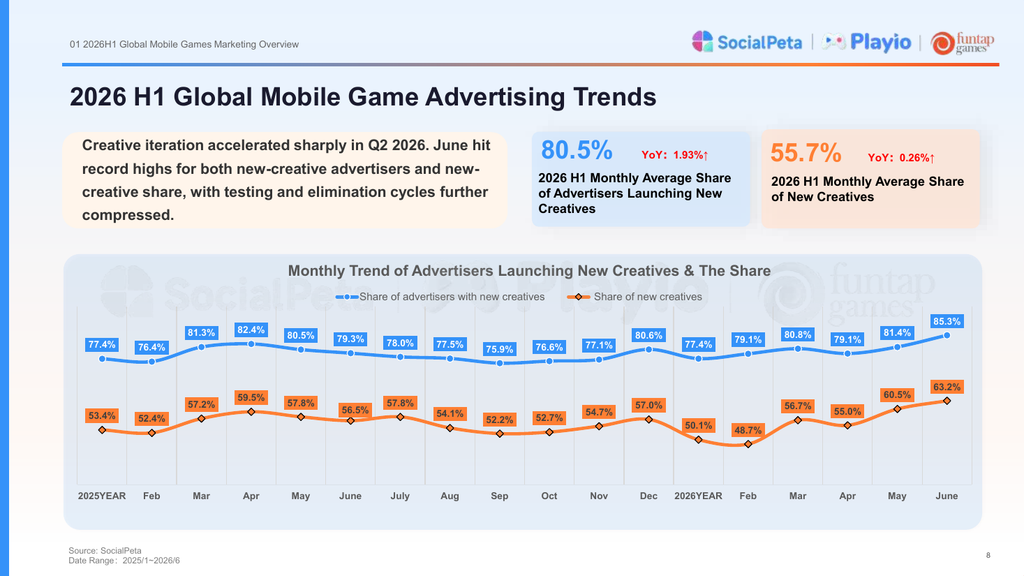
- An average of 80.5% of advertisers launched new creatives each month.
- New creatives represented 55.7% of monthly creative volume.
- Both figures reached an 18-month high in June.
- Europe had the largest advertiser base, with 60,400 advertisers per month.
- North America recorded the highest creative intensity, averaging 112 monthly creatives per advertiser.
Competition also varied by genre. Casino and casual games relied on advertiser scale, while tabletop and strategy titles competed through heavier creative investment. Tabletop games averaged 370 creatives per title and strategy games averaged 305.
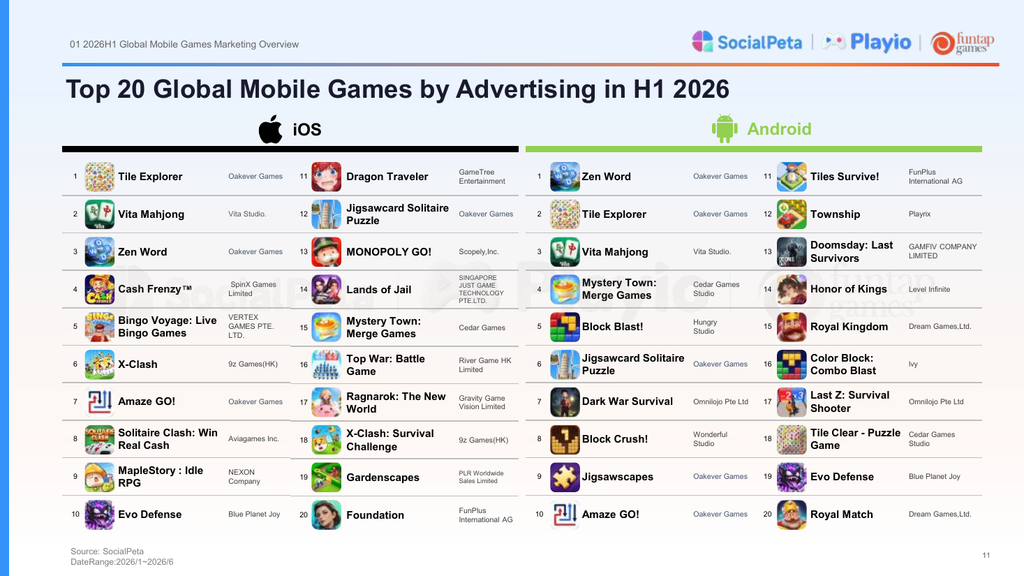
Oakever Games titles including Tile Explorer, Vita Mahjong, and Zen Word appeared among the leading advertisers across iOS and Android. Block Blast!, MONOPOLY GO!, and Dark War: Survival also maintained strong positions in the H1 rankings.
AI Adoption Has Not Automatically Produced Growth
AI is already widely used in mobile game creative workflows, but its business impact remains uneven. Industry research compiled in the report indicates that 49% of projects have applied AI to creative production, while only 30% have observed ROI growth.
The 19-percentage-point difference represents what the report calls the AI maturity gap. Generative tools have made it easier to produce scripts, images, videos, voiceovers, and localized assets, but higher output alone does not guarantee better campaign performance.
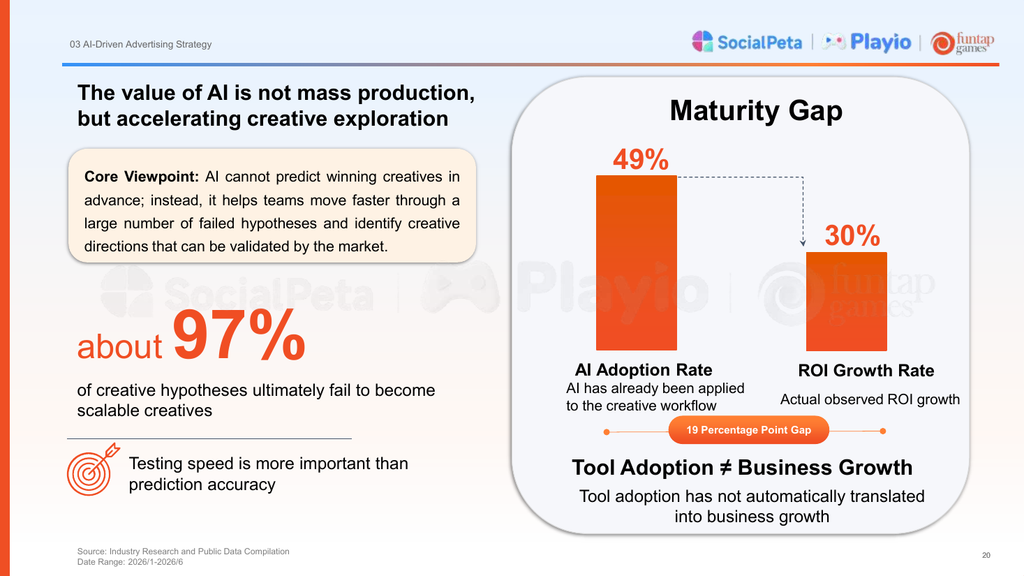
Funtap Games estimates that approximately 97% of creative hypotheses fail to become scalable winners. Its position is that AI cannot reliably predict a winning creative in advance. Instead, AI helps teams test more ideas, move through unsuccessful hypotheses faster, and identify directions validated by the market.
Funtap Games applies this approach through a four-stage loop: market insight and creative hypotheses, prompting and rapid conceptualization, execution and creative variations, and data analysis and scaling.
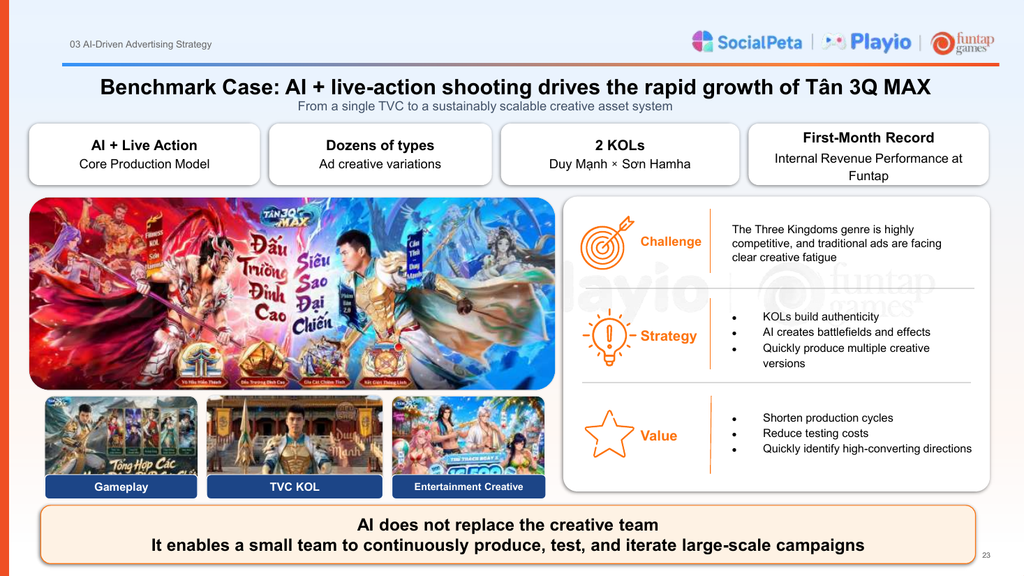
The method has been adapted to different products. Tân 3Q MAX combined AI effects and virtual battlefields with live-action appearances by Vietnamese KOLs Duy Mạnh and Sơn Hamha. The campaign supported dozens of variations and contributed to a first-month internal revenue record for the title.
For Infinity Kingdom, an AI cinematic trailer turned a hero announcement into a larger brand event. Dark War: Survival used fully AI-generated CG to communicate complex survival and SLG mechanics more intuitively.
The publisher’s conclusion is that AI does not replace creative teams. It allows smaller teams to produce, test, and iterate campaigns at greater scale.
PlayioTurns Rewarded Gameplay Into Behavioral Intelligence
Creative performance explains how a game earns attention, but the install itself reveals little about long-term player quality.
Playio uses a rewarded gameplay ecosystem to observe what happens after acquisition, including playtime, retention, level progress, engagement, and cross-genre preferences. These first-party behavioral signals help advertisers evaluate whether users are likely to keep playing and generate sustainable value.
Playio’s Q1 2026 internal data for Korean Android users and campaign games recorded:
- 86 minutes of average daily playtime.
- More than 60 minutes of daily playtime across every measured genre.
- More than 90 minutes for RPG, strategy, and racing games.
- An average of 3.6 games played per user per day.
- 66.7% of users exploring genres beyond their primary preference.
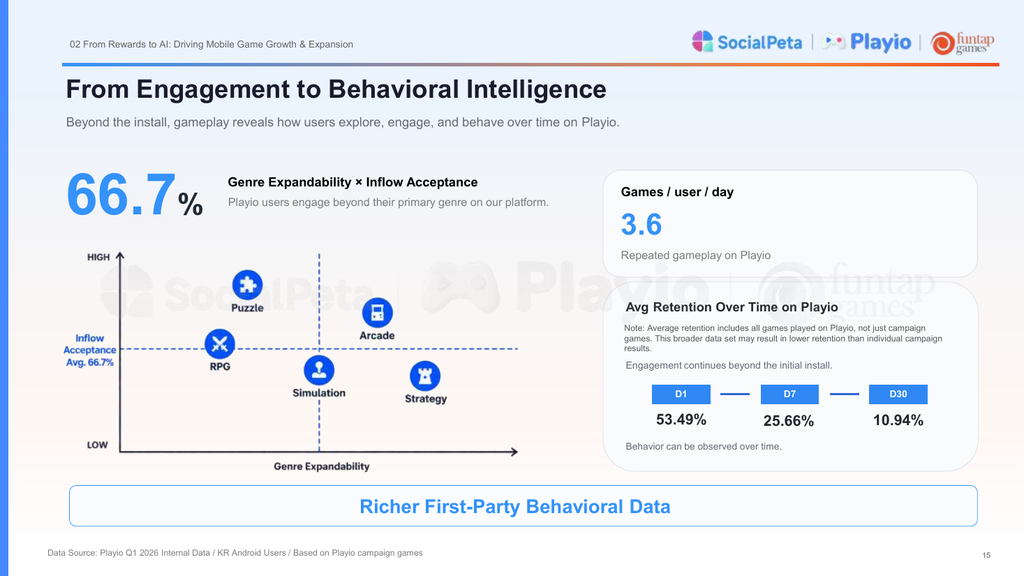
Playio’s STORM engine – Smart Targeting & Operations for Retention Monetization – applies AI to this behavioral data. It maps 90-day gameplay sequences and uses visual and linguistic embeddings to understand how users respond to game icons and descriptions.
Rather than relying only on static demographics or isolated post-install events, STORM aims to identify player intent, engagement patterns, and long-term value potential.
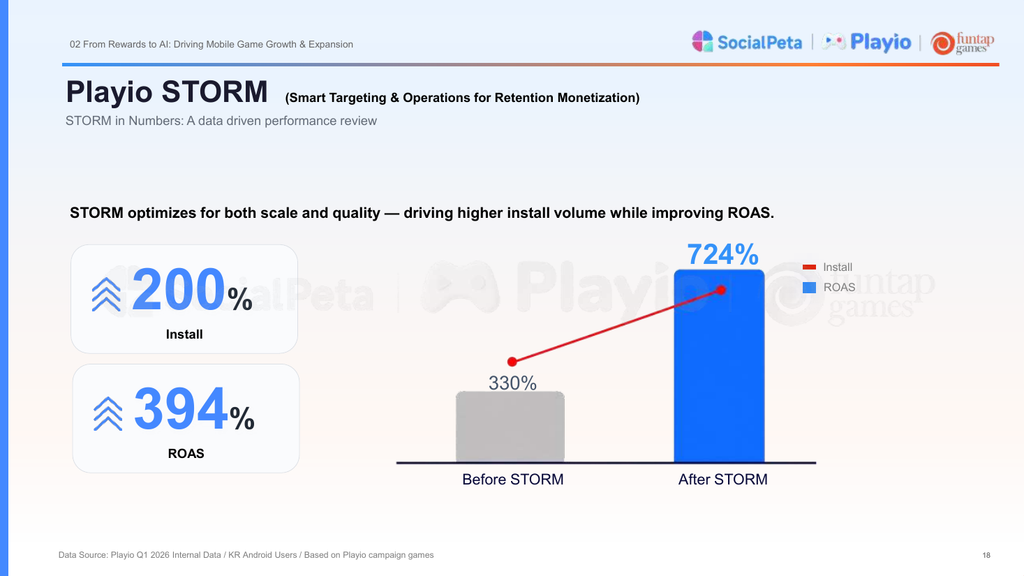
In the campaign example included in the report, applying STORM increased daily install volume by 200%, while ROAS rose from 330% to 724% – an increase of 394 percentage points. The figures are based on Playio’s internal dashboard and represent a campaign example rather than a universal benchmark.
AI Hooks Become a Standard Part of Creative Structure
SocialPeta’s advertiser analysis shows that leading games are increasingly using AI as an attention layer before transitioning to real gameplay.
Last Asylum: Plague
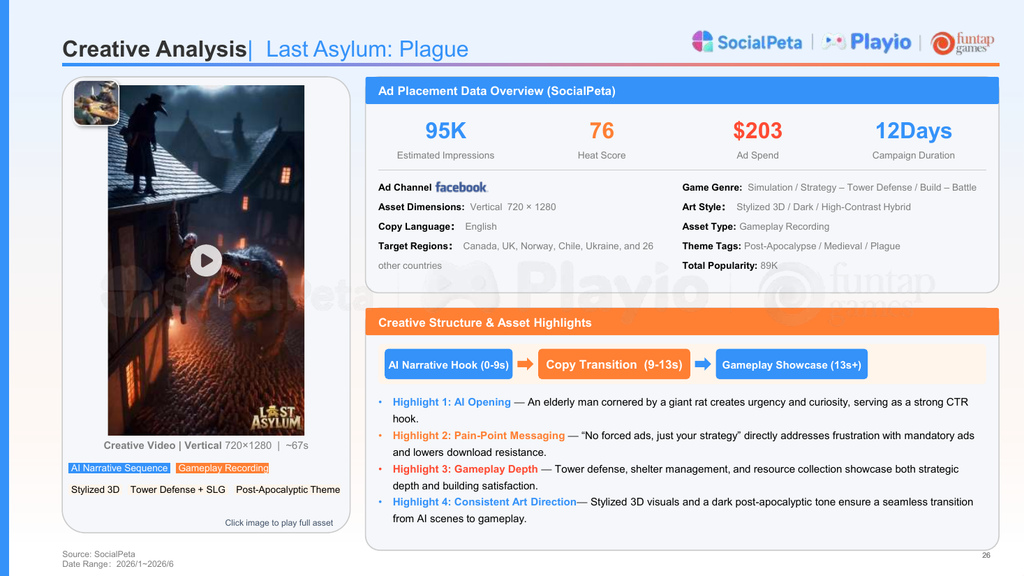
A high-performing creative opened with an AI-generated cinematic sequence featuring an elderly man cornered by a giant rat. It then moved into messaging and footage of tower defense, shelter management, and resource collection. The asset generated an estimated 95,000 impressions over 12 days.
The Cozy Florist
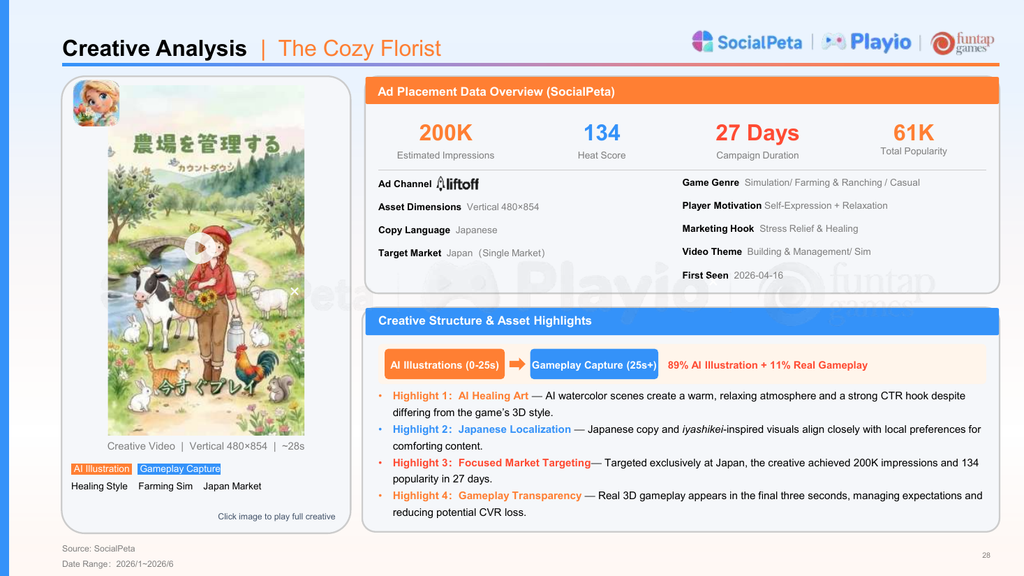
A Japan-only creative used warm, watercolor-style AI illustrations for approximately 25 seconds before revealing the game’s 3D gameplay in the final three seconds. It generated an estimated 200,000 impressions and a SocialPeta popularity score of 134 over 27 days.
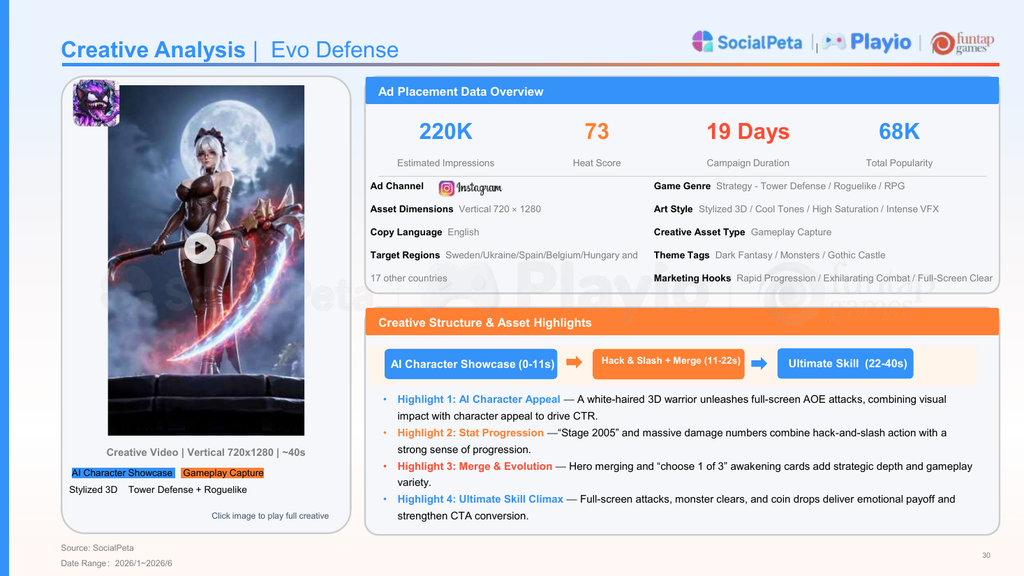
Evo Defense
An AI-generated 3D warrior and full-screen attacks created the opening hook before the creative shifted into progression, hero merging, and combat footage. The asset generated an estimated 220,000 impressions over 19 days.
Across all three examples, AI attracts attention while gameplay footage explains the product and manages player expectations.
Mobile Game Marketing Moves Toward a Connected AI Workflow
The report identifies batch generation, cross-style art adaptation, intelligent localization, and dynamic or interactive content as four major applications of AI in mobile game advertising. It also highlights five challenges: copyright and compliance, creative homogenization, inconsistent art quality, character authenticity, and platform review risks.
Over the next one to two years, AI creative workflows are expected to evolve toward a connected process covering insight, generation, testing, optimization, and attribution. AI may not remove uncertainty from mobile game marketing, but it is giving teams a faster and more structured way to learn from it. Download the full 2026 Global Mobile Game & AI Marketing Insights to gain more insights.