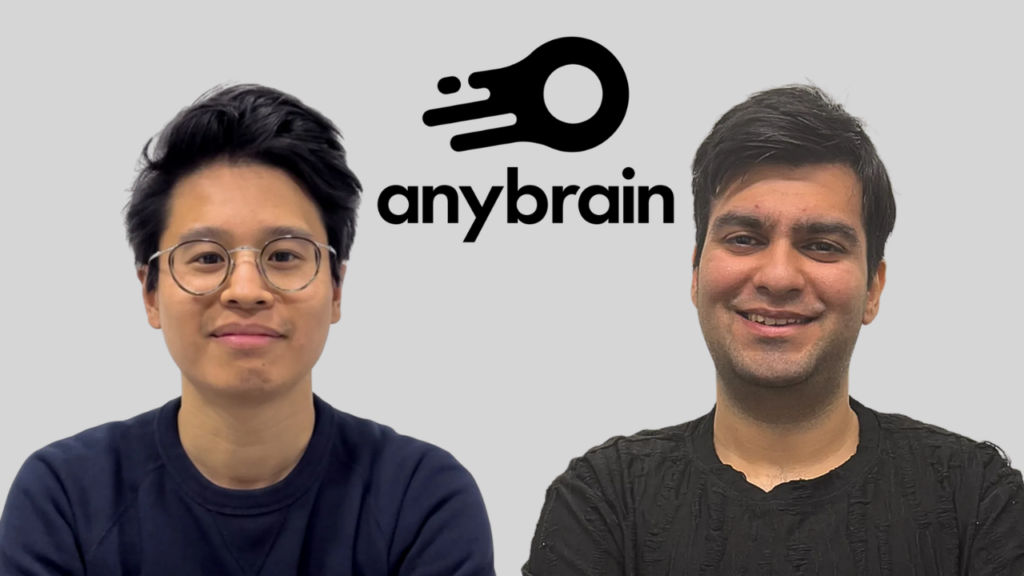

As cheating tools become more sophisticated, game studios are rethinking how they protect competitive integrity.
We spoke with André Pimenta Ribeiro, CEO & Co-Founder of Anybrain, about how behavioral biometrics and AI-powered profiling can detect cheaters in the cloud, complement existing anti-cheat stacks, and future-proof online multiplayer games against evolving threats.
Can you provide a brief rundown on how Anybrain works, from how it detects cheaters to when the ban is delivered to the player?
Anybrain is a cloud-based anti-cheat solution that enables games studios to identify abnormal player behaviour with the use of AI. It highlights how those players operate all the way down to minute detail.
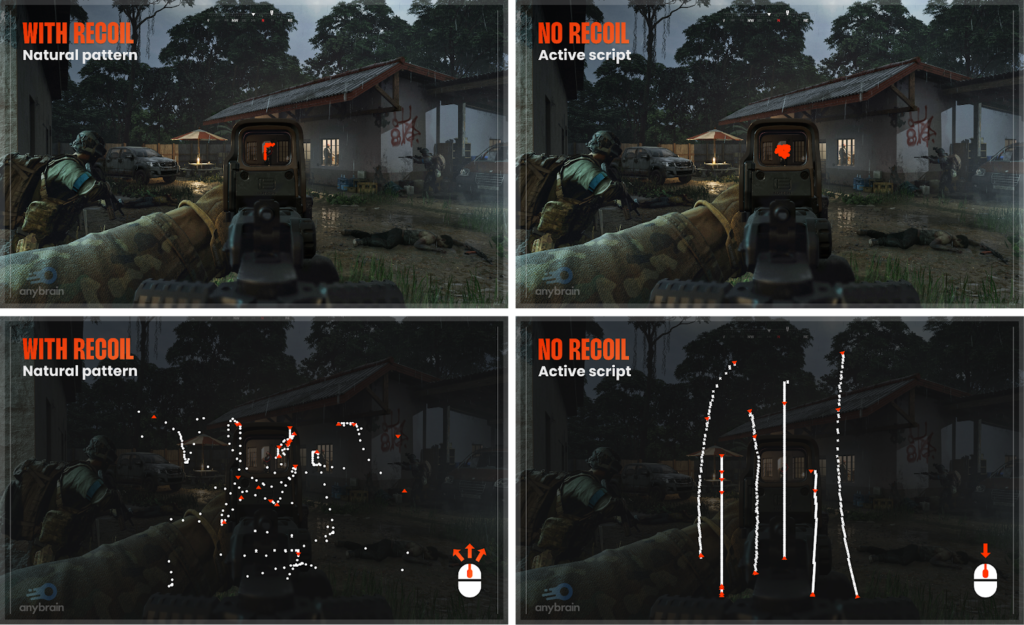
Our anti-cheat is based on player behavior analysis. We have developed our platform with a Human Computer Interaction (HCI) approach based on machine learning algorithms capable of learning from the game and player, understanding gameplay, and detecting fraud by interpreting abnormal behaviors.
It then tests this against known cheating profiles to determine if a player is a cheater, and if so it will inform the developer, so they can take appropriate action to ban the player.

How does Anybrain distinguish between a high-skill professional player and an AI-assisted cheater?
Anybrain compares player actions against the actions of known cheaters. It provides developers with clear resources to inform them about the difference between the actions of real players and AI to make that distinction even clearer. And in the case of unknown cheats, the Anybrain algorithm learns what is humanly possible within the game and is able to determine if the action performed by the cheater is legitimate or not.
In the speedrunning community, there is a category called Tool Assisted Speedruns (TAS), where runners use software to go frame by frame in a game in order to get frame-perfect inputs.
By doing this, it allows the speedrunner to pull off inhuman actions in games, like pressing a button every single frame. Technically, it’s not impossible for a human to perform some of the inputs in the same way a TAS bot could, but to do it consistently or at the same speed as TAS is impossible.
A player whose every hit is a headshot and turning at speeds beyond normal human reaction times, and doing so consistently game after game, is certainly going to have some kind of tool assisting them with their actions.
Can you explain the founding story of Anybrain?
We created the first iteration of Anybrain 10 years ago during my PhD. My research involved exploring technology through AI and human-computer interaction to detect mental fatigue. The initial product was called “Performetric,” a mental fatigue management system, which was initially used within contact centers and consulting firms.
After finding success in this market, we looked for a new opportunity to apply our learnings and pivoted to the games industry.
So we pivoted to gaming, applying the same mental fatigue detection tech to professional esports teams. In 2020, following funding from Trust eSport, Anybrain stopped the Performetric project, and we focused on becoming a solution to help the gaming industry with cheating and identity fraud to ensure fair play.
Source: Anybrain
Do you think kernel-level anti-cheat still has a place, with the advent of AI-driven anti-cheat solutions?
It is a current problem that cheaters are learning to get around current kernel anti-cheat solutions. Unlike Anybrain, which focuses on behavioural profiling from the cloud, kernel-based anti-cheat has built-in parameters to detect cheating.
Cheaters have been moving towards AI and CV hacks, and second machines (DMA setups) because the combination of kernel any-cheat and Windows security features is successfully blocking traditional cheating machines. This is only true for the games with good security stacks or course, like Vanguard and Javelin. But the general feeling is that kernel-based anti-cheat is improving.

Unfortunately, these improvements have driven cheaters towards external devices for cheating that are easier to use and difficult to capture by kernel-level anti-cheat. Given enough time and dedication, cheaters have learnt to bypass what previously worked. Even if the kernel is updated to counter the cheaters counter, it is unlikely to last forever and often increases the file size requirement in the process, taking up more storage space and frustrating players even more, resulting in less spending, fewer players, reduced player session time, and ultimately less revenue.
It’s an unfortunate side-effect of the traditional kernel-level approach, and a big reason why we made Anybrain operate in the cloud.
Does Anybrain serve as a replacement for proprietary anti-cheat solutions, or can it work alongside existing anti-cheat stacks? Why is the Anybrain approach the preferred approach?
It can absolutely work in a stack, and in fact, we encourage it. While the Anybrain solution can be used as the only anti-cheat solution installed on your game, from our experience, the more weapons you have against cheaters, the better.
Think of a game like your house. To keep your house safe from thieves, you install a door to close it off, but that’s not the only form of security you might have. You could add a lock to the door, a sensor that detects movement, and even a camera to monitor your house while you are away. All of these security features work in tandem to keep your house safe, and anti-cheat works in the same way.
If your studio’s proprietary anti-cheat solution is the house door, then we see Anybrain as being the security camera that monitors for any cheaters who manage to bypass the first defense. That is why we designed Anybrain to be stackable. It’s just as much an accompaniment as it is a primary source for anti-cheat.
What is the main concern developers have when it comes to implementing anti-cheat software into their games?
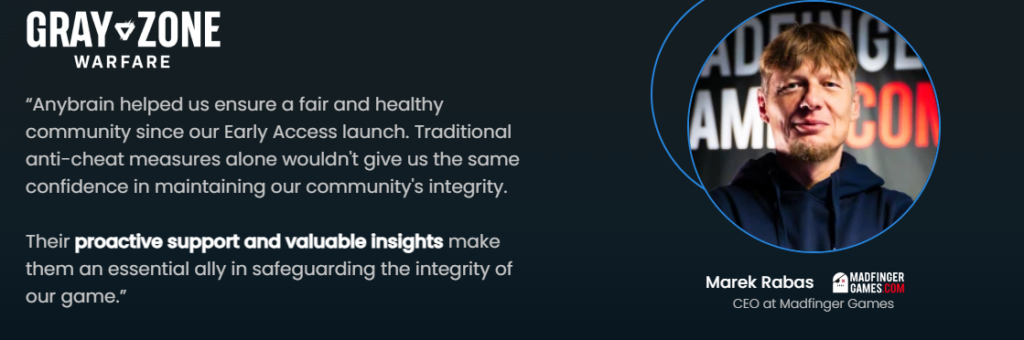
It’s usually the player’s reception. Introducing bad anti-cheat or an anti-cheat that doesn’t work could cause frustrated players to give up on a game entirely, believing it has been taken over by the cheaters and no tools can stop that.
While this could ultimately happen, maybe even an inevitability, if anti-cheats were never implemented at all, there is something about the developer trying and failing that leaves a bad impression on players: it results in player churn, reduced retention, and less spend on in-game purchases, all ultimately leading to a decrease in revenue.
As stated before, this is especially true with kernel-level anti-cheat solutions, as players may get frustrated knowing they have to install software that doesn’t even work.
How autonomous is Anybrain and how is it future-proofed against new cheats?
Anybrain uses our own patented anti-cheat solution, which uses AI & ML to analyse player behaviour and create a player profile. It constantly tracks this player and compares their actions against those of other players, that player’s own history, and the activity of cheating bots to identify if a player is cheating.
The whole process is automatic, and the results are flagged to the developer and publisher for a final decision. The only thing that Anybrain doesn’t do automatically is ban the cheater; it just supplies all the evidence so an informed decision can be made.
As far as future-proofing goes, it is very secure. As it is based on the behaviour of the player, it doesn’t matter if the player updates their cheating software; it won’t be able to avoid detection from Anybrain. This is because the cheating software, no matter what level it is, has the same goal, and that’s to win in the game, and that requires specific actions to take place, which Anybrain can identify.
So developers don’t need to worry about updating Anybrain. It can be added to the game and then left to run automatically forever, only requiring occasional input when making a decision on bans or to look at the data.
What are Anybrain’s plans in 2026?
In 2026, we aim to see Anybrain implemented in many of the top-rated online multiplayer games, taking the world by storm.
We have recently been implemented into Arc Raiders, and it has been going well. We have some other big titles already in the pipeline, and we hope to get even more ready. It only takes a few hours to a couple of days, give or take, to get Anybrain up and running in a game, installed within the existing network and alongside any existing anti-cheat solution.

Anybrain CEO & Co-founder
Related News: Anybrain strengthens its team to scale AI Anti-Cheat infrastructure for game studios