
Direct-to-consumer (D2C) monetization isn’t an experiment anymore. Web Shops have become a core part of the modern game economy, giving studios more control over pricing, margins, and long-term player engagement.
While adoption is growing, there is a massive opportunity for optimization. Developers who refine their Web Shop strategy see transformative results: conversion becomes a clear driver of growth, and loyal players are more likely to return and spend more after their first purchase. The difference lies in moving from simple infrastructure to masterful execution.
Web Shops without Live Ops underperform
A common pattern is emerging across studios:
- Players visit but don’t convert consistently
- Teams struggle to enhance webshop retention
- Incremental revenue is limited due to a lack of engagement options
- Trust remains lower compared to in-game stores
Does this sound familiar?
In this model, Web Shops behave like static storefronts. Players drop in, make a purchase, and leave. The shift happens when Web Shops become live-service systems offering both value and engagement opportunities.
Live Ops turns Web Shops into growth channels
Operational gains are just the starting point. Live ops features directly shape player behavior across acquisition, monetization, and retention – and the impact compounds at every stage of the funnel:
- 15% faster campaign launch times
- 20% reduction in offer setup errors
- Minimum 15% average increase in Web Shop revenue
More importantly, live ops features directly impact player behavior across acquisition, monetization, and retention.
Acquisition: Driving traffic and first-time conversion
Top-performing Web Shops actively generate demand rather than waiting for it.
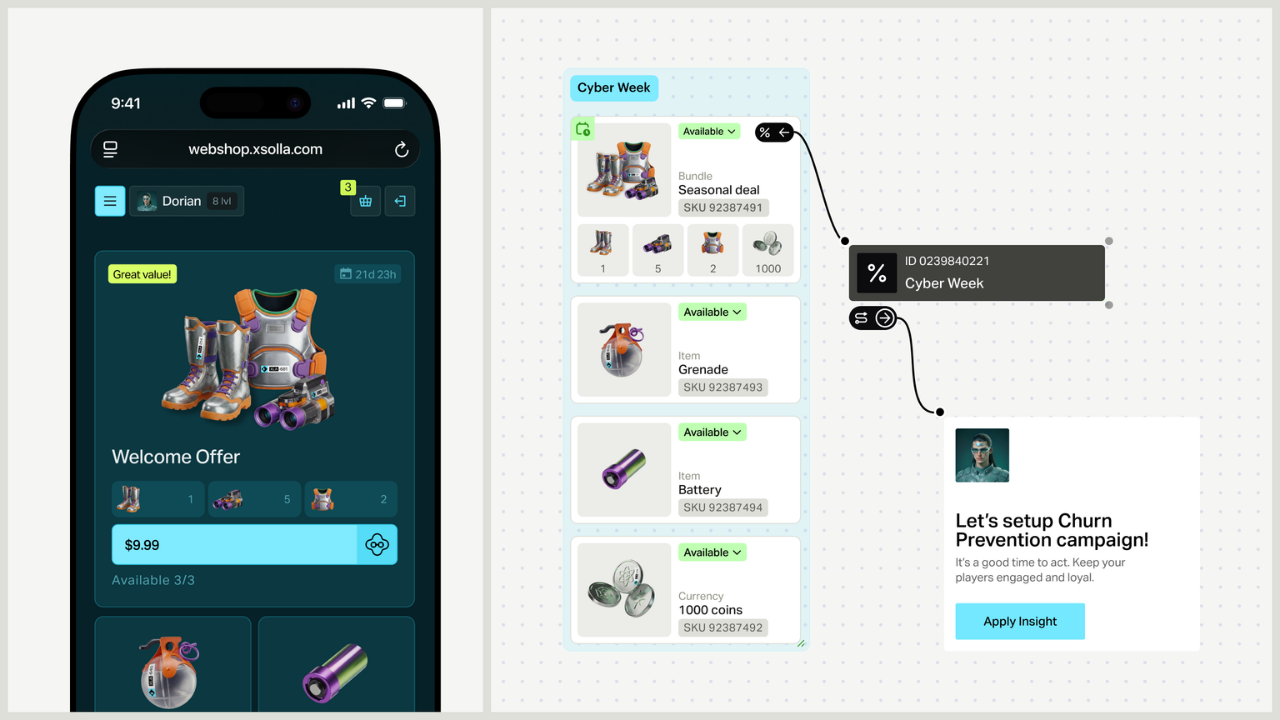
Welcome offers and first purchase bundles are among the strongest entry points:
- +85% median revenue growth
- +65% increase in payer count
- +60% visitor growth
These mechanics don’t just convert existing players, they create acquisition loops.
Promo codes and coupons further amplify this effect:
- +84% median revenue growth
- +51% payer growth
- +98% DAU growth
In practice, this nearly doubles daily active Web Shop users during campaign periods, making them one of the most effective traffic drivers available.
Monetization: Increasing depth, not just conversion
Once players enter the Web Shop, the next challenge is increasing purchase frequency and value.
Offer Chains play a central role here. Instead of a single purchase moment, they create structured progression across multiple transactions.
Cross-project analysis shows:
- +42% average growth in first time buyers
- +4.5% increase in purchases per user
- +53% growth in 7-day retention
- +16% average daily revenue growth
- +31% ARPPU uplift
Beyond monetization depth, Offer Chains also expand the audience:
- +48% median growth in traffic
- +54% median growth in DAU
In one racing game case, implementing Offer Chains led to:
- +92% increase in first-time buyers
- +54% increase in daily revenue
- +119% growth in 7-day retention
This directly addresses the “one-and-done” purchase problem by building continuity into the purchase journey.
Retention: Building habits and long-term value
Retention is where most Web Shops fail – and where live ops have the biggest impact.
Daily Rewards systems are a key driver of habit formation:
- 10x growth in 30-day retention
- 70% of authorized users claim rewards
- 67% of new users make a purchase after claiming
In one case, 67% of new payers interacted with rewards before their first purchase, often converting weeks later. This shows that engagement mechanics don’t just retain users, they prime monetization.
Loyalty systems extend this further:
- 14% growth in average check size
- +49% increase in DAU
These features are less about short-term revenue spikes and more about increasing lifetime value and reactivation.
Personalization and trust as conversion levers
Players’ trust remains a critical barrier in Web Shops. If the experience feels disconnected from the game, conversion drops.
Two levers consistently improve performance:
- Personalization: +54% median revenue, +35% payer growth
- Localized pricing: +23% revenue, +26% payer growth
Tailored offers and regionally appropriate pricing reduce friction and make the Web Shop feel like a natural extension of the game.
Operational efficiency as a growth multiplier
One of the biggest concerns for developers is the cost of maintaining live ops on the web.
This is where tooling matters. Faster campaign setups and fewer configuration errors don’t just save time, they enable:
- Higher experimentation velocity
- More frequent content updates
- Better alignment with in-game events
Speed and consistency are critical in keeping Web Shops relevant.
The next phase: from storefront to system
Web Shops are evolving from standalone monetization channels into fully integrated live-service ecosystems.
Emerging features such as gacha mechanics, wishlists, and progress-based rewards, point toward a more gamified commerce experience. The direction is clear: Web Shops are becoming extensions of the game loop itself.
The takeaway is crystal clear
D2C success isn’t defined by launching a Web Shop, but by operating it effectively.
Studios that treat their Web Shop as a live-service product, powered by continuous live ops, personalization, and engagement systems, are seeing measurable gains across revenue, retention, and player lifetime value.
The next generation of high-performing game economies will not separate gameplay and commerce.
They will design them as one continuous system. Ready to turn your Web Shop into a live-service growth channel? Talk to Xsolla.