

Jorge Gomes, Co-Founder and CTO of Ludo.ai, provides an analysis of how automated sprite generation addresses critical production bottlenecks for lean development teams.
By compressing manual animation workflows into rapid, automated outputs, Gomes argues that the primary value of generative AI lies in its capacity to reallocate technical resources toward core gameplay innovation and iterative design.
For any team looking to develop their next game, challenges around affordability, productivity, and whether they have the resources to produce the assets they need are driving the use of AI tools.
These challenges were front and centre for us when Ludo.ai attended the Mobidictum Conference last October at the Lütfi Kırdar Congress Center in Istanbul. Over the course of the event, we spoke with many developers about their own development processes and the production challenges they face.
A familiar pattern emerged: the concept might work, the core gameplay mechanic may be fun, but momentum slowed when the project reached the 2D asset creation stage. It is at this stage of the development cycle that tools such as Ludo’s Sprite Generator are rapidly becoming a godsend. What struck me most when speaking to developers at the Conference in Istanbul was how much time and money this tool is saving in the day-to-day process of making games.
Addressing the production bottleneck
The traditional 2D pipeline – concept → sprite → animation → implementation – can look deceptively simple on paper. In practice, it is more complex.
Animation can be the most time-consuming step of a typical 2D workflow. Creating dozens of frames by hand for a single character can take days. For a small team predominantly made up of engineers, the time this takes can have a significant impact on productivity.
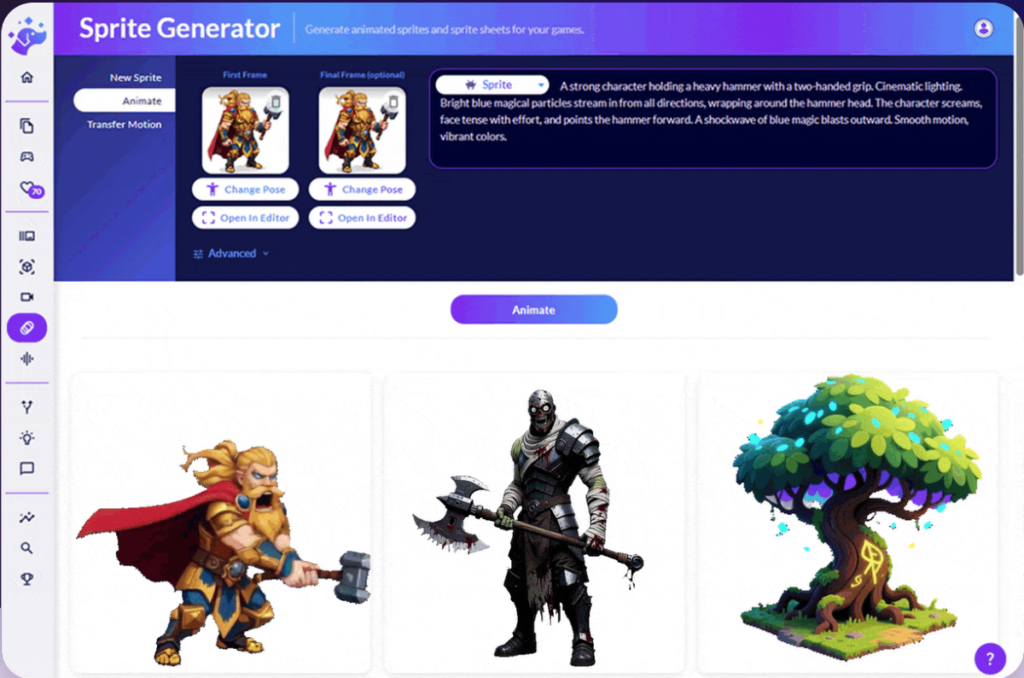
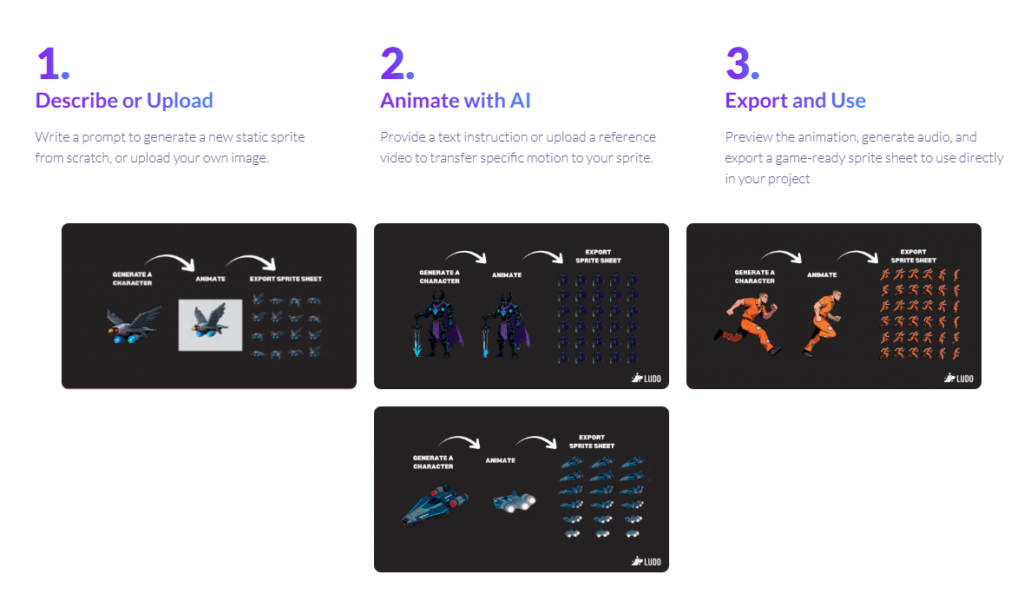
Ludo’s Sprite Generator can compress this pipeline. Developers can generate static sprites from text prompts, animate them using movement descriptions, and attach game-specific audio and SFX before exporting sprite sheets for their chosen game engine.
Steps that have previously taken days to complete for one iteration of an idea can now be completed in seconds and across a variety of different versions of that same idea.
Generative AI tools such as these aren’t designed to replace creativity. They are designed to help small teams at every stage of the creative pipeline. The assistance these tools provide is invaluable, but they are nothing without human judgment. They are accelerators. They fundamentally change what a small team’s throughput can be, but the final say on any end product must remain with the development team.
Prioritising guardrails when it comes to AI asset generation
When speaking with developers at the Conference, the passion and vision they had for their games was clear to see. It is important to us that these developers remain central to realizing that vision.
Certain guardrails can be implemented into production workflows to ensure the use of AI tools in the development process remains checked and monitored. These include teams remaining in control of the overall art style, and the assumption that everything AI-generated will require review.
The most important guardrail of all is to remain curious in the use of these tools. Teams will get the best outcome by experimenting with initial results. Ludo’s Sprite Generator is built around this philosophy. Its integrated editor allows teams to refine outputs before animation.
Customizable frame counts mean assets are production-ready. Exports are formatted properly and can be dropped into a chosen game engine. When it comes to the Sprite Generator, control remains with the developer.
As production values rise, so will player expectations
Over the next few years, the biggest shift in indie games will be the impact AI has had on production values, with small teams able to bring games to launch that look and feel polished without maxing out their budgets.
As AI tools make the development process more efficient, player expectations for visual quality will rise. Indie devs will be able to ship products with cohesive animation, prototype art styles before launch, and test gameplay elements without asset creation hold-ups.
But as more teams gain access to these tools, standing out from the crowd may become harder. The best performing teams will be those that recognise that AI tools can give them more time. Time to try new ideas, discard ones that don’t serve their purpose, and pursue ideas that they feel will resonate with their target audience. Using AI is one thing. Taking advantage of the time AI gives you is another.
Whether it be a large publisher experimenting with generative tools at scale, or a smaller indie team using these tools simply to get a playable version of their game out there.
The conversation is no longer about whether AI belongs in game development. It is about how intelligently these teams use the time it gives them.
You can try Ludo’s Sprite Generator tool by visiting here.

Co-Founder & CTO at Ludo