Monetizing a Web Game on a standalone website: The RocketGoal and Playgama Ad Case Study
PocketHaven Games launched Rocket Goal, its multiplayer car soccer game, on a standalone domain with Playgama Ad as exclusive monetization partner; in six months, the game generated over 65 million ad impressions with viewability above 90% — where interstitials, despite serving 4.5x fewer impressions than banners, drove around 60% of revenue.
One almost undeniable truth about the web gaming market — which consists of hundreds of gaming portals, platforms, and ecosystems — is the need for distribution. If you made an HTML5 game, the standard path is simple: upload it to web game portals and platforms, reach an audience, but in exchange, share a portion of your revenue and give up control over the game, with no say in monetization or the ad stack.
But a growing number of developers are now experimenting with a different model, launching games on standalone domains, engaging directly with the audience, owning organic growth, and managing monetization independently.
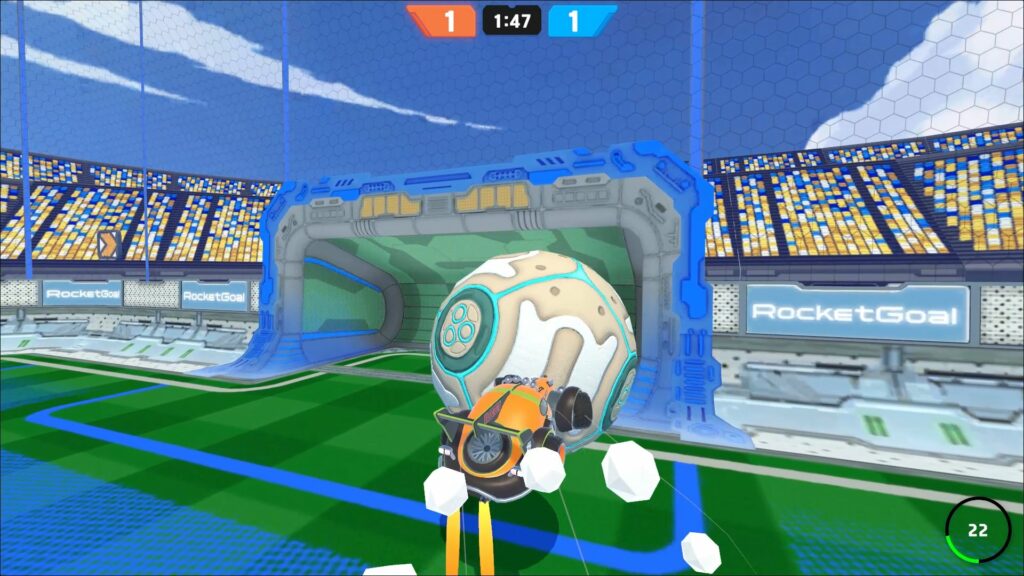
One of the teams successfully exploring this model is PocketHaven Games, the developers behind RocketGoal — a browser-based multiplayer car soccer game inspired by the physics-heavy chaos of Rocket League.
This case study explores how PocketHaven Games approached a standalone launch, and what they learned from optimizing ads inside a highly competitive browser game environment.
PocketHaven Games, the studio behind RocketGoal, Rumble Rush, and Rogue Legend
PocketHaven Games makes the kind of games you can jump into in seconds and lose an afternoon to. The studio’s lineup spans genres — the Rocket League–style car soccer of RocketGoal, the board-based roguelike RPG Rogue Legend, and the mayhem of multiplayer runner Rumble Rush — but shares one instinct: real-time, competitive, broadly accessible games built to travel by word of mouth across web and mobile.
RocketGoal — Multiplayer Car Soccer
A fast-paced car-soccer game in the spirit of Rocket League: you pilot a rocket-powered car to boost, drift, jump, and fly, smashing a giant ball into the opponent’s net. Multiplayer with global matchmaking, physics-driven ball control, and skill mechanics. Available on the web and mobile, it’s the title at the center of this case study.
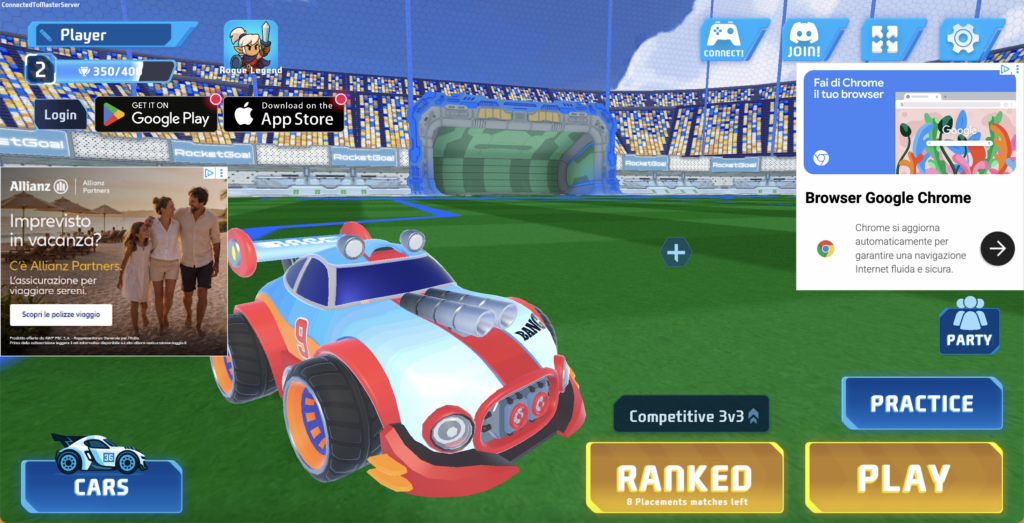
PocketHaven takes a truly platform-agnostic approach to its games, distributing them on popular web game portals while also launching on standalone websites and mobile app stores. For RocketGoal, the team selected Playgama Ad as its exclusive monetization partner and went with a straightforward ad setup, which included overlay banner placements on both sides of the screen and interstitial ads during natural breaks in gameplay.
About Playgama Ad
Playgama Ad is a monetization partner and adtech solution built from the ground up to monetize web games and web game portals. It connects via a simple Ad SDK integration and covers both in-game (pre-roll, mid-roll, rewarded video) and website-level formats around the game (interstitials and various display banner sizes).
Playgama Ad provides web game developers access to top-tier Ad networks and premium sources of gaming-specific demand, including Playgama direct deals. On top of that, Playgama Ad is a Google MCM Partner, which unlocks access to Google Ad Manager and its demand. All these sources compete for your ad inventory simultaneously — and this competition ultimately delivers significantly higher CPMs than standard monetization solutions.
Beyond the technology itself, web game developers get hands-on support: a detailed analytics dashboard that delivers performance metrics, and a dedicated team to help act on what that data reveals. The Playgama team supports you in everything from the initial SDK integration through ongoing monetization tuning, including specific recommendations on ad formats and placements, and help with testing to make sure everything works as intended.
The launch and the first challenge: an invisible revenue drain
The integration process began in December 2025: the team implemented the Playgama Ad SDK, configured basic ad formats — overlay banners and interstitials — and launched ads on a standalone website that hosts the game.
Early monetization data showed that despite high-quality traffic, eCPM (revenue per 1,000 ad impressions) and match rate (the share of ad requests that receive a valid bid from demand partners) were below benchmarks, suppressing overall RPM (revenue per 1,000 ad requests). PocketHaven Games and Playgama Ad began to investigate why the metrics weren’t showing the expected results and noticed that the share of personalized ads on RocketGoal was significantly lower than in other comparable games.
Further investigation pointed to the root cause: the game’s privacy signals were being transmitted incorrectly, causing most ad requests to be treated as non-personalized. This directly reduced the value of the ad stream. Same impressions. Same placements. But the difference in revenue was drastic.
This is an easy problem to overlook because nothing appears “broken.” Ads continue to load, fill rates remain healthy, and users see no obvious difference. The only visible symptom is lower revenue.
If you monetize a game on your own website, privacy compliance becomes part of your monetization stack. Depending on where your users are located, different privacy regulations may apply, including the GDPR and ePrivacy Directive in the EEA and UK, as well as state privacy laws in the US such as the CCPA/CPRA. Game developers, web game portal owners, and publishers therefore typically implement a certified Consent Management Platform (CMP) to collect users’ privacy choices and transmit standardized privacy signals to demand partners.
Those signals determine how each ad request can be processed, including whether personalized advertising is permitted. Even a small configuration error can cause a large portion of ad requests to be monetized as non-personalized inventory, substantially reducing RPM.
In RocketGoal’s case, Playgama Ad and PocketHaven engineers traced the issue to the Google Tag Manager configuration, where the privacy signals were being passed incorrectly. After fixing the implementation, ad requests once again carried the correct privacy signals, allowing personalized advertising where permitted. As a result, RPM increased substantially, and overall revenue began to climb.
The experience underscores a broader point: technical collaboration between a web game developer and their monetization partner is not a nice-to-have. In many cases, it is the difference between an average setup and the one your game truly deserves.
Inside RocketGoal’s ad setup and performance
RocketGoal was originally conceived as a platform-agnostic project that the team planned to launch on a standalone website as well as on the App Store and Google Play, counting on organic growth. Right after launch, the game went extremely viral thanks to its well-thought-out mechanics and strong market fit.
RocketGoal kicked off with an ad format mix common to web games, as noted above: overlay banner placements on both sides of the screen and interstitial ads at natural gameplay breaks.
Banners appear outside of active gameplay, on secondary screens — while preparing to start a match or choosing a car.
Banner placements serve a valuable role: they build a consistent, predictable revenue baseline and, when well-placed, have minimal impact on gameplay. But Interstitials, deployed at natural pause points, generate significantly more value per impression.
This is quite evident when looking at how RocketGoal’s monetization worked out in the end. After fixing the consent signals issue and as more data built up, it became clear that interstitial ads, despite having4.5x fewer impressions, generate the bulk of the revenue — about 60% — with an eCPM 8x higher than with banners and CTR 30x higher.
In six months RocketGoal generated over 65 million impressions with viewability consistently above 90%, primarily Tier-1 traffic, and 70% of its revenue coming from the U.S.
That said, there’s always room for improvement in ad logic and monetization. The next major step for RocketGoal is adding rewarded ads and in-game purchases. Both have the potential to bring in additional income comparable to what interstitials generate. In-game purchases fit naturally with RocketGoal’s core game design — buying different cars and customizing them — and tend to perform well in competitive matchmaking games.
Valeria Svistunova, Head of Monetization at Playgama
“The best monetization strategy is rarely built around a single format. Rewarded ads are often an untapped opportunity because players actively choose to watch them in exchange for meaningful in-game rewards. That typically leads to strong engagement, and in many games they can eventually rival interstitials in revenue.”
PocketHaven plans to further develop its setup: “We haven’t yet fully tapped into RocketGoal’s potential in terms of monetization, and we plan to explore in-game purchases alongside rewarded ads and continue developing the game around that,” said Amit Klein, co-founder of the studio.
The Standalone vs. Distribution Question — and What’s Next for PocketHaven
Asked when a developer should go standalone versus through distributors and platforms, PocketHaven’s answer is simple: both.
“For small teams whose games live on virality and daily active users, being everywhere maximizes reach,” says Amit Klein, co-founder of PocketHaven Games. “Platform-driven discovery from web game portals — and sometimes even mobile app stores — feeds the top of the funnel, while a standalone website gives the studio full control over monetization and a direct relationship with its audience. The two aren’t competing strategies — they’re complementary.”
Beyond that, the same instinct shapes how PocketHaven runs as a studio and grows its portfolio. Rather than betting everything on a single title, the team launches several projects in parallel and watches which one resonates most with players, then shifts high-intensity operations there.
Takeaways for Web Game Developers
RocketGoal’s journey — from misconfigured consent to a balanced, high-performing format stack — offers several lessons for any developer approaching web game ad monetization:
Consent configuration is not optional. A misconfigured consent pipeline silently destroys RPM. Audit it early with your monetization partner.
Impression volume is not the goal. Format quality and placement context matter more. Fewer, better-targeted interstitials can outperform a wall of banners.
Experimentation compounds. Each format added, each placement tested, each data point reviewed adds up. Monetization is an ongoing process, not a one-time integration.
Building a game is a detail-driven craft, and earning from it is no different. Monetizing a standalone web game takes ongoing technical collaboration between developer and adtech partner, where a single hidden misconfiguration can quietly cost a large share of income. Great games earn attention; great setups make sure that attention pays.