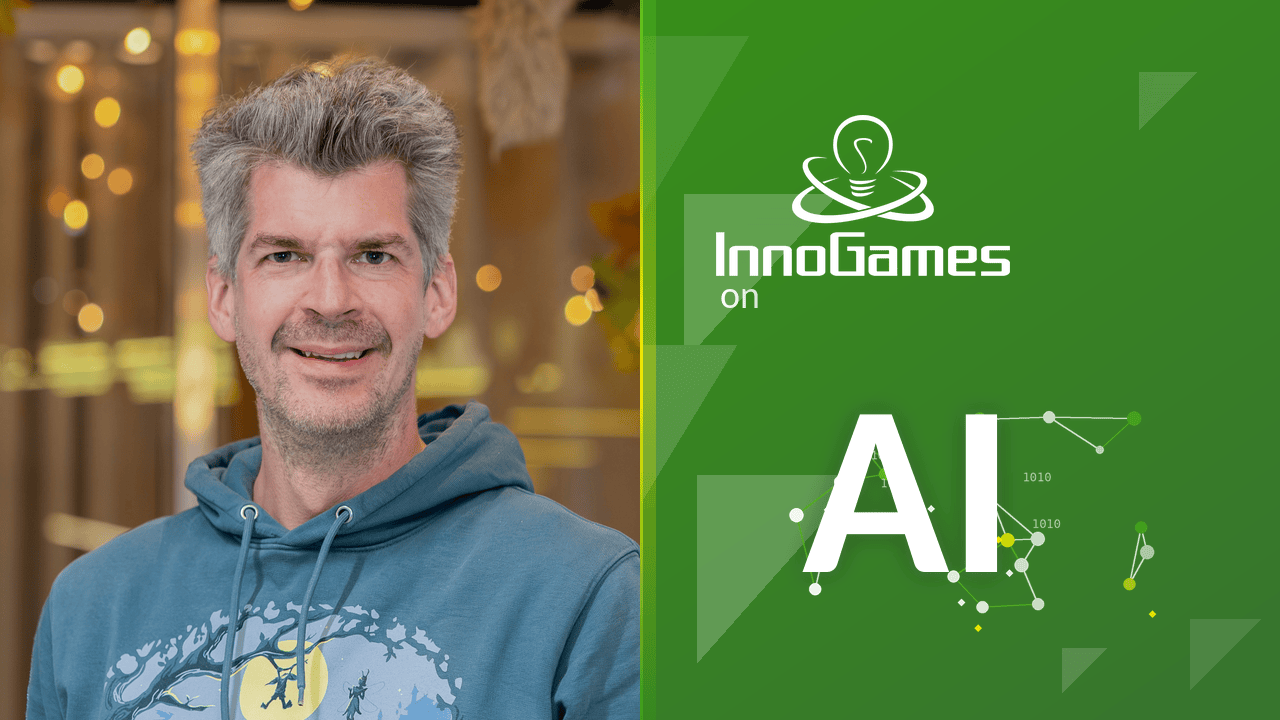

In this interview, Marc Robert discusses how artificial intelligence is transforming user acquisition at InnoGames, from automating campaign optimization and creative production to improving data analysis and accelerating experimentation.
AI has rapidly evolved from experimental technology into a core part of user acquisition. When did that shift happen for the Elvenar team, and how has AI changed the way you approach campaign planning, optimization, and day-to-day decision-making compared to a few years ago?
We made first contact in late 2022, when ChatGPT came out. In the beginning, it was simple stuff on pure GPT models: questions about the market, first ad copy ideas, translations and translation checks, etc.
Things got even more interesting when we introduced TypingMind. It gave us access to different models and let us build our first UA agents, fed with our audience data, and the key parameters of each game. In parallel, the first MCPs were created, connections through which agents pull in additional content: competitor analysis via Sensor Tower, for example, or our app store presence and reviews, showing what players like, which then flowed directly into our campaigns. That alone made us significantly more efficient.
The most recent leap forward came with Claude. First Claude Code, now Claude Cowork. Agents now run analyses, work agentically, and create documents that have measurably improved our daily work routine. Through MCPs they have access to our partners, our MMP and our internal BI, and they document and share results via Jira, Confluence, and Slack. That bundles our knowledge and lets agents work for us in a tailored way.
For the day-to-day, this means complete ad copy sets across partners are created in minutes instead of hours, with the UA Manager still needed for curating. Our weekly UA reports per game are agent-supported, pulling spend, installs, ROAS and early LTV signals automatically. And in planning, including strategic planning, agents help us get smart on what our games and seasonality will bring. Player motivation analyses can be built in minutes. The insights gained feed into our roadmap plannings, and partner and creative tests can be set up per creative tactic and market.
As advertising platforms increasingly rely on AI-driven campaign optimization, how has the role of UA managers evolved? Which responsibilities have become less important, and where does human expertise remain indispensable?
The channel algorithms of platforms like Meta and Google are taking over more and more targeting and bidding. The days when a UA Manager built dozens of manually segmented ad sets and adjusted bids by hand are largely over, and routine reporting is getting less important as well.
What remains, and what has become more important, is everything the algorithm cannot do: setting the strategy, formulating hypotheses, judging creatives, knowing how to address the right message to the right player, and deciding on budgets.
AI is now working on both sides of the campaign, so the remaining lever for advertisers is feeding the algorithm better audience-tailored creative material faster than the competition. The role shifts from executor to orchestrator: the agent delivers the data foundation and suggestions, but the hypotheses, the final selection, and quality control stay with the UA Manager and our artists.
AI has made it possible to automate many aspects of campaign optimization. How has it changed the way your team approaches experimentation, whether that’s testing audiences, bidding strategies, or campaign structures?
The testing cycle has become much shorter. Previously, it would take at least several days, and sometimes even weeks, to pull data for a new creative or setup in testing.
Today, an agent combines three sources: our creative performance from the MMP and BI (ROAS, early LTV signals, purchases), competitor intelligence from tools like Sensor Tower, player feedback from our app stores, and even some partner-related data. The result: Finished briefings – including production-ready video prompts for Scenario – that take minutes instead of hours.
Because experiments have become much cheaper, we run a lot more of them. Whether it is a new angle for a market, new combinations of ad copy, formats and theme settings for our campaigns, a different campaign structure or a bidding change – the pattern is always the same: the human defines the hypothesis, the agent prepares the test and the readout, and the human draws the conclusion.
Has AI made it easier to uncover patterns in player behavior or campaign performance that might have been difficult to identify manually?
Absolutely. Instead of writing queries myself, I can now ask an agent questions like: “How did channel X in region Y develop over the last five days?” and get an analysis within minutes, including anomalies and hypotheses. Though this is not perfect, it saves quite some time when analyzing and optimizing our UA campaigns across games, platforms, partners, and countries.
Combining resources yields an even greater effect. Patterns that used to sit in separate silos, campaign KPIs in one tool, store reviews in another, competitor creatives in a third, now show up in one analysis. That is how you notice that a certain creative angle works in one market but not in another, and more importantly, why.
Elvenar has been live for more than a decade. How has AI changed your approach to user acquisition for a mature live-service game, both in optimizing existing audiences and identifying new player segments?
Elvenar has been live for over a decade, so the core audience is well known. Hence, efficiency in the proven segments comes first. AI helps us get more out of them: seasonal hooks and proven angles per market are encoded in our skills, so every campaign wave starts from the accumulated learnings of many years instead of from scratch.
For new segments, the shortened testing loop is the key. We can now afford to explore angles and formats that would have been too expensive to create and test before. Playable ads, for example, are now built in-house with AI support as lean HTML files, where production used to be outsourced. And since player feedback from the app stores flows directly into these tests, new creative directions are grounded in what actual players say rather than in gut feeling.
As AI automates more repetitive work, what skills are becoming more valuable for user acquisition professionals? Has AI changed the profile of talent you’re looking for when building a UA team?
I can think of four skills that are becoming ever more valuable. First: being able to translate your own work into repeatable instructions. Anyone who can describe their workflow precisely can delegate it to agents, which makes context and prompt engineering a core competency rather than a nice-to-have.
Second: Creative skills. It used to be that the biggest lever was mastering your partner setup – how you structured campaigns, how you bid, how you segmented, etc. Most of that is automated now, so the leverage has moved to the creative side. The question a UA Manager must answer today is which creatives, both written (like ad copy) and visual, will produce the best result with a specific partner, on a specific platform, in a specific market.
Third: Data literacy as a control instance. You must know your KPIs well enough to immediately spot an agent analysis that sounds plausible but is wrong. Responsibility for the numbers and conclusions that end up in a report stays with the human.
Fourth: What my colleague Sven Miketta called “openness” in his recent interview. In UA, that means questioning at least one of your own manual processes every week and checking whether an agent could do it faster, better – or both.
Changes in these four skills also change the team profile. Some of what only a UA Manager could do, or could only partly be looked up in Confluence, is now available as a skill, and experience from past campaigns can be pulled in via MCPs. That makes onboarding and standard tasks noticeably easier. It doesn’t replace a manager’s expertise, but it isn’t meant to.
Consequently, nowadays I am looking for people who can write a channel playbook, check its output, and rewrite it when the market moves, rather than people who can only execute one.
Do you think AI is leveling the playing field for smaller studios in user acquisition, or will larger publishers continue to benefit the most from their scale, data, and resources?
Both are true. The entry barrier has clearly dropped: a small team with a handful of AI tools can today produce creatives, reports and analyses at a level that used to require a whole department. In that sense the playing field is more level than it was three years ago.
But scale still pays. Larger publishers have more data to feed into their loops, more budget to run tests, and portfolios where a learning from one game transfers to the next. What AI really rewards is neither size nor smallness but speed of learning. An organization that chains analysis, production and testing into fast loops will beat a slower one, whether it has ten employees or a thousand.
Looking ahead, which areas of user acquisition do you expect AI to transform the most over the next three to five years?
Within the next three to five years? That’s an eternity in the world of AI. I can only really offer my best guesses.
To look at the shorter term first: We have a clear vision of what we want to achieve by the end of 2026, namely a UA Manager who automates large parts of the work from end to end with the help of AI, with decisions executed directly at our partners via MCP integrations. The platforms are heading the same way: Meta, for instance, is pushing toward fully automated campaigns, so UA becomes a matter of goals, budgets, guardrails and feeding the algorithms better input than the competition.
All of this applies primarily to smaller markets that are highly optimization-intensive but generate lower revenues than tier one markets. Efficiency is especially important in such tier three markets, as it creates more capacity for optimization towards tier one markets.
Will the UA manager role still exist in its current form? Certainly not. Whether separate departments will exist at all, or whether game and marketing will merge, is the bigger question, and one that also depends on company size.
How we interact will keep changing too: three years ago, my main interface was the keyboard. Today it is voice input, and with devices like Meta’s Ray-Ban glasses, that may become the next big channel. Chip implants are still too far out, but extending our bodies through devices is not: think of wristbands that read neural signals, so you control a device by merely thinking about a movement. For marketing, every single one of these devices is a new surface, from contextual ads in our fields of vision to players sharing their gameplay directly from the glasses instead of capturing it first.
Discovery is shifting as well: with ads and recommendations moving into AI assistants, the question might no longer just be how to rank in the app stores, but how a personal AI recommends your game.
Not least, regulation will shape how much AI we can actually use. Take AI labeling, a hot topic right now: the EU AI Act requires AI generated content to be marked, and New York recently became the first US state to require disclosures for ads featuring AI generated performers.
While nobody knows what the future will bring, I am convinced that you shouldn’t delegate your strategic decisions to AI, at least as long as the models haven’t progressed much further. Otherwise, you will optimize in the wrong direction at high speed.

Head of Game UA (Elvenar) at InnoGames