
For the better part of a decade, mobile gaming monetization operated on brute force. Growth teams bought volume via low-cost user acquisition channels, ad operations stuffed loops with blunt interstitial cascades, and mediation waterfalls were manually stacked on spreadsheets. If a player churned after three aggressive pop-ups, another install was waiting in the queue.
That era is dead.
Facing stricter privacy frameworks, climbing user acquisition (UA) costs, and players with zero tolerance for jarring ad experiences, the industry’s economic center of gravity has shifted. Sustainable monetization is no longer a downstream plumbing job; it is a core game design discipline combining real-time auction mechanics, behavioural psychology, and predictive machine learning.
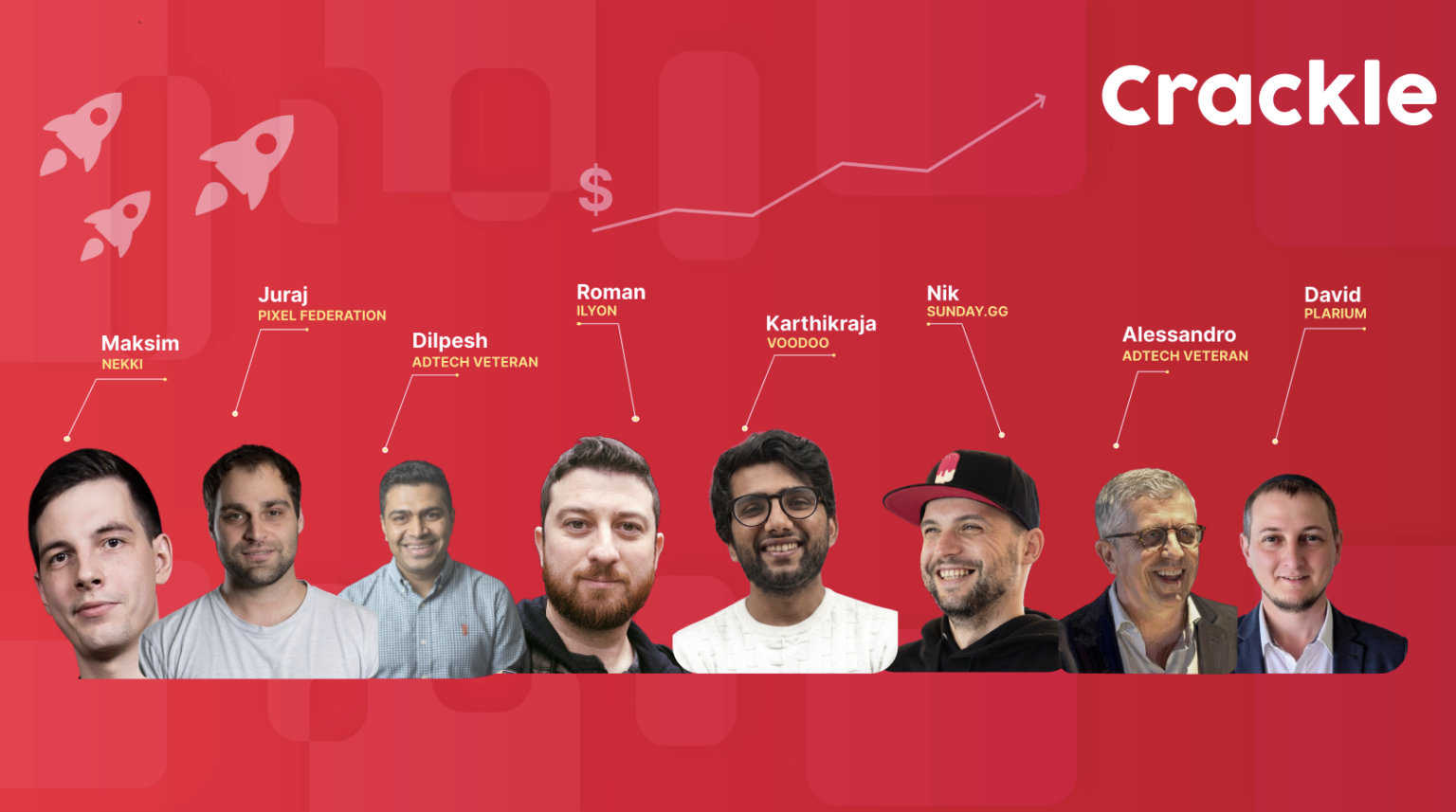
To understand how global leaders navigate this transformation, adtech intelligence platform Crackle hosted an in-depth series of technical dialogues, Crackle’s Adtech Conversations with monetization leads, studio heads, and adtech veterans across the gaming and app ecosystem.
Featuring insights from practitioners including Roman Svirsky (Ad Monetization Lead at Ilyon), David Sigal (Ad Monetization Manager at Plarium), Maksym Amosov (Head of Monetization at Nekki Studios), Karthikraja Krishnamoorthy (Senior Growth & Monetization Manager at Voodoo), Nik Jovanovski (Game Producer at Sunday.gg), Dilpesh Parmar (Adtech Veteran and Entrepreneur), and Alessandro De Zanche (Audience Monetization Strategist), these discussions surfaced the tactical blueprints shaping high-yield studios today.
Here are the 10 defining principles of modern mobile ad monetization.
1. Treat Ads as Progression, Not a Penalty
The outdated fear that ad placements cannibalize in-app purchases (IAP) has been dismantled by hybrid-casual design. In modern game economies, ad engagements act as top-of-funnel discovery mechanisms for premium loops.
At Nekki Studios, home to the Shadow Fight series and Vector, monetization models are built around player progression rather than transactional interruptions.
“On Vector, we ran into a classic ‘ads kill purchases’ problem where rewarded ads directly competed with purchases,” explained Maksym Amosov, Head of Monetization at Nekki. “So we asked ourselves: If ads kill purchases, what happens if we help them finish the job? We simplified the meta-progression: ads now fully cover baseline progression for free users, while IAPs focus on removing ads and
unlocking exclusive heroes. We didn’t lose purchases; we rebuilt the value proposition from scratch.”
David Sigal, who manages monetization across Plarium’s mid-core portfolio, echoes this symbiotic philosophy:
“Monetization is fundamentally tied to design, player behaviour, and long-term engagement. When ads are strategically placed in a way where it feels natural to engage, they actually help IAPs. Higher engagement with ads leads to higher overall engagement and better conversions.”
2. Time Is the Real Currency: Respect the Player’s “Tax”
Every ad shown is a friction point that levies a cognitive tax on the player. Game designers must treat user attention with the same rigorous balance applied to in-game economies.
“The reward a player receives for interacting with ads is never ‘free,'” * notes Amosov. “If a player watches advertising or performs an action, they make a payment not with money, but with their time.”
Nik Jovanovski, Producer at Sunday.gg, approaches game loops by calculating this exact tax:
“You have to think about two things: the tax, which is the monetization, and the fun, which is the core loop. Work backwards from the tax. Understand how much you need to tax your players, divide that load between forced friction and additive rewarded formats, and remember: players don’t churn because of rewarded ads; they churn because of interstitials interrupting their flow.”
3. Move Beyond Country Tiers: Shift to Granular, Cohort-Based Segmentation
Broad geo-bucketing (Tier 1 vs. Tier 3) leaves significant margin on the table. Today’s top studios segment by early lifetime value signals, network campaign origin, and demonstrated ad tolerance.
At Voodoo, managing a portfolio of hundreds of titles requires deep segmentation engines.
“A lot of monetization folks use too broad of a net country-level or format-level segmentation,” says Karthikraja Krishnamoorthy, Ad Monetization Lead at Voodoo. “You leave money on the table by not adjusting bid prices and ad density at a user level. If a user comes from an IAP-focused UA campaign, we give them a clean, premium experience – no ads for the first two to three weeks to let them hook into the meta. If they come from an ad-tolerant cohort, we introduce monetization earlier.”
Roman Svirsky of Ilyon applies a similar patience model:
“UA algorithms identify players who are most probable to become payers. Once we acquire them, we give them time between 20 days to several months to become payers before we start showing them ads. Testing proved that holding ads back on these cohorts yielded higher aggregate lifetime profitability.”

4. Auction Control Has Migrated: Master Bid Floors and Timeout Optimization
While real-time app bidding has replaced the operational nightmare of manual 40-line waterfalls, it has introduced a “black box” dynamic where publishers risk ceding yield control to demand algorithms.
Svirsky emphasizes that publishers must actively create competitive tension:
“Bidding is dominant, but waterfall instances still have a role because they force bidders to raise bids under direct competition. On bidding, ad sources optimize aggressively for timeouts, never let slow network responses drag down the auction. On floors, we start from average eCPMs per geo and format, climb systematically through A/B testing, and pinpoint the sweet spot protecting ARPDAU without crushing fill rate.”
Pixel Federation experienced a 5% ARPDAU uplift when they added a waterfall line item of Crackle. Juraj Hajnala, Monetization Manager at Pixel Federation says
“Crackle delivered exactly what we needed, a way to grow our revenue with our high threshold of ad quality requirements. Their ability to bring in Rewarded Video Ads demand across markets without compromising our user experience has been exceptional.”
5. Kill the Two-Week A/B Test: Measure Downstream LTV and Cohort Health
One of the most dangerous traps in ad monetization is celebrating a short-term ARPDAU spike that quietly degrades long-term retention.
“Short A/B tests can be profoundly misleading,” warns Plarium’s Sigal. “You may see great results in the first two weeks, but by day 30 or 60, the cohort picture completely changes. You must run multi-month tests and focus on long-term retention curves. Make sure your data is clean, whale spend spikes can heavily distort results and always leverage A/B testing to validate testing setups.”
Jovanovski (Sunday) reinforces the principle of proving the negative:
“Write down your hypothesis and deliberately try to disprove it. If your ARPDAU spikes but your day-14 or day-30 LTV curve bends downward, that’s a red flag until proven otherwise. You are never ‘just lucky’ on a secondary metric.”
6. Replace Broken SDK Assumptions: Build Resilient Technical Infrastructure
Historical dogmas, such as the belief that integrating more than five SDK networks will inevitably crash a build are giving way to unified architectures and centralized frameworks.
“The assumption that adding SDKs crashes your game is outdated; mediation tools and SDK quality engineering have matured,” notes adtech veteran Dilpesh Parmar. “The real failure point is operating without tools to gauge real-time impression value.”
Voodoo’s Krishnamoorthy advises strict modularity to manage technical debt and regulatory compliance:
“Do not integrate every network SDK manually. Maintain a single centralized wrapper that bundles ad networks, consent management platforms (CMPs), and analytics tools. When an app store updates compliance rules or flags a third-party vulnerability, a centralized architecture lets you patch globally in hours rather than debugging dozens of individual studio repos.”
7. Track Ad Latency and Churn-Inducing Creatives
Aggregated end-of-day dashboards mask critical revenue leaks. High-scale studios now instrument granular alerting pipelines linking attribution providers (MMPs) with mediation reporting.
“When hyper scaling games, spending hundreds of thousands daily, a 48-hour delay in catching an SDK malfunction causes lasting damage,” states
Krishnamoorthy (Voodoo). “Because acquisition algorithms optimize on D7 and D14 ROAS targets, a 48-hour data blind spot leads to weeks of margin recovery.”
Krishnamoorthy highlights two operational metrics beyond eCPM:
● LTV per Ad Impression: Quantifying the real retention cost of an ad exposure. ● Ad Duration per Network: Tracking deceptive or unclosable creatives extending past 60 seconds that trigger immediate app abandonment.
8. Deploy Machine Learning for Diagnostics, Guardrails, and Quality Control
Artificial intelligence is rapidly shifting from creative ideation into ad operations, automating routine yield tasks and catching edge-case anomalies.
“Where AI delivers immediate impact for us is data diagnostics,” says Ilyon’s Svirsky. “When numbers slip, feeding multi-dimensional performance reports into analytical models uncovers root causes that human analysts miss in spreadsheets.”
For Nekki and Plarium, machine learning acts as an automated shield protecting player experience.
“We rely on AI as an instrument for ad quality tracking, classifying, and intercepting deceptive or broken creatives before they pollute our user base,” notes Amosov. “However, human judgment remains the final gatekeeper. AI provides the operational leverage; humans govern the player’s trust.”
9. Build for the Long Tail: Balance Immediate Arbitrage with 5-Year LTV
Industry veteran Teut Weidemann, who has consulted on game economies ranging from Ubisoft’s The Settlers Online to long-running free-to-play titles, warns against the industry’s obsession with disposable loops.
“The app ecosystem is run by short-term data hounds chasing 30-day payback windows,” Weidemann argues. “Yet over 60% of top-tier store revenues originate from deep mid-core economies that run profitably for 5, 10, or even 20 years. Design your progression for day 365. When you establish a fair value exchange, players gladly support the game for years. Don’t chase fleeting hypercasual spikes when you can build enduring player equity.”
10. Tear Down the Silos: Align Product, UA, and Monetization Under One Roof
Yield optimization cannot exist in isolation from growth and game design. Disjointed goals between UA teams chasing cheap installs and monetization managers maximizing immediate ad load create systemic churn.
“Operating in silos is like driving with one eye closed,” Plarium’s Sigal explains. “When UA aligns directly with ad monetization on regional performance and cohort quality, both teams gain complete visibility.”
Audience monetization strategist Alessandro De Zanche sums up the organizational imperative:
“Monetization requires a holistic strategy. Too often within a publisher, the user acquisition team, product team, and advertising team are incentivized on conflicting
metrics. Without an audience-first philosophy and a unified commercial strategy, technology only automates inefficiency.”
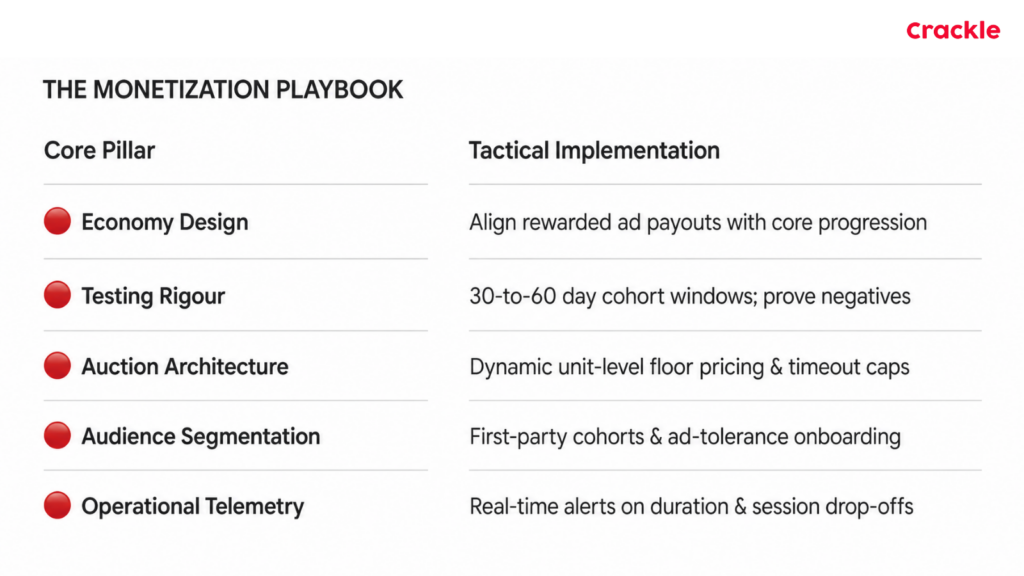
As programmatic auctions evolve, game studios that treat ad monetization as a core product pillar rather than an afterthought will build sustainable, high-yield gaming businesses.
Through Adtech Conversation, Crackle.tech aims to provide mobile game publishers with the clarity, tools, and infrastructure needed to turn complex ad monetization insights into sustainable commercial growth.
Crackle is an AI-powered Adtech company with a mission to enable publishers to maximize their earnings potential and build sustainable businesses.