
Reframing GAM: From Replacement to Reinforcement.
If there is one thing publishers like Amanotes, Se7en, and Rocket Game Studio have in common, it is that none of them treated GAM as a replacement for anything. Instead of restructuring monetization stacks that were already performing, they brought GAM in as an additional demand layer, one that competes alongside the existing setup and serves only where its bids actually win.
This additive approach also underpins PubScale’s immersive ads strategy: creating an additional revenue stream without replacing existing ad formats or mediation.
The Return of the Waterfall: Driving Growth in Unexpected Places.
Now for the part nobody saw coming. After years of the industry declaring waterfall placements obsolete, the waterfall is where this revenue playbook earns most of its money. Publishers running GAM through structured waterfall placements are seeing it capture somewhere between 10 – 20% share of voice in mature setups, which is comfortably ahead of what bidding-only integrations tend to reach, and at stronger yields on top of it.
The reason becomes obvious once you look at what a waterfall placement actually gives an operator: dials. Price floors can be tuned by position, by geography, and by demand cycle, easing lower during soft periods to protect match rate and climbing when buyers strengthen. Real-time bidding still supplies the demand density underneath, but the waterfall structure prices that demand deliberately rather than passively accepting whatever the auction produces. It is the combination of control and competition, rather than a choice between them, that moves the number.
Reading PubScale’s demand map.
Every good playbook starts with knowing where the money actually is, and the demand map for GAM has a few surprises in it. These benchmark figures come from monetization platform PubScale, drawn across its managed GAM portfolio:
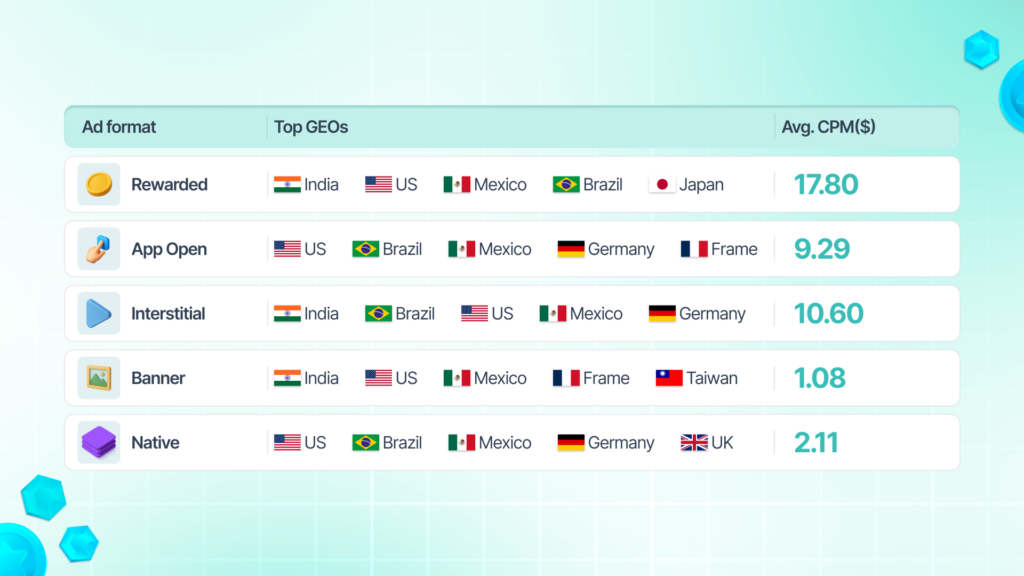
Rewarded and full-screen formats carry the premium end of the table, as you would expect, and in strong titles the top US inventory clears far above these blended averages. What is less expected, and genuinely good news for a large part of the market, is how consistently India, Brazil, and Mexico show up in every row. Studios with big emerging-market audiences are often told their inventory is an afterthought for premium demand, but the data says otherwise, and geo-level floors are exactly how that demand gets priced on its real strength rather than averaged into a global number.
Se7en’s run from five games to forty.
To see the whole playbook in motion, Se7en’s trajectory is hard to beat. GAM entered its portfolio as an additional revenue stream on roughly five games, with a deliberately modest brief: explore what the channel could do while the existing setup ran completely untouched.
What followed was patient, unglamorous craft. Floors were treated as living instruments and adjusted against daily and seasonal demand patterns. Country-targeted floors sat on top of a global baseline so stronger-buying regions paid their true capacity. Hourly monitoring mapped out peak demand windows, and tag refreshes were timed so inventory met the market at its strongest. When GAM Native launched, the team adopted it early and automated it to run through Se7en’s existing Banner and MREC placements, which meant the mediation layer never needed new ad unit IDs or any restructuring at all.
The results made the case for expansion better than any pitch could have. GAM grew from those first five games to more than forty across the portfolio, reached roughly 8% share of voice in top titles on its way toward the playbook’s mature range, and lifted ARPDAU in those games by about 15%, while the Native layer alone drove approximately 1.5x daily revenue. That near-perfect match between share of voice and ARPDAU gain is the detail worth sitting with, because it means the second engine was winning the impressions the incumbent stack valued least and monetizing them at full strength.
What sets the top managed GAM partners apart.
As you explore the managed GAM landscape, you’ll find that the partners driving the strongest results for their publishers tend to share some common characteristics. These are the qualities that enable them to execute this playbook effectively across diverse portfolios, and they provide a handy framework for assessing potential partners.
Flexibility and Automated Custom Workflows are the key hallmarks of top performers in this space. Can they adapt smoothly to your existing tech stack, integrating cleanly with your current mediation setup?
PubScale, for example, has built their platform to plug seamlessly into the most popular mediation solutions out there, from AppLovin MAX to LevelPlay and beyond. It’s an approach that allows publishers to layer in a new demand source without upending their entire monetization infrastructure, much like how Se7en was able to route their new Native line items through their existing placement structure.
In our interview with Arpit Jain, Founder of GreedyGame and PubScale, he discussed why publishers need more connected monetization systems—and why revenue gains should be evaluated alongside retention and player experience.
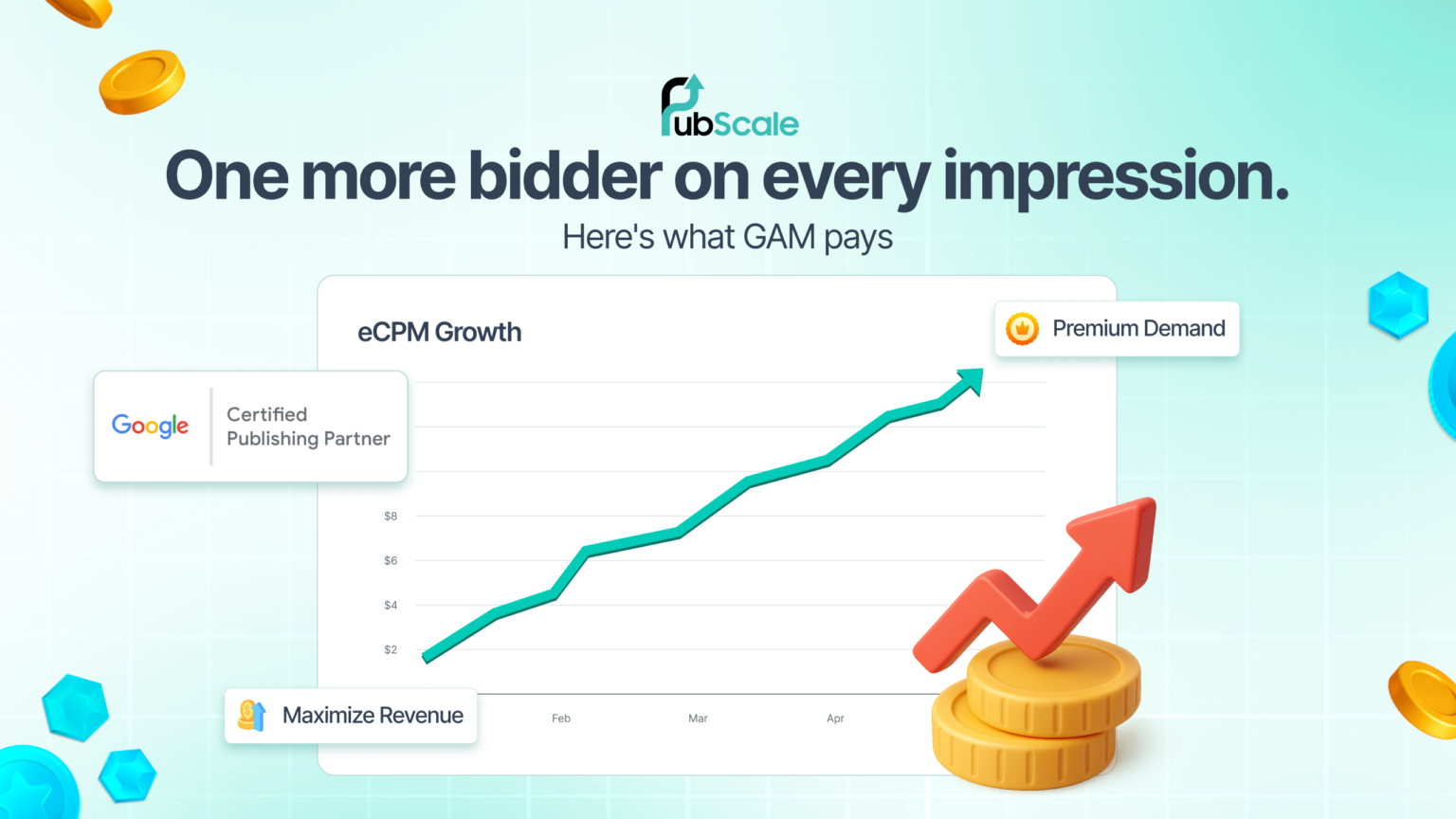
When you put all of these elements together, the results speak for themselves. PubScale regularly sees their publishers achieve CPM increases in the 20-40% range as they transition from a default GAM setup to a fully managed and optimized one. And those gains are very much in line with the broader portfolio-level impacts we’ve observed from other leading publishers in the space.
Your next steps.
The beauty of this whole playbook is how lightweight it is to get started with. One extra demand source, running through your existing setups, benchmarked against metrics anyone can track. The publishers finding success with it, from the rhythm game giants to the one-hit wonders, all took the same path forward: start small, keep a close eye on that SoV, and scale up the pieces that prove themselves.
For just about any publisher/studio out there, getting this ball rolling only takes one conversation with PubScale.