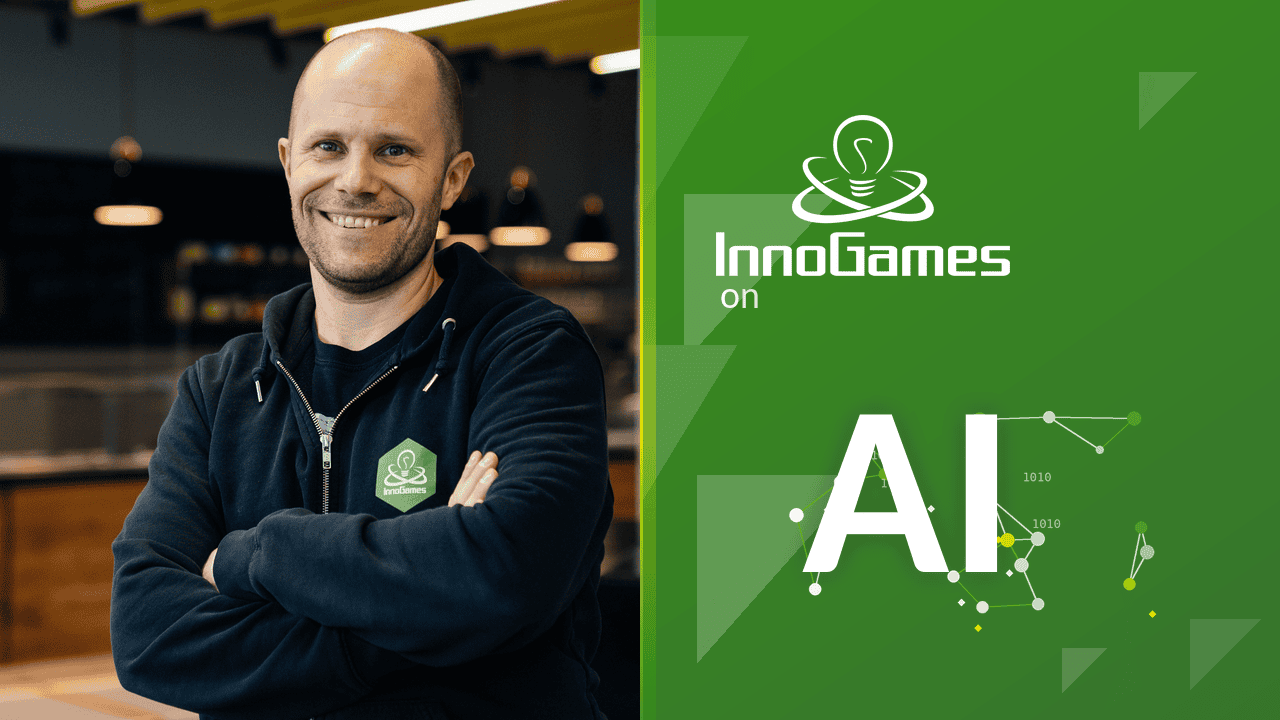

Welcome to the first edition of our InnoGames on AI series, where we explore how AI is transforming the way games are developed, marketed, and operated.
To kick off the series, we spoke with Sven Miketta, Head of Marketing Operations at InnoGames, about how the studio has integrated AI into its marketing workflows, from creative production and campaign optimization to internal collaboration. Sven also shares why human expertise remains critical as AI takes on more of the execution.
Where has AI moved past the “experimental” phase in InnoGames’ marketing operations and become a fully scaled, everyday reality? Which specific area has seen the most measurable impact so far?
We’ve left the experimental phase behind most clearly in the creation of ad creatives. Today we produce over 90% of our static banners with the help of AI tools like Midjourney and Nano Banana. Our first AI-generated banner went live back in May 2023, giving us a real head start as one of the early adopters in the games market. This has allowed us to increase our output of static creatives by more than 200% over three years, while our artists retain full control and use their experienced eye to keep asset quality high.
Our development in video creation has followed a similar path. We started experimenting early on with tools like Runway and launched our first AI-generated video ad in October 2024. AI tools also let us produce a much broader range of videos in-house: from UGC ads to playable ads, our artists now create diverse concepts internally that we previously had to outsource.
Using AI, we’re also now able to produce game trailers that come close to the quality we otherwise only achieve with CGI trailers that take months to produce externally. In some cases, we complete these in-house productions in three to four weeks, at a fraction of the budget.
Right now, we’re moving toward mapping entire video ad production processes into node-based workflows, similar to what many will know from tools like ComfyUI. Scenario is a strong partner for us here, helping us map out and further automate our AI-supported workflows.
Through nodes defined by our artists, we orchestrate the optimal tool for each specific step of the process. For example, Seedream, Hailuo, and Kling mesh together perfectly for us, enabling automation and further efficiency gains.
At the same time, we retain full control over quality, character design, and visual consistency. With quality actually improving, we’ve been able to increase our video production output by more than 350% in just two years. In that sense, video ads are certainly the area with the clearest measurable impact for us.
How does the application of operational AI differ when you are managing marketing for a highly mature, decade-old live-ops title versus building a launch pipeline for a brand-new game?
Brand-new games certainly benefit the most from the creative freedom we have in approaching AI-supported processes and workflows. When developing new games, we work very closely between the marketing and game teams, including game design and graphics. This means we can think much more broadly in our creative strategy and let AI support us. Even at the research stage, when figuring out who our target audience should actually be and exactly which buttons to push for them in our creative strategies, we send out AI agents via Claude Code and Cowork.
We can then use Midjourney and Nano Banana to turn the content of the marketing strategy into meaningful drafts for storyboards and concepts. At this stage, the game itself is still in an early, highly malleable exploratory phase and can respond to marketing’s suggestions, ideas, and strategies. Since game development is now also heavily supported by AI tools, both in coding and in the development of visual game worlds, we’re flexible and adaptable on both sides and can iterate, test, and experiment quickly.
One of the first steps we take in the early phase of game development is defining several alternative settings, such as high fantasy, science fiction, or a colorful candy world. AI helps us here as a sparring partner for developing these ideas, and then also for visually shaping the first concept tests and even early video trailers.
We then use these in initial marketing tests to evaluate how our potential target audiences react to the different settings. Here too, we sometimes use AI-supported external tools like emhance (formerly Sensemitter), which, for example, analyze users’ emotional reactions to our video trailers and app store presence and give us valuable insights into how to shape our concepts, creative strategies, and, in turn, the content of the game.
With established titles like Forge of Empires or Heroes of History, on the other hand, we must pay much closer attention to reflecting and staying true to the art style, characters, and nature of the game. Here we work a lot with visual guidelines that we give the AI tools as context, consisting of existing characters, artwork, color palettes, and so on.
By now, the tools have also become very good at maintaining consistency when it comes to characters and the depiction of our game worlds. In the early days of generative AI, this was still difficult, since characters rarely stayed consistent and a lot of manual rework was needed. Today, this kind of consistency is no longer a bottleneck for us.
Beyond external ad campaigns, how is AI being used internally to optimize team management, cross-department knowledge sharing, or project planning?
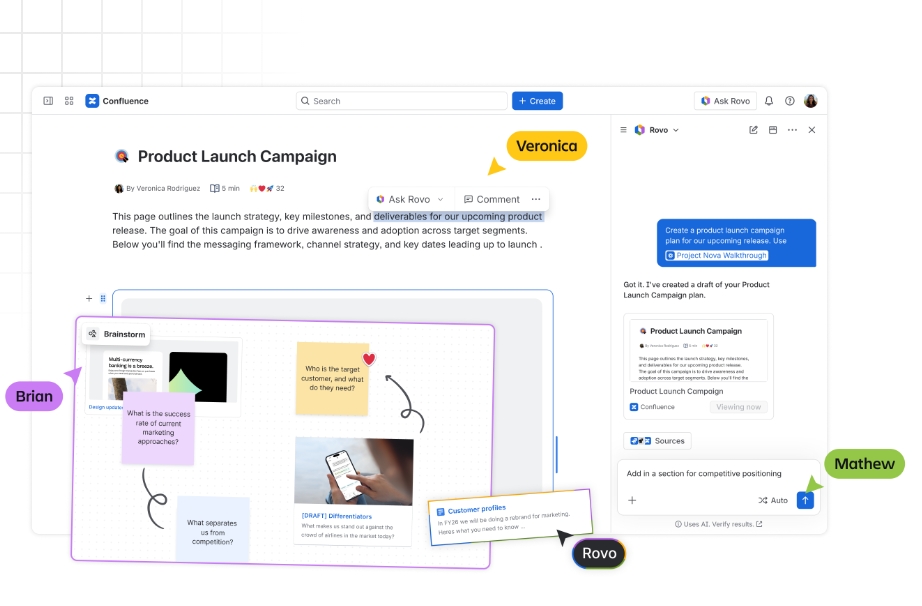
We’re currently in the process of expanding our AI setup and, above all, integrating it with existing tools, connecting it to things like Confluence, Sensor Tower, and our own Creative Administration Tool, CAT. This means I can send out an AI agent to look at our competitors’ latest creatives, identify commonalities, pull in internal creative data, summarize everything neatly on a Confluence page, and then send a short post with the key insights to marketing via Slack. Until recently, that simply wasn’t possible, and it allows for much faster, cleaner work, documentation, and communication.
AI can also become a useful tool for things like preparing for a one-on-one meeting with team members. For example, I can have it look through all of an employee’s current tickets in Jira beforehand and give me a short summary of what happened in the past week and where there might be difficulties I could help with.
Beyond that, many AI tools already offer the built-in ability to build artifacts that I can then share with my stakeholders. That could be a roadmap that automatically adjusts to changed timings in tickets or shows more or less detail depending on the audience. It’s fascinating to have the ability to build and share such tools yourself in relatively short time.
As internal workflows become more automated, the ideal profile of a marketer changes. What specific skills, mindsets, or qualities are becoming non-negotiable for future talent in an AI-augmented workplace?
In my view, one of the most important requirements for working in marketing, probably in all areas of knowledge work, is openness to technological development and a hunger for the possibilities that AI offers. That naturally also requires a certain tolerance and acceptance of change, which always brings a bit of stress and effort at first.
It’s essential to stay up to date, to keep reminding yourself of the almost daily changing circumstances and tools, and to quickly reach the point where you realize: ah, there’s something in this for me, this opens up entirely new possibilities and improves my work and my impact.
A good example: we have artists who previously mainly built 3D scenes and who are now using AI to build their own video editing tools. One of these automatically recognizes the spoken text in a video, converts it into subtitles, and lets you adjust their styling and translate them into any language. That saves an enormous amount of time, and nobody told these colleagues how to do it: they simply got started.
That’s exactly what matters right now, experimenting with AI and recognizing its potential, and everyone has to gather their own experience with that. You can’t rely on someone else building you the perfect AI workflow that you then simply adopt.
You have to make the effort yourself, dive in, inform yourself, and try things out. And of course, once everyone has a certain basic understanding of what’s possible with AI and how we can use it effectively, it’s important to share experiences and learn from one another.
How do you see AI further optimizing game marketing processes in the near and mid-term future? Are there any developments or use cases that you believe the industry should be paying closer attention to?
Automated, closed loops that are initiated by humans but executed by AI agents will become a completely normal process rather than an exception. Today, for example, it’s already possible to send out AI agents to set up a test campaign for creatives on Facebook, pull the results after a week, summarize them on a Confluence page, communicate them to marketing via Slack, and translate your learnings into new tickets for the artists, so the new creatives can then be uploaded into the next test campaign.
And always with a human in the middle, who remains responsible at every step for checking: does what the AI is doing and suggesting here actually make sense, and is it something I can stand behind and want to? Are these the learnings and insights I would draw from the data set myself, or is the AI hallucinating here, making me believe I have valid results when the numbers don’t actually support that? Assuming that’s the case, though, it shows just how much faster I can be in creative testing, communication, and iteration, and how quickly I can test my way toward ever-new best performers.
At the same time, I see the challenge of maintaining clear roles and responsibilities. AI suggests that suddenly everyone can do everything and that all expertise has been democratized. That’s exactly where the danger lies, because AI is at its strongest in the hands of experts who know what’s behind the agent and how to evaluate a result.
Anyone who, as an analytics novice, sends around unchecked evaluations, or, as a non-artist, deploys AI-generated creatives, quickly ends up adopting hallucinations or missing the fit between the creative and the motivational factor. AI helps generate a quick first output, but the crucial step remains taking that to the real experts. Resisting the temptation of the quick path and not leaving strategic decisions to AI is, for me, the important lesson we all need to learn right now.
Looking ahead, loops that are controlled by humans but executed by AI agents are, in my view, the most exciting area for the entire industry. In our case, people are moving step by step from execution toward steering and quality control: we set the guardrails, define the hypotheses, and make the final decisions, while AI takes over the legwork in between.
Over the next one to two years, I expect us to connect these loops across the entire optimization process, from competitive and data analysis through the conception and production of ad creatives to testing and documenting results. Whoever masters this combination of automation and human expertise early will learn faster and deploy better creatives, app store listings, and landing pages than the competition.
Because, in my view, this very competition will keep intensifying because of AI. Ever-shorter development cycles will lead to a continually rising number of game releases. Only those who can keep pace with this speed and who likewise use AI to produce high-quality, audience-tailored marketing assets at scale will have a chance to keep up. That’s the development I believe the industry should be watching most closely.

Head of Marketing Operations at InnoGames