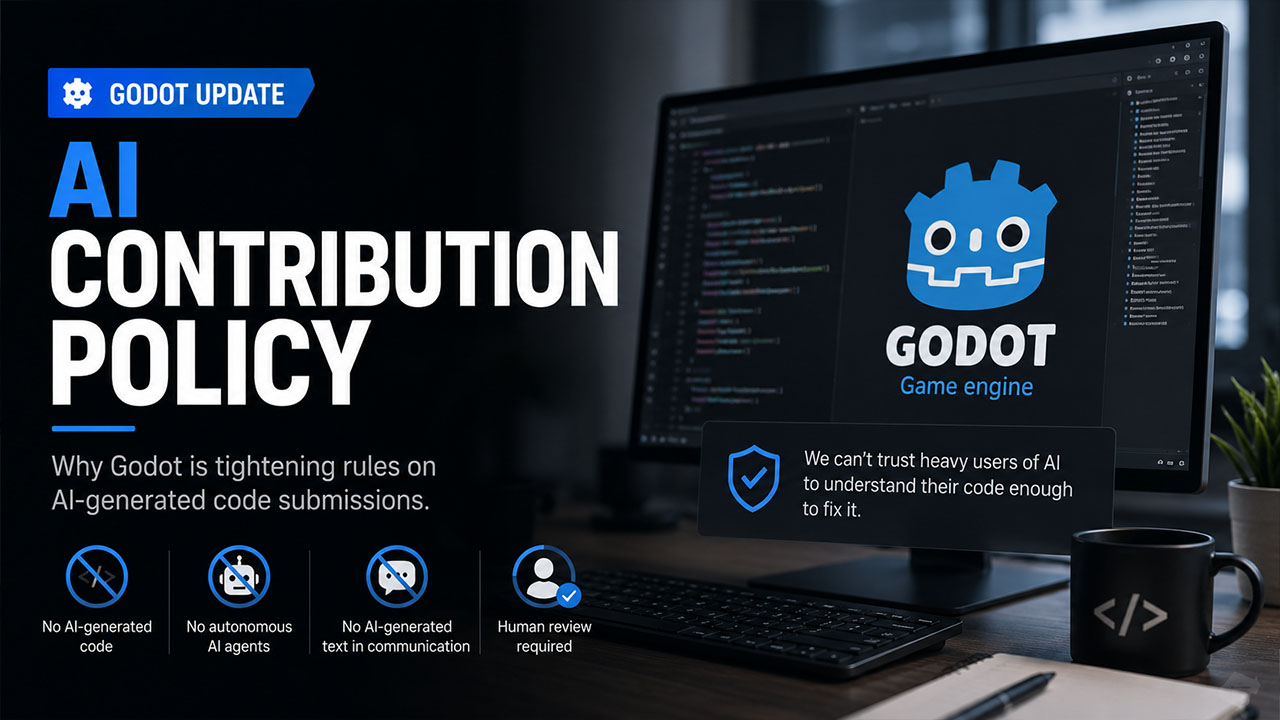

The team behind Godot has announced major changes to its contribution policy, including stricter rules on AI-generated code.
According to the Godot Foundation, the issue isn’t AI itself. The Foundation says the recent increase in AI-generated pull requests has significantly increased the workload for volunteer reviewers. While submitting code has become easier, reviewing it still requires experienced maintainers, and the number of reviewers hasn’t kept pace.
Under the updated policy, contributors will no longer be allowed to submit substantial AI-generated code or use autonomous AI agents. Limited AI assistance, such as code completion, regex, and simple find-and-replace tasks, will still be permitted, but any AI-assisted code must be disclosed in the pull request discussion. The Foundation also says contributors should be able to take responsibility for the code they submit and be willing to maintain or fix it when necessary.
Summing up its position, the Foundation wrote:
“We can’t trust heavy users of AI to understand their code enough to fix it.”
Why the Decision Makes Sense
Review capacity is the real bottleneck. According to the Foundation, AI has reduced the effort required to submit pull requests, leading to more submissions without a corresponding increase in qualified reviewers.
Accountability remains essential. Open-source projects depend on contributors understanding the code they submit and being able to maintain it over time. The Foundation argues that this responsibility should always remain with the human contributor.
The policy isn’t a complete AI ban. Rather than prohibiting AI entirely, Godot still allows limited AI assistance for routine tasks while restricting AI from becoming the primary author of contributed code.
Why the Decision Is Still Debatable
Enforcement will be difficult. There is currently no reliable technical method to determine whether code was AI-generated, meaning the policy largely depends on contributors honestly disclosing AI usage.
AI may not be the root cause. Poorly written or poorly understood code creates maintenance problems regardless of whether it was produced by AI or a human. AI may simply be increasing the volume of an existing challenge rather than creating a new one.
Some developers may see the policy as restrictive. Many programmers use AI as a productivity tool while still understanding every line of their code. The updated policy may discourage some legitimate contributors, even if that isn’t the Foundation’s intention.
What do you think? Should open-source projects focus on restricting AI-generated code, or should they judge contributions solely by their quality and maintainability?
If you enjoy gaming industry news, game development discussions, and technology updates, don’t forget to follow me for more.