
Guest post by David Purdy, CEO and Founder of Palladio AI
Your best players are willing to give games they love more of their time and money. When the game lets them down, there is a measurable disconnect, and the experiences leading up to it show what to improve.
Headline retention and revenue figures summarize a whole audience. I find it especially useful to look at people whose behavior shows commitment: returning regularly, trying to progress or spending. What helps them get more from the game, and what gets in their way? The problems these players expose can affect many others too.
We launched Palladio AI last year to bring proven AI capabilities developed for growing consumer apps to mobile games. We have since talked with studios from soft launch to maturity, and with their investors, publishers and vendors.
We found the same core approach worked in different industries: identify how users become committed and regularly use your app, and pinpoint where that relationship can be improved.
For example, at Uber, we looked for strong motivation that met failure. Think of a rider trying to get home after a concert, finding the wait time is too long, the price too high, or no drivers available.
We developed methods to pinpoint where failure was happening. Fixing what we found was worth roughly a billion dollars a year to Uber and our drivers.
Another consumer app applied these methods to surface issues that, when fixed, accounted for thirty percent of that year’s growth in active users. That is free growth: fixing the experiences of highly motivated new users who already wanted to use the product.
Another company applied these methods to surface failures that were so common, users not only stopped reporting issues, they materially reduced engagement.
As we spoke with studios, many were generous with what they shared, and two questions kept coming up: how should they identify and reach their best audiences, and what experiences will most engage them?
Those are a studio’s two levers: whom it reaches and what they experience. In our experience, these apply to any consumer app.
We built the Double Lifecycle internally to keep both in view. It puts the player’s journey through onboarding, regular play, seasons and spending alongside the game’s progress from soft launch through growth and maturity. Studio and vendor leaders asked for copies, so we’re sharing it here.
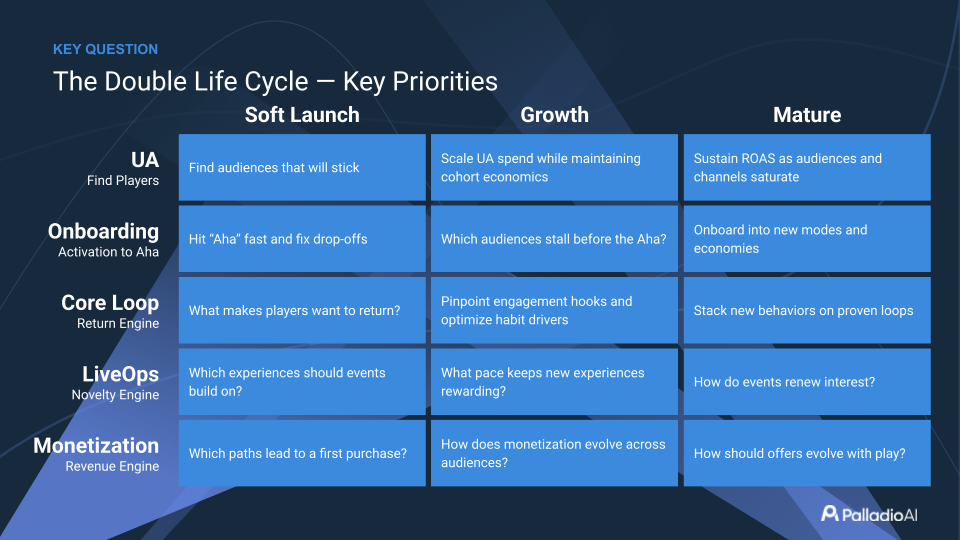
Read across the grid to see how the questions change as a game grows. At any stage, a session count or purchase records activity. The player’s history helps explain what brought them there and what comes next.
Soft launch: who is our audience?
Teams in soft launch told us, “We need to find our audience and prove the game works with them.” Studios told us investors were asking who their audience was, and they were still working out the answer. The question underneath: which players produced our numbers, and what experiences drove them?
Supercell reported 38% day-seven retention in a Squad Busters beta with more than 140,000 players. Behavior and retention after global launch fell short of the beta, and the short soft launch had not established longer-term retention and monetization. (Supercell’s retrospective)
A large sample tells us about those players. It does not, by itself, establish how another audience will respond or how the beta players will behave months later.
Session counts tell only part of the story. We also need to understand whether players discovered the experience the team set out to create and whether it lived up to what brought them in.
Questions to consider:
- Who is finding value in the game, and what do they value?
- Can we reach more players who will value those experiences?
Growth: what should we carry forward, and what needs to change?
Teams in growth describe volatile campaigns, spending while they wait for results, and more possible improvements than they can prioritize. These return to our two questions: whom are we reaching, and what do they experience?
Multiple studios reported holding back growth spending while identifying the right player segments and how best to reach them.
Some of our most revealing findings have involved frustrated but intensely engaged players: playing heavily, progressing through many levels or spending substantially, and then disengaging. In some studios we have worked with, this pattern seemed to account for 20–40% of apparent churn among longer-tenured, higher-value players. A closer look revealed soft churn: players taking a break, deleting an account and creating another, or deleting the app and reinstalling. We also saw hard churn: players leaving altogether.
The experiences preceding disengagement have been remarkably revealing about opportunities to improve the underlying game mechanics. Once the precursors to soft churn were identified, the key mechanics to change or introduce became much clearer, especially where existing mechanics inhibited progression or enabled upsetting exploits.
Compare a player’s experiences before disengagement with their earlier experiences, or with those of similar players who continued. Those comparisons help identify what to investigate and test. Predicting who will leave is a different question from understanding what happened to them.
Questions to consider:
- What experiences precede a break, a restart, or a regular spender’s decision to stop buying?
- What could we change so those players can keep doing what they enjoy?
- Which segments are worth spending on, and can we reach them at a cost the revenue from their play supports?
Mature: capturing opportunities for new experiences
Maturity is a business stage, not simply a game’s age. A mature game can offer experienced players new possibilities while giving others a way into them.
Numbers can be misleading. Making a mature game harder can increase sessions, time or spending while breaking the expectations of some established players. Rising overall metrics can conceal segment-level disengagement.
Pinpointing opportunities to improve mechanics can also require commitment. King’s redesign of Candy Crush’s Fish mechanic made square matches a way to create Fish, adding a strategic choice to familiar play. Initial reception was weaker than hoped; player feedback informed months of refinement. (Interview with King’s Alena Rybik)
Players can also reveal new directions through the ways they choose to play. World of Warcraft Classic players created a Hardcore challenge, giving each character one life. In 2023, Blizzard launched official Hardcore servers, where dying means starting again in that mode. (Blizzard’s announcement)
For a mature game, the opportunity may lie in supporting a way of playing that its community already values. Understanding who discovers it, who benefits and who struggles can help a team decide what to develop or make easier to learn.
Questions to consider:
- Which players have found value in a new experience, and what would help others discover it?
- How does an update affect established players, as well as people who are new or returning?
- Are this quarter’s paying players the same people as last quarter’s?
Using the framework
Teams are often organized around the player lifecycle. Embrace the player’s journey by digging deeper into how committed users are, how intensely they engage and progress, and ask where in the lifecycle your most committed users change behaviors and the experiences leading up to it.
By narrowing the aperture of your user focus, you can ask which players produced changes in metrics: who is progressing or struggling, and what they experienced along the way. Include those who took a break, restarted or left. Would the answers change the audience you seek, the onboarding you build, or the next mechanic you test?
This is what we have learned so far. If we have something wrong, that’s on us, and we’ll learn. I will be in Istanbul for Mobidictum and would welcome the chance to compare notes about your game.

David Purdy is CEO and co-founder of Palladio AI. He presented the Double Lifecycle as an invited speaker at KDD 2026. He can be reached at [email protected].