
One player completes a few levels, watches two rewarded ads, spends virtual currency, sees an in-app offer, and closes the game. That short session leaves a long trail of data.
Firebase Analytics supports up to 500 event types per app and up to 25 parameters for each event type. Add advertising and every impression can carry information about the placement, format, device, location, consent status, demand partner, bid, floor price, and auction result.
For an illustrative game with one million daily players, three sessions per player, and 65 events per session, that becomes 195 million events a day and about 5.9 billion a month. Ten ad requests per session sent to eight bidders could add 240 million bidder requests a day. These assumptions show the scale; they are not industry averages.
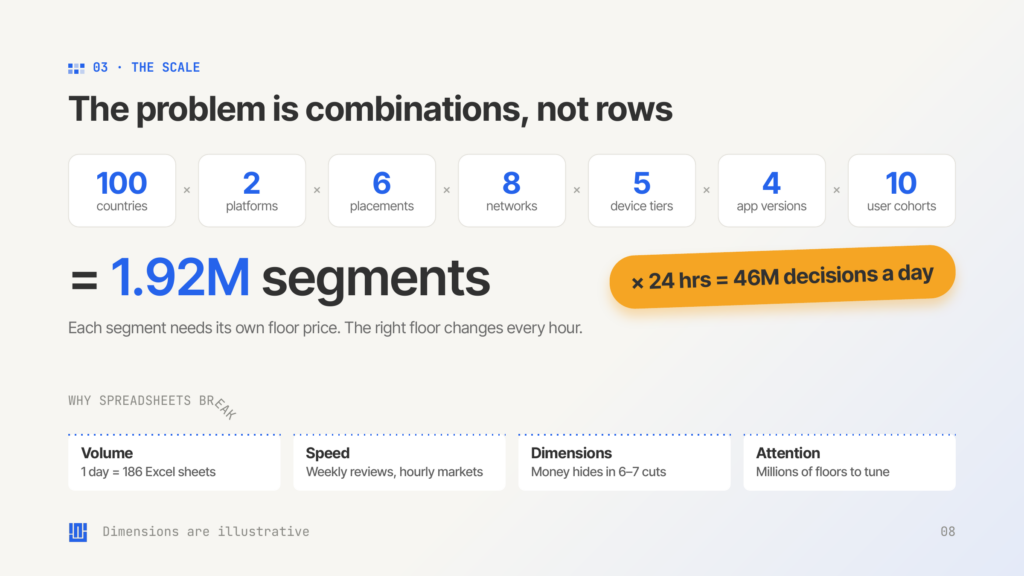
The harder problem is the number of combinations. Countries, platforms, placements, networks, devices, app versions, and user cohorts multiply into millions of segments. Publishers need to know what changed, where it changed, why it changed, and what to do next.
1. Connect Data Across the App
App data is split across product analytics, payment systems, mediation platforms, and user acquisition tools. Each system sees one part of the business. An agent becomes useful when it connects the parts.
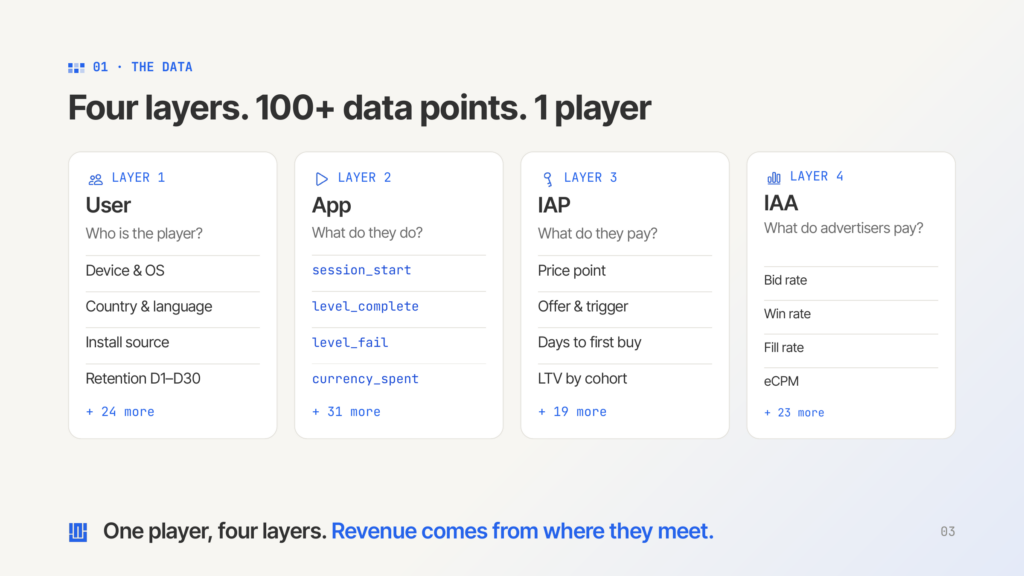
- User data: country, language, device, install source, and retention
- App behaviour: sessions, level progress, failures, and virtual currency
- In-app purchases: offer, price, timing, repeat purchases, and lifetime value
- In-app advertising: bid rate, win rate, fill rate, show rate, eCPM, and latency
Shared fields such as app, country, format, placement, cohort, and hour let the agent follow a signal across systems. It can see whether rewarded-ad engagement fell after a level change, whether purchasers are seeing too many ads, or whether one app version is producing more requests while showing fewer ads.
Global averages hide these problems. The answer often sits inside a narrow combination, such as rewarded ads on Android devices in Turkey for users acquired during the previous seven days.
2. Monitor Meaningful Segments Continuously
App performance can change within hours. A bidder may stop responding, a release may break ad loading, or a floor may become too high as advertiser demand shifts.
Weekly reporting catches these problems late, especially when seasonality and sudden demand shocks reshape the market. An agent can monitor bid rate, win rate, fill, show rate, eCPM, latency, purchase conversion, retention, and revenue per daily active user around the clock.
The agent should look inside segments. A 2% global decline may appear harmless while one valuable segment has fallen by 30%.
Example: Rewarded-ad fill rate fell 18% for Android version 4.2 in Turkey. The decline began at 02:10 UTC and is concentrated in two demand partners. Other app versions remain stable.
That message gives the monetization team a starting point. Smaller publishers gain the kind of coverage that once required several analysts watching separate platforms.
3. Explain Why a Metric Changed
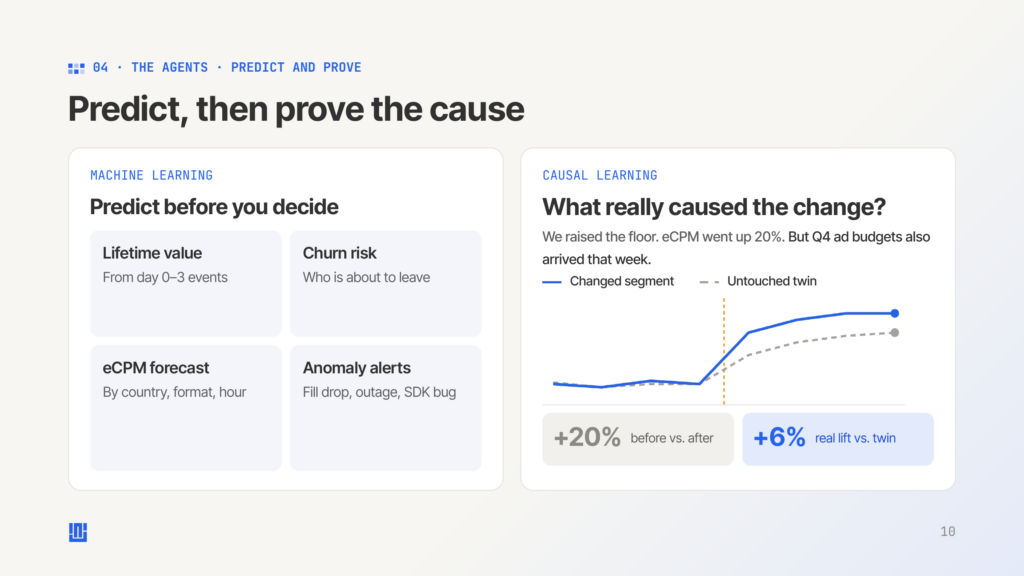
Suppose a publisher raises a floor price and eCPM rises by 20%. The change looks successful. Advertiser budgets may also have increased that week, so the floor cannot take full credit.
An agent can compare the affected segment with a similar untouched segment. If the changed group improves by 20% while its reference group improves by 14%, the estimated lift linked to the intervention is closer to 6%.
A controlled experiment is needed to prove whether AI AdOps created incremental revenue. Causal-impact methods estimate what probably would have happened without the intervention while accounting for trends, seasonality, and related variables.
The agent should report its confidence and the evidence behind the conclusion. That helps teams separate a genuine improvement from a lucky week.
4. Test Decisions with Controlled Risk
Which floor price will earn the most revenue? Which offer should appear after a level failure? How often should an interstitial appear? Historical averages help, but they cannot predict every shift in user behaviour or demand.
Consider static floors versus AI floor pricing. Instead of moving all traffic to a new floor, an agent can test several options with a small share of inventory. It measures revenue, fill rate, and user impact, then sends more traffic toward the stronger option as evidence grows.
This resembles multi-armed bandit testing: the system keeps learning while it allocates more traffic to better-performing choices. Thin samples still require caution. Fourteen wins from 200 bids may show a 7% observed win rate, but the true rate could be higher or lower.
Safe tests need limits on traffic, sample size, floor range, daily revenue exposure, duration, and stopping rules. The goal is steady learning with a small blast radius.
5. Act Report and Learn
Monitoring leaves work unfinished if someone still has to change a floor or pause a weak source. An AI AdOps layer can work with existing mediation platforms, including AdMob, AppLovin MAX, and Unity LevelPlay.
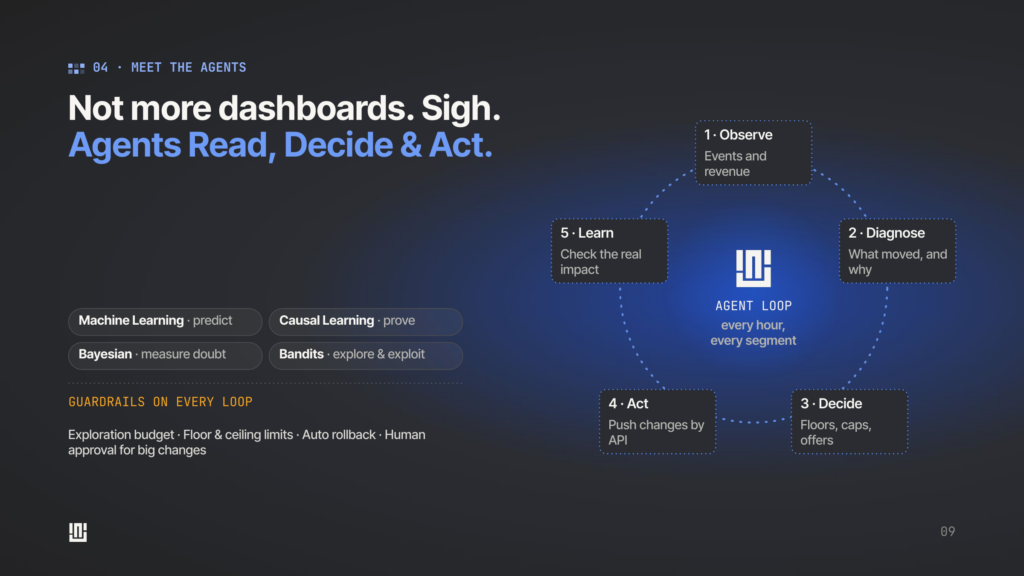
The operating loop is straightforward:
- Observe the events and revenue signals.
- Diagnose the affected segment.
- Select an action within approved limits.
- Apply the change through an API.
- Measure the result and report it.
The AdMob API, for example, can update mediation groups, demand sources, ad-unit mappings, and eCPM values. Every automated action should record what changed, why, which traffic was affected, the expected impact, and whether rollback is active.
A useful result message might say: Fill rate increased by 9%, eCPM decreased by 2%, and revenue per request increased by 6%. The new floor will remain active for this segment.
Guardrails Before Action
An agent connected to live inventory needs firm operating rules: floor and ceiling limits, small exploration budgets, human approval for large changes, action logs, privacy checks, and automatic rollback.
Apple requires user permission before an app can track activity across other companies’ apps and websites or access the advertising identifier. Agents must work with signals publishers are allowed to collect.
The NIST AI Risk Management Framework recommends human oversight, ongoing monitoring, documented testing, and ways to override or deactivate systems that behave outside their intended use.
What This Looks Like in Practice
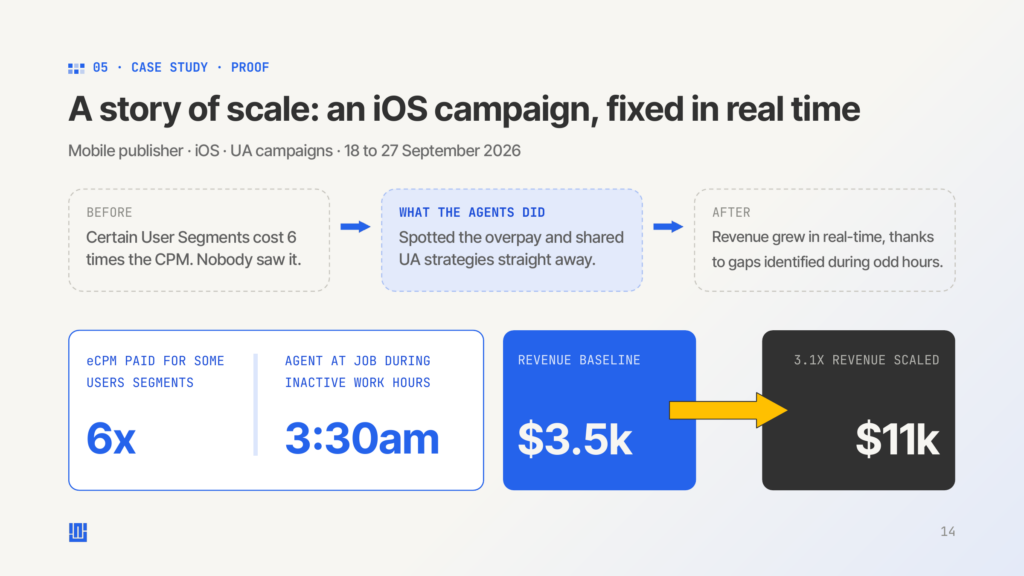
During an anonymised iOS campaign monitored by UndrAds from 18 to 27 September 2026, certain user segments were costing six times the expected CPM. The agents found the issue at 3:30 a.m. and shared the affected segments with the team.
During the monitored period, revenue moved from a $3.5k baseline to $11k, a 3.1x increase. The operational value came from detecting a narrow problem and responding while the opportunity was still active.
The Practical Takeaway
App publishers already have plenty of data. AI agents make it usable by connecting signals, monitoring meaningful segments, explaining changes, testing decisions, and applying approved actions. That gives smaller teams continuous monetization operations without asking people to watch every market, format, cohort, and demand partner around the clock.
About the expert / author: Lakshya Ankit is the Founder and CEO of UndrAds, an agentic monetization platform for app, game, and web publishers.